[Asia Economy Reporter Park Hyesook] Incheon City has embarked on finding a solution to underground the Gyeongin Line, which has caused urban division for over 120 years.
The city announced on the 21st that it has launched the 'Gyeongin Line Underground Promotion Strategy Establishment Project' and plans to complete it by July next year.
This project will develop a plan for undergrounding the Gyeongin Line and establish a master plan for the redevelopment of the railway's upper land and surrounding areas.
Additionally, it will predict changes in demand for the Gyeongin Line when the currently underway metropolitan area express railway (GTX) Line B, the 2nd Gyeongin Line, and the Seoul Line 7 extension to Cheongna International City open, and formulate optimal construction and operation plans while analyzing economic feasibility.
The city plans to investigate domestic and international cases to devise a plan to improve residential conditions in the original downtown area and restructure the upper land and surrounding areas into future-oriented urban spaces by systematically and efficiently allocating residential, commercial, and public facilities.
Along with this, measures for public-private-government cooperation to ensure smooth project progress will be devised, and related systems such as special laws and funding procurement plans will also be reviewed.
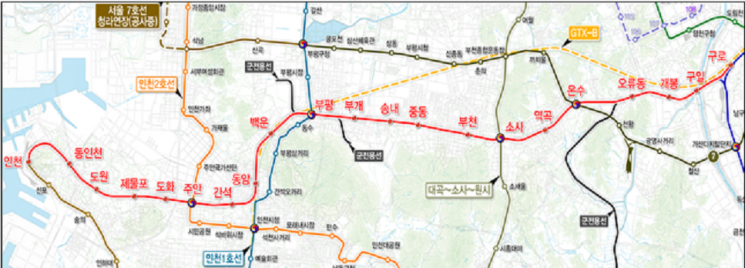
The Gyeongin Line underground project targets 21 stations over a 27 km section from Incheon Station to Guro Station, with an estimated total project cost of 9.5408 trillion KRW. Among this, the Incheon section covers 11 stations over 14 km from Incheon Station to Bugae Station, accounting for more than half of the entire project section.
The Gyeongin Line, based on the Gyeongin Line railway opened in 1899?the first railway in Korea?has been expanded into a quadruple-track railway and established itself as a major transportation infrastructure in the metropolitan area.
However, the above-ground railway divides living areas and reduces land use efficiency, leading to continuous demands for undergrounding.
The undergrounding project was first discussed in 2009 by the Metropolitan Area Economic Development Committee, composed of three metropolitan local governments, but was effectively halted due to economic feasibility and enormous project costs.
During the 20th presidential election, candidate Yoon Seok-yeol promised to underground the Gyeongin Line to connect the north-south divided living and economic zones, and with its inclusion in the new government's national agenda, momentum to resume the project was secured.
The Ministry of Land, Infrastructure and Transport announced in its 2023 major work plan that it would propose a special law for undergrounding above-ground railways in the first half of this year, begin establishing a statutory comprehensive plan in the second half, and review commercialization of projects such as the Gyeongin Line starting next year.
An official from Incheon City stated, "We are conducting the Gyeongin Line underground strategy establishment project in connection with the Ministry of Land's promotion plan," adding, "During the project, we plan to collect diverse opinions from citizens and experts through public hearings, forums, and surveys to enhance the plan's acceptability and feasibility."
© The Asia Business Daily(www.asiae.co.kr). All rights reserved.

















