Exports from January 1-20 at $33.6 billion... 2.7% ↓
Imports at $43.9 billion... Trade deficit of $10.3 billion
Trade with China also worsens... $3.24 billion deficit
[Asia Economy Sejong=Reporter Lee Jun-hyung] The trade deficit accumulated in just 20 days this year has reached $10.3 billion. The trade deficit with China (Daejung) approached $3.25 billion. Concerns are growing that Korea's economic "growth engine," trade, may be caught in a structural deficit.
According to the Korea Customs Service on the 21st, exports from the 1st to the 20th of this month amounted to $33.6 billion, a 2.7% decrease compared to the same period last year. The average daily export value, considering working days, has decreased by 8.8% over the past year. On the other hand, imports increased by 9.3% to $43.9 billion.
As a result, the trade balance recorded a deficit of $10.3 billion. If the entire trade balance for this month records a deficit, it will mark 10 consecutive months of deficits since April last year. A 10-month consecutive trade deficit has not occurred since the 1997 foreign exchange crisis.
The ongoing trade deficit is largely due to deteriorating trade relations with China, Korea's largest trading partner. From the 1st to the 20th of this month, the trade deficit with China was $3.244 billion. Exports were $6.77 billion, down 24.4% year-on-year, while imports were $10.014 billion, up 9.7%.
If the trade balance with China records a deficit this month as well, it will be the fourth consecutive month of deficits since October last year. Until 2018, China was Korea's largest trade surplus country. However, last year it fell outside the top 20. This means Korea did not profit from trade with China as much as before.
Semiconductors, a key export item, are also shrinking. Semiconductor exports from the 1st to the 20th of this month were $4.426 billion, a sharp 34.1% drop compared to the same period last year. Semiconductor exports have been declining for five consecutive months since August last year. The decline exceeded 20% since November last year and surpassed 30% from the 1st to the 20th of this month. Other export items such as steel products (-11.2%), precision instruments (-9.9%), computer peripherals (-44.9%), and home appliances (-47.5%) also showed a downward trend.
Imports continue to rise steadily. In particular, the increase in imports of the three major energy sources?crude oil (11.3%), gas (14.1%), and coal (40.5%)?stood out due to the surge in international energy prices. Imports of petroleum products (12.2%), machinery (11.9%), wireless communication devices (87.9%), and passenger cars (62.3%) also increased.
Meanwhile, Korea's trade deficit last year reached a record high of $47.2 billion. It is the first time in 14 years since the 2008 financial crisis that the annual trade balance has turned to a deficit.
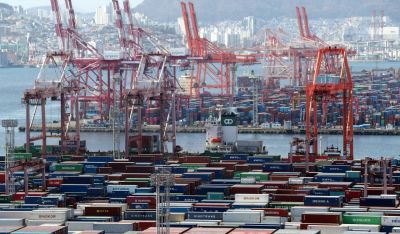 Current Account Deficit Again After 3 Months Due to Export Slump... -$620 Million in November
(Busan=Yonhap News) Photo by Kang Deok-cheol = On the 10th, container handling operations are underway at Sinsundae Pier and Gamman Pier in Busan Port. With exports of semiconductors and other goods sharply declining, the current account balance returned to a deficit in November last year after three months. According to the preliminary balance of payments statistics announced by the Bank of Korea on the 10th, the current account deficit for November last year was $620 million (approximately 772 billion KRW). This is a decrease of $7.44 billion compared to a surplus of $6.82 billion one year earlier. 2023.1.10
kangdcc@yna.co.kr
(End)
<Copyright(c) Yonhap News Agency, Unauthorized reproduction and redistribution prohibited>
© The Asia Business Daily(www.asiae.co.kr). All rights reserved.

















