Indoor Mask Mandate Becomes Recommendation from the 30th
Excludes High-Risk Facilities, Hospitals, Pharmacies, and Public Transport
If Exposed to COVID-19 Confirmed Case, "2-Week Wearing Recommended"
[Asia Economy Sejong=Reporter Song Seung-seop] From the 30th of this month, masks will no longer be required in most indoor locations. The government has lifted the indoor mask-wearing mandate after 2 years and 3 months, switching it to a recommendation. However, mask-wearing obligations remain in certain places, so caution is needed as fines may be imposed for 'no mask' violations.
The Central Disaster and Safety Countermeasures Headquarters received a report from the quarantine authorities yesterday regarding the review of indoor mask-wearing mandate adjustments and future plans, and decided to relax indoor mask-wearing to a recommendation. Ji Young-mi, head of the Central Disease Control Headquarters, said, "We thank the public for participating in mask-wearing for the sake of quarantine and our society despite the inconveniences in daily life," adding, "The protective effect and necessity of masks have not disappeared; this is a change from a legal obligation to a recommendation."
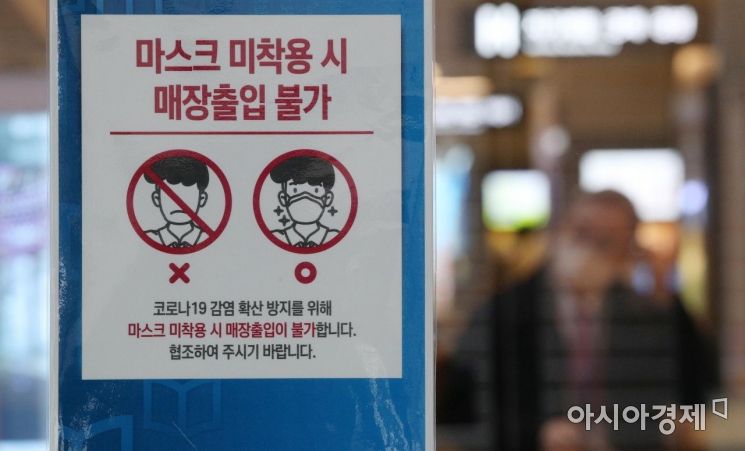 On the 17th, when government-level discussions on lifting the indoor mask-wearing mandate begin, a large bookstore in Seoul displays a notice about the mask-wearing requirement. The National Infectious Disease Crisis Response Advisory Committee held a video conference that afternoon to discuss the timing of adjusting the indoor mask mandate. Based on the committee's discussions, the Central Disaster and Safety Countermeasures Headquarters is likely to hold a meeting on the 18th or 20th to decide the timing for lifting the indoor mask mandate. Photo by Kim Hyun-min kimhyun81@
The quarantine authorities explained that three out of four conditions for relaxing the indoor mask mandate (stabilization of patient occurrence, decrease in severe cases and deaths, stable medical response capacity) have been met. They judged that external risk factors such as the spread of COVID-19 from overseas entrants, including those from China, are at a sufficiently manageable level. The fact that most countries, except Taiwan and Egypt, have eased quarantine measures was also taken into consideration.
The relaxation will take effect at 0:00 on the 30th. The timing was adjusted to coincide with the Lunar New Year holiday period, which lasts until the 24th and sees a sharp increase in population movement. The time required to guide and promote the places where the mask mandate is lifted was also considered.
However, masks must still be worn indoors in certain facilities. These include infection-vulnerable facilities, public transportation, and medical institutions. Infection-vulnerable facilities include nursing hospitals, long-term care institutions, mental health promotion facilities, and welfare facilities for the disabled. However, senior welfare centers and community centers are not included in infection-vulnerable facilities, so masks are not mandatory there. Medical institutions include not only hospital facilities but also pharmacies.
Public transportation includes buses, railways, urban railways, passenger ships, ferries, and aircraft. Taxis must also still require masks as before. Large vehicles used for commuting to kindergartens, schools, and academies, as well as chartered buses, are also included in public transportation and require masks. Failure to wear a mask will result in fines, and as before, transport operators and drivers can refuse boarding to passengers not wearing masks.
However, the mask mandate applies only while on board the transportation. Masks do not have to be worn in indoor subway stations, train stations, bus stops, airports, or port facilities.
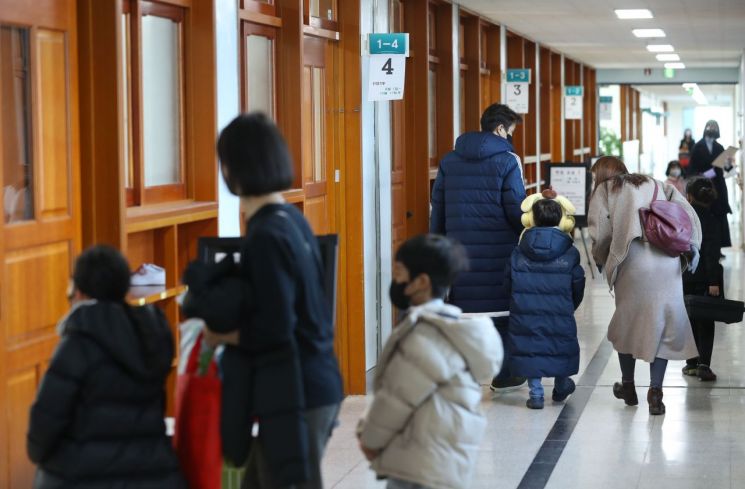 At the beginning of this month, the 2023 school year new student orientation day was held at Dongdaegu Elementary School in Daegu.
 [Image source=Yonhap News]
On the other hand, elementary, middle, and high schools, as well as kindergartens, have been exempted from the mask-wearing mandate. The Ministry of Education announced yesterday, "From the 30th, indoor mask-wearing in schools at all levels will be adjusted from mandatory to voluntary recommendation." With this measure, students will be able to attend classes without masks in the classroom starting from the remaining winter vacation.
Although masks are no longer mandatory, there are cases where wearing them is strongly recommended. These include when exhibiting suspected COVID-19 symptoms or having contact with a suspected case, being in a high-risk group such as the elderly or those with underlying conditions or having contact with high-risk individuals, being in 3M (closed, crowded, close-contact) places with poor ventilation such as elevators, or when many people are gathered and shouting, singing, or conversing. The recommended mask-wearing period after contact with a confirmed case is two weeks.
The quarantine authorities advised that even after adjusting the indoor mask mandate, continuous practice and habituation of personal quarantine rules such as mask-wearing, hand washing, and ventilation remain the most fundamental measures to prevent the spread of COVID-19 and reduce the burden on the medical system.
© The Asia Business Daily(www.asiae.co.kr). All rights reserved.
![Clutching a Stolen Dior Bag, Saying "I Hate Being Poor but Real"... The Grotesque Con of a "Human Knockoff" [Slate]](https://cwcontent.asiae.co.kr/asiaresize/183/2026021902243444107_1771435474.jpg)

















