Cold Snap Begins on Return Trip from 23rd
"Be Careful of Icy Roads When Driving"
[Asia Economy Reporter Park Hyun-joo] Both holiday travelers returning home for Lunar New Year and those enjoying Seolkangs (Seol + vacation) are expected to need to pay attention to safety. This is because cold winds blowing over the Korean Peninsula will cause temperatures to drop sharply, and rain or snow may freeze, creating icy roads.
According to the Korea Meteorological Administration on the 20th, the weather will be clear nationwide from the start of the return journey on this day through the 21st due to the influence of high pressure. However, cold north winds will blow, causing temperatures to drop sharply, with cold wave warnings issued for the central inland and North Gyeongsang inland areas. The lowest morning temperatures on the 21st are forecast to be between -18 and -4 degrees Celsius, and the highest daytime temperatures between -2 and 6 degrees Celsius. In particular, temperatures in the Gangwon mountain region are expected to fall below minus 15 degrees Celsius.
On the day of Lunar New Year, the 22nd, light snow or rain will fall nationwide. As a pressure trough passes over the northern part of Korea and the southern sea near Jeju, snow will fall in the central regions and rain in Jeju. However, precipitation amounts are expected to be low.
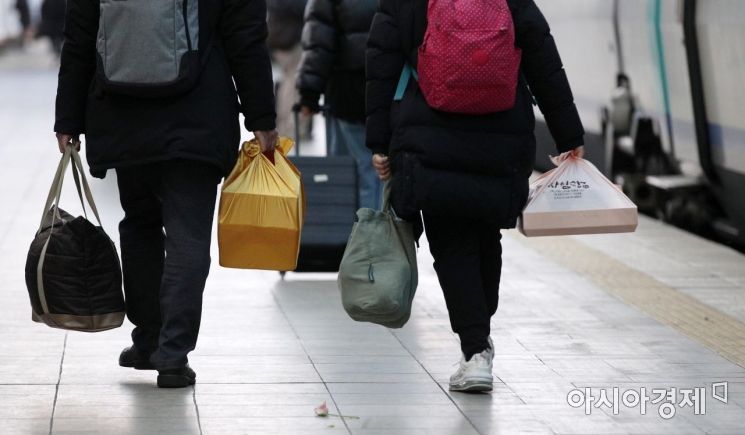 On the 20th, a day before the Lunar New Year holiday, travelers including those returning home are boarding trains at Seoul Station. Photo by Hyunmin Kim kimhyun81@
Especially from the 23rd, when the return journey home is in full swing, the strongest cold wave of this winter is expected to begin. From the 23rd to the 24th, a continental high-pressure system will expand its influence from the northwest of Korea, bringing cold winds and causing temperatures to drop sharply. Morning temperatures are expected to fall by more than 10 degrees Celsius in a single day, with Seoul’s lowest morning temperature on the 24th forecast to drop to minus 17 degrees Celsius.
From the 24th to the 25th, heavy snow is expected in Honam and Jeju due to snow clouds developing over the West Sea. This is caused by cold air passing over the warm West Sea, creating a temperature difference between the air and sea surface (sea-air temperature difference), which forms snow cloud bands.
The Korea Meteorological Administration forecasted that many places will experience black ice on roads as snow that fell from the evening of the 19th freezes. Black ice is a phenomenon where melted snow or rain on the road freezes, creating icy patches.
To prevent black ice accidents on the return journey, the Korea Meteorological Administration urged drivers to reduce their speed by 20 to 50% compared to usual and to maintain at least twice the normal distance between vehicles. Due to the continued cold weather, black ice is likely to remain on roads throughout the holiday period. It mainly forms on shaded roads, tunnels, underpasses, bridges, and elevated roads, so caution is necessary.
According to the Ministry of the Interior and Safety, from 2016 to 2020, there were 4,868 traffic accidents caused by road frost and ice. The likely cause of the 44-car chain collision accident that occurred on the night of the 15th on the Guri-Pocheon Expressway in Pocheon, Gyeonggi Province, is also known to be black ice.
© The Asia Business Daily(www.asiae.co.kr). All rights reserved.
![User Who Sold Erroneously Deposited Bitcoins to Repay Debt and Fund Entertainment... What Did the Supreme Court Decide in 2021? [Legal Issue Check]](https://cwcontent.asiae.co.kr/asiaresize/183/2026020910431234020_1770601391.png)
















