Regardless of Age or Nationality... Neglect Is a No-Go
#. Ms. Lee, a housewife in her 40s, sighs at the thought of visiting her in-laws during the Lunar New Year without social distancing. The long distance and the discomfort of visiting her in-laws cause her considerable stress. Ms. Lee’s large extended family had avoided gathering during holidays for the past three years due to COVID-19, but they started meeting again from last Chuseok. She said, "Even during last Chuseok’s holiday week, I felt chest tightness and depression, and it’s the same this time," adding, "I’m not happy that face-to-face meetings have returned during the holiday."
With the COVID-19 endemic, face-to-face Lunar New Year holidays have returned after about three years. Due to social distancing making visits difficult during past holidays, this Lunar New Year sees an increase in visits to hometowns and relatives. However, not everyone is happy about meeting face-to-face during the holidays.
Holiday syndrome, which used to frequently appear among housewives experiencing increased labor during holidays, is now appearing across all age groups. If just thinking about spending the holidays makes your chest feel tight and you sigh often, you may be experiencing holiday syndrome caused by holiday stress.
The Universal 'Holiday Stress'
Holiday syndrome is a condition where stress around the holiday period causes feelings of depression, lethargy, and difficulty regulating mood, also known as holiday depression. Causes of stress include increased household chores, long travel times, changes in daily routines, and uncomfortable conversations with relatives. Differences in values between generations who want to share problems and more individualistic generations also have an impact.
Although this syndrome is known domestically as related to traditional customs and thought to be unique to Korea, the American Psychological Association (APA) officially names a similar mood regulation disorder occurring around special holidays as "holiday blues." People mainly feel stress and depression around Christmas, Thanksgiving, and relatives’ weddings. Countries with holiday cultures similar to Korea, such as Japan and China, are also known to experience severe stress.
Main Symptoms of Holiday Syndrome
If you have holiday syndrome, you become sensitive before and after the holiday, and recalling holiday schedules causes extreme stress. You may feel depression and lethargy without realizing it, and in severe cases, physical symptoms such as insomnia, dizziness, headaches, indigestion, abdominal pain, and heart palpitations may appear.
After the holiday, emotional fluctuations such as increased sensitivity and irritability may continue. Generally, holiday syndrome resolves over time, but in some cases, it can become a chronic mood regulation disorder. Commonly called Hwabyeong, it is a psychological illness that appears as a reaction after suppressing feelings of injustice and resentment. Symptoms include chest tightness, flushing, facial heat, and feelings of injustice and resentment.
Excessive labor or long travel times can cause pain disorders such as muscle pain, joint pain, and herniated discs, which can also be major causes of holiday syndrome. If pain lasts more than two weeks, it is advisable to visit a hospital for treatment.
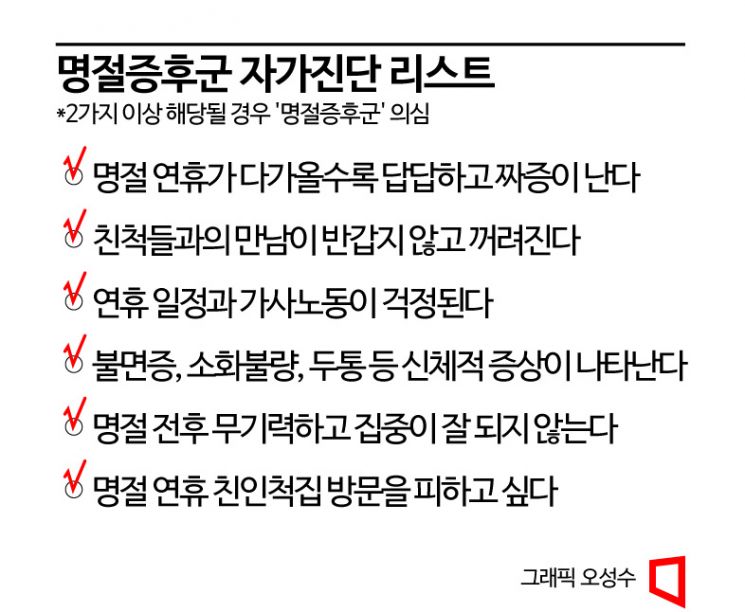
'Could it be me?'... Check with Self-Diagnosis
If you are unsure whether you have holiday syndrome, check with the self-diagnosis (first image). During this year’s Lunar New Year holiday, if you experience two or more of the following: △ reluctance to meet relatives △ worry about holiday schedules and household chores △ physical symptoms such as insomnia, indigestion, headaches △ lethargy and decreased concentration before and after the holiday △ reluctance to visit relatives’ homes during the holiday, you should suspect holiday syndrome.
Don’t Neglect It, How to Overcome?
Holiday syndrome usually resolves over time, but if depression and mood regulation difficulties persist, you should see a specialist for treatment. Generally, before the holiday, it is good to avoid stressful situations by changing your mindset, and after the holiday, quickly relieve stress and take sufficient rest to stabilize your mind and body.
Avoid sudden changes in daily rhythms as much as possible, and try to maintain your usual wake-up and bedtime to prevent disrupting your body’s rhythm. Also, during holidays, it is easy to consume greasy food and alcohol, but excessive drinking or overeating can worsen your condition, so it is best to refrain. Fatigue can worsen if you are dehydrated, so drink plenty of water to stay hydrated.
Since the intensity and duration of household chores increase significantly during holidays, the burden also grows, so it is best to share chores fairly to avoid physical strain and conflicts. If you have spent a lot of energy on household chores and conversations with relatives, it is good to take sufficient breaks or go for a walk during travel or between chores to have some alone time.
© The Asia Business Daily(www.asiae.co.kr). All rights reserved.

















