Beware of Norovirus and Rotavirus
Always Wash Hands Before Cooking
Store and Cook Vegetables and Meat Separately
Norovirus Disappears When Heated Above 85℃
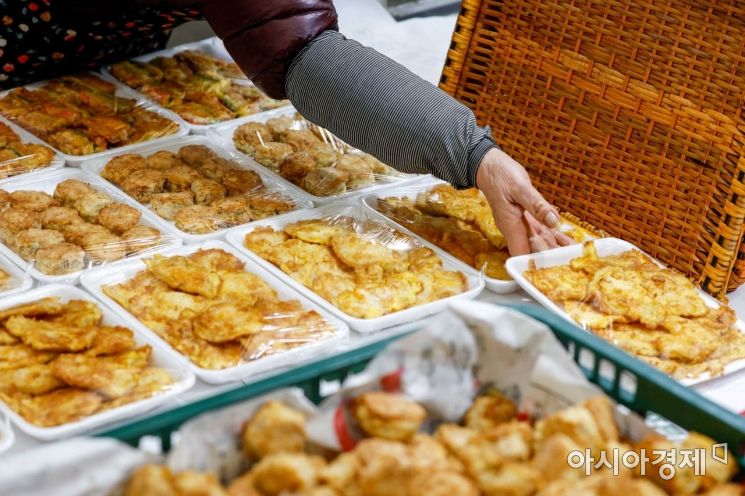 On the 19th, three days before the Lunar New Year holiday, a merchant is preparing for business at Yeongdeungpo Traditional Market in Seoul. Photo by Jinhyung Kang aymsdream@
[Asia Economy Reporter Lee Chun-hee] One of the greatest pleasures of the holidays is the variety of festive foods. During the cold Seol holiday, the risk of common food poisoning is relatively low, but it cannot be completely ruled out. There is a risk of norovirus, commonly known as "winter food poisoning," and rotavirus, which mainly affects children. These viruses can spread regardless of the season, so caution is still necessary. To avoid risks such as food poisoning, it is important to maintain hygiene during cooking, use appropriate cooking methods, and pay attention to food consumption.
First, before preparing food, it is recommended to wash hands thoroughly with soap or hand sanitizer under running water for at least 30 seconds. Especially when handling vegetables or fruits after touching eggs or raw chicken, hands must be washed to prevent cross-contamination of food poisoning bacteria.
When storing ingredients, it is advisable to keep eggs, meat, and fish separate from vegetables and other foods that are consumed without heating or cooking, even when refrigerated. Frozen meat, seafood, and long-term storage foods should be placed inside the coldest part of the freezer, while foods to be consumed soon should be stored near the refrigerator door where temperature fluctuations are greater.
Thawing also requires caution. Bacteria that were dormant in frozen food can multiply again if thawed improperly. It is preferable to thaw food in the refrigerator or microwave. Refreezing thawed food, thawing in warm water or at room temperature, or leaving food submerged in water for extended periods can promote the growth of food poisoning bacteria and should be avoided.
During cooking, when washing poultry such as chicken, seafood, or meat, care should be taken to prevent water from splashing onto nearby vegetables or fruits. Washed ingredients should be used for cooking as soon as possible, and if pre-prepared, the ingredients should be stored in the refrigerator. Cooking utensils such as knives and cutting boards should be separated by food type?vegetables, meat, seafood?or thoroughly cleaned and disinfected with detergent each time the ingredient changes to prevent cross-contamination.
When heating and cooking, food must be cooked thoroughly to the inside. Ground meat products like meatballs must be fully cooked inside, processed meat products such as ham and sausages should be heated to a core temperature of 75℃ for at least 1 minute, and shellfish like oysters and clams should be cooked at 85℃ for at least 1 minute. Oysters, in particular, pose a high risk of norovirus, a major cause of winter food poisoning. Norovirus can survive at -20℃ but loses infectivity when heated above 85℃ for more than 1 minute. If the product packaging indicates "for cooking" or "to be eaten cooked," it should be consumed after heating and cooking, such as in oyster soup or oyster pancakes.
If cooked food cannot be eaten immediately, proper storage methods must be followed. Cooked food should not be left at room temperature; it should be cooled quickly, covered, and stored in the refrigerator or freezer. If left at room temperature, it should be consumed within 2 hours or reheated before eating.
© The Asia Business Daily(www.asiae.co.kr). All rights reserved.

















