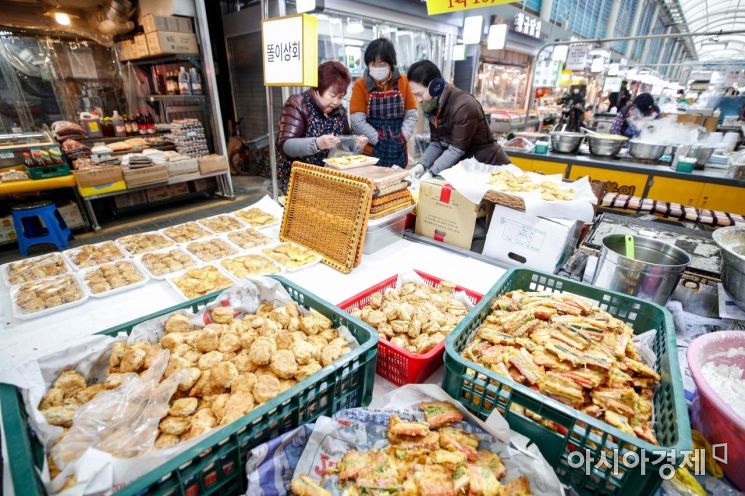
 Three days before the Lunar New Year holiday, on the 19th, a vendor is frying jeon at Yeongdeungpo Traditional Market in Seoul. Photo by Jinhyung Kang aymsdream@
[Asia Economy Reporter Lee Myunghwan] As the Lunar New Year holiday officially begins, shopping for holiday food is in full swing. To have a healthy Lunar New Year holiday, it is essential to thoroughly check for spoilage or expiration dates of ingredients.
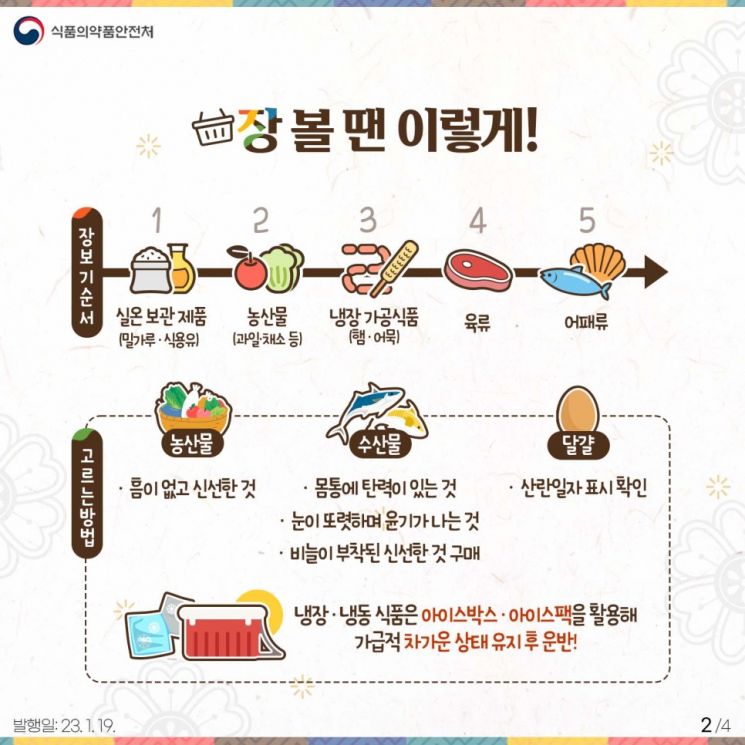
According to the Ministry of Food and Drug Safety on the 21st, to prevent spoilage of ingredients, it is best to purchase refrigerated and frozen foods last when shopping. Specifically, it is advisable to start with non-refrigerated items such as flour and cooking oil, followed by agricultural products like fruits and vegetables, then refrigerated processed foods such as ham and fish cakes, and finally meat and seafood. This is because leaving ingredients purchased from large discount marts or traditional markets in a shopping basket at room temperature for a long time can lead to bacterial growth.
When selecting agricultural products, it is best to choose those that are fresh and free of blemishes by carefully inspecting their appearance. For seafood, it is better to buy fresh ones with firm bodies, clear eyes, shiny skin, and attached scales.
When purchasing food, you must check the labeling such as the expiration date. Since the 1st of this month, the 'consumption period' labeling system has been implemented instead of the food expiration date, but a one-year grace period has been granted to ensure the system's establishment and to prevent resource waste. Accordingly, the consumption period labeling system will be applied sequentially starting with companies prepared this year.
Since products labeled with either the consumption period or expiration date will be sold mixed for the time being, it is essential to check the displayed date and storage method when purchasing products. It is best to avoid consuming products past their consumption period.
After finishing shopping, when transporting ingredients, refrigerated and frozen foods should be kept cold as much as possible using ice boxes or ice packs. Fruits and vegetables that are consumed raw should be separated from meat or seafood to prevent cross-contamination.
When purchasing food ingredients or prepared foods online, they should be received quickly to avoid being left at room temperature for a long time. Also, it is advisable to check the delivery method on the sales site and choose products that are delivered while maintaining refrigerated or frozen temperatures whenever possible.
When refrigerated or frozen foods purchased online arrive, first check for any damage to the packaging seams and whether the delivery matches the storage requirements, then inspect the contents. If there is no problem with the contents, store them refrigerated or frozen until consumption and consume them as soon as possible. The refrigerator’s refrigeration temperature should be below 5℃, and the freezing temperature should be minus 18℃.
However, medicines should not be purchased online. It is difficult to verify whether medicines distributed online are genuine, and their safety and efficacy cannot be guaranteed. Problems such as spoilage or contamination during storage may also occur, so caution is required.
© The Asia Business Daily(www.asiae.co.kr). All rights reserved.


















