'Mask Shortage'... Prices Soar Up to 7,000 Won Per Mask
Grateful Masks That Prevent Infectious Diseases
"Please Wear a Mask" Conflicts... Delays in Language Development in Infants and Toddlers
[Asia Economy Reporter Yoon Seul-gi] In the era of infectious diseases, masks have become the most basic means of quarantine. Although masks have been invaluable in blocking viruses, controversies surrounding their use have never ceased. There have been incidents of assault when mask-wearing was requested, as well as concerns about language development delays among the COVID-19 generation. On the 20th, marking three years since the spread of COVID-19, the government announced that the indoor mask mandate will be relaxed to a recommendation starting from the 30th.
Masks were a representative personal quarantine measure preceding social distancing during the COVID-19 period. After it was revealed that a Chinese national A, who entered from Wuhan, China on January 20, 2020, was confirmed to have COVID-19, the 'COVID-19 fear' became a reality, increasing interest in personal quarantine measures such as masks and hand sanitizers. Suddenly, the demand for masks surged, causing shortages. Pharmacies nationwide were crowded with people trying to buy masks.
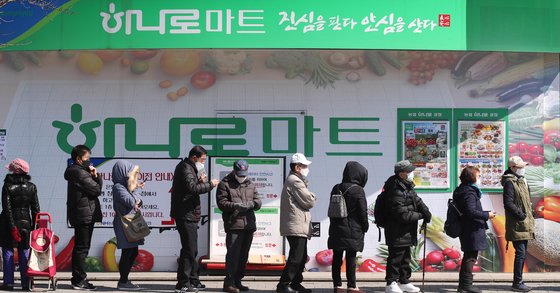 On the afternoon of March 5, 2020, citizens lined up outside the Hanaro Mart Changdong branch in Dobong-gu, Seoul, trying to buy masks. Photo by Yonhap News
Some were caught attempting illegal hoarding. In response, the government issued a notice banning hoarding of masks and other items on February 5, 2020, and introduced a 5-day mask purchase system from March to stabilize supply. The 5-day system allowed individuals to purchase two masks per person only on designated days based on their birth year.
By supplying public masks at a uniform price of 1,500 won, mask prices stabilized. The price of health masks, which had soared to about 7,000 won per piece in early March, soon returned to the level seen in early February before the full-scale spread of COVID-19.
Public institutions and companies independently mandated mask-wearing and sanitizer use to prevent COVID-19. In March 2020, local governments in Seoul, Daegu, Jeju, and others appealed for participation in 'social distancing,' suggesting ▲ refraining from going out and postponing gatherings ▲ strict adherence to personal hygiene rules such as mask-wearing and handwashing. Local governments also issued administrative orders mandating mask-wearing to respond to the spread of infectious diseases.
From November 13, 2020, mask-wearing became mandatory in frequently visited places such as public transportation, medical institutions, and pharmacies. Failure to wear a mask could result in a fine of up to 100,000 won.
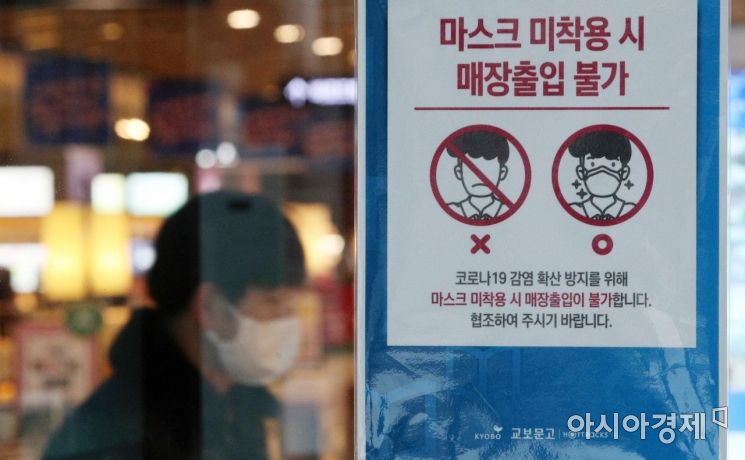 On December 23 last year, a notice regarding mask-wearing was posted at a bookstore in downtown Seoul. On the same day, the government finalized and announced the indoor mask-wearing mandate adjustment plan through a Central Disaster and Safety Countermeasure Headquarters meeting. Photo by Kim Hyun-min kimhyun81@
Masks also became a source of conflict among citizens. There were many incidents of assault and verbal disputes over mask non-compliance across the country. In November 2021, an incident was reported on social media where a part-time convenience store employee was slapped after asking a customer to wear a mask.
In particular, assaults on bus drivers requesting mask-wearing were frequent. In October 2021, in Chuncheon, Gangwon, a bus driver was assaulted after asking a passenger to properly wear a mask. In June 2022, a man in his 50s who assaulted a bus driver asking him to wear a mask in Jung-gu, Daejeon, was prosecuted under the Act on Aggravated Punishment of Specific Crimes for assaulting a driver and sentenced to prison.
As mask-wearing continued for over three years, side effects also emerged. Language development delays were observed among infants and toddlers of the COVID-19 generation. From May to November last year, Seoul City, together with the Korean Academy of Child and Adolescent Psychiatry, conducted a 'Post-COVID Infant and Toddler Development Survey' targeting 542 children aged 0 to 5 who experienced the COVID-19 period. Among 456 infants attending daycare centers, 152 (33%) were found to have developmental difficulties requiring expert assistance.
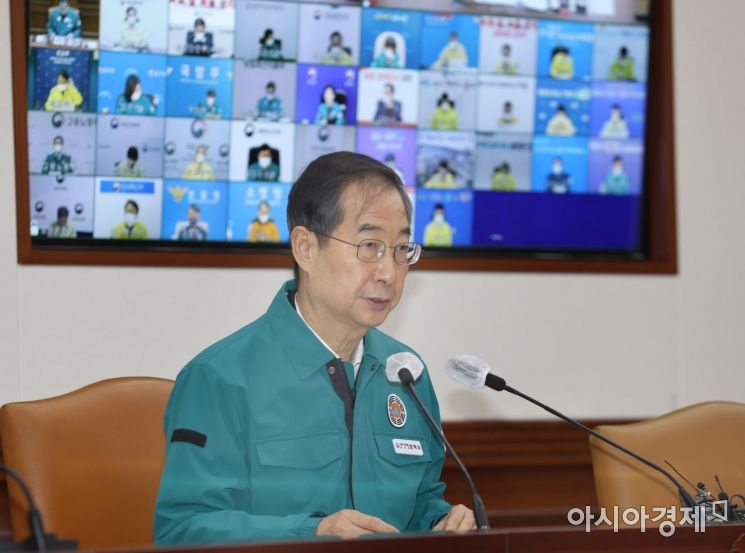 On the 20th, Prime Minister Han Duck-soo is delivering opening remarks at the Central Disaster and Safety Countermeasure Headquarters meeting on COVID-19. At the meeting, it was decided to ease indoor mask-wearing to a 'recommendation' starting from the 30th. Photo by Heo Young-han younghan@
Since 2022, the Omicron variant has led the COVID-19 spread, significantly weakening its toxicity, and the atmosphere is shifting from a pandemic to an endemic.
The mask-wearing mandate has also begun to be lifted one by one. The government completely lifted the outdoor mask mandate in two phases in May and September last year, and with various quarantine indicators stabilizing, it decided to relax the indoor mask mandate to a recommendation starting from the 30th.
On the 20th, Prime Minister Han Duck-soo stated in the Central Disaster and Safety Countermeasure Headquarters (CDSCH) meeting, "From the 30th, we plan to discuss and finalize the plan to relax the indoor mask-wearing mandate to a recommendation, except for some facilities." However, he added, "To protect vulnerable groups, the mask-wearing mandate will be maintained for medical institutions, pharmacies, vulnerable facilities, and public transportation for the time being," and "We will actively review whether to switch to a recommendation depending on future infection trends."
© The Asia Business Daily(www.asiae.co.kr). All rights reserved.



















