Excluding Medical Institutions and Public Transportation
[Asia Economy reporters Lee Gwan-ju and Gu Chae-eun] After three years of the COVID-19 pandemic, we are approaching a return to normal life by removing indoor masks. Starting from the 30th, the mandatory indoor mask-wearing requirement will be adjusted to a recommendation, except for some facilities such as medical institutions, social welfare facilities, and public transportation, which are vulnerable to infection.
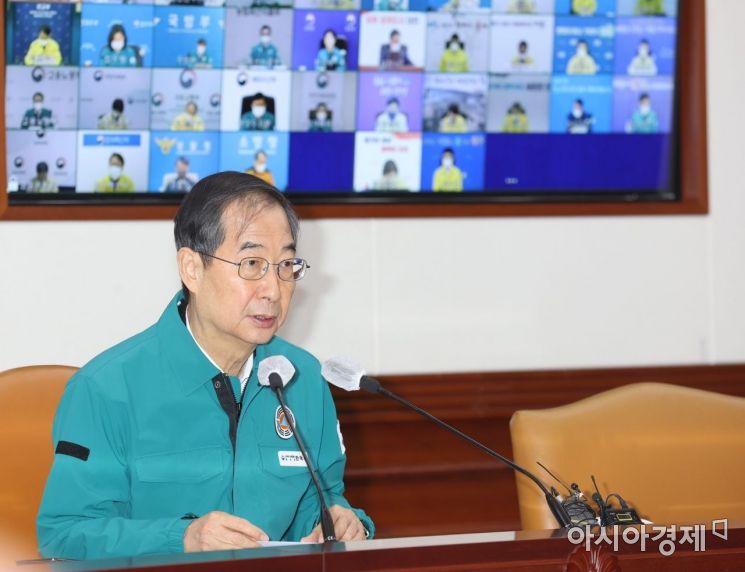 On the 20th, Prime Minister Han Duck-soo is delivering opening remarks at the Central Disaster and Safety Countermeasure Headquarters meeting on COVID-19. At the meeting, it was decided to ease indoor mask-wearing to a 'recommendation' starting from the 30th. Photo by Heo Young-han younghan@
On the 20th, Prime Minister Han Deok-su said in his opening remarks at the Central Disaster and Safety Countermeasure Headquarters (CDSCH) meeting, "From the 30th, we will discuss and finalize the plan to relax the mandatory indoor mask-wearing to a recommendation, except for some facilities." Prime Minister Han added that among the four indicators the government presented for adjusting the indoor mask mandate ? ▲ stabilization of patient occurrence ▲ reduction in severe cases and deaths ▲ stable medical response capacity ▲ immunity acquisition in high-risk groups ? the first three have been met, and external risk factors such as the spread in China are also considered manageable.
Considering Lunar New Year Holiday... Mask Wearing Continues in Medical Institutions
The decision to implement the shift to recommended indoor mask-wearing on the 30th took into account that it is the first Monday after the Lunar New Year holiday. Prime Minister Han said, "We decided this considering the increase in travel and face-to-face contact during the holiday," and emphasized, "Related agencies should thoroughly check the guidance and preparation status for facilities where mask-wearing remains mandatory to avoid confusion on the ground."
However, the lifting of the indoor mask mandate will be phased. Prime Minister Han explained, "To protect vulnerable groups, the mandatory mask-wearing in medical institutions, pharmacies, infection-vulnerable facilities, and public transportation will be maintained for the time being," and added, "We will actively review whether to switch to recommendations depending on future infection trends."
It is currently difficult to specify when indoor mask-wearing will be lifted in all facilities including medical institutions. The government is considering transitioning to a lifestyle of infection prevention guidelines recommending mask-wearing only when necessary if the COVID-19 crisis level is lowered from the current 'severe' to 'alert' or 'caution,' or if the legal infectious disease classification is adjusted (currently level 2 → level 4).
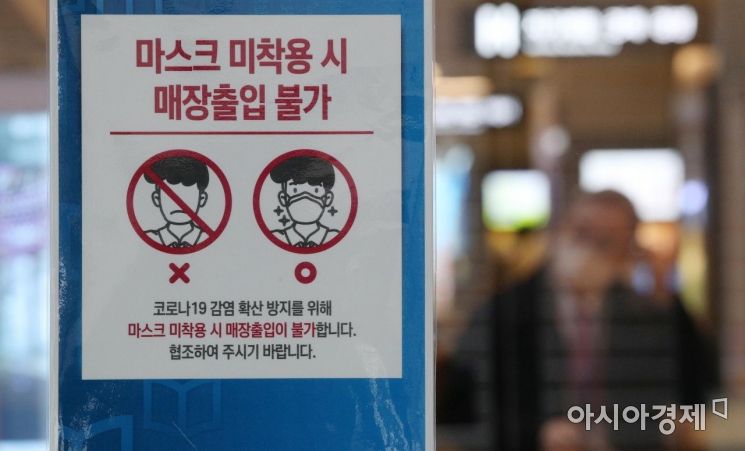 A large bookstore in Seoul has a notice mandating mask-wearing posted. Photo by Hyunmin Kim kimhyun81@
Temporary Increase in Cases Feared... "Follow Prevention Guidelines and Get Vaccinated"
Even with the adjustment of the indoor mask mandate, variables remain. First, the government plans to discuss reinstating mandatory mask-wearing if the burden of infection control increases at any time. The health authorities stated, "If there is a rapid increase in cases due to the spread of new variants or changes in overseas situations, or if the medical response system is burdened, re-mandating mask-wearing can be considered." This means they will comprehensively consider the weekly COVID-19 risk assessment results.
If the indoor mask mandate is lifted from the 30th, there is a possibility of a temporary increase in confirmed cases. Prime Minister Han said, "We recommend that elderly people and other high-risk groups wear masks at any time in places they consider risky." The importance of receiving the updated vaccine has also increased. Since it has been confirmed that the updated vaccine has an average 76% higher effectiveness in preventing severe illness and an average 80% higher effectiveness in preventing death compared to existing vaccines, health authorities urge vaccination to protect high-risk groups.
Meanwhile, as of midnight on the same day, 27,408 new COVID-19 cases were added, bringing the cumulative total to 29,955,366. At this rate, the cumulative number of confirmed cases is expected to exceed 30 million during the Lunar New Year holiday. After three years of the pandemic, about 60% of the population has been infected, marking a step closer to recovery to normal life.
© The Asia Business Daily(www.asiae.co.kr). All rights reserved.
![User Who Sold Erroneously Deposited Bitcoins to Repay Debt and Fund Entertainment... What Did the Supreme Court Decide in 2021? [Legal Issue Check]](https://cwcontent.asiae.co.kr/asiaresize/183/2026020910431234020_1770601391.png)
















