EU Commission Officially Proposes 'Carbon Neutrality Law'
French and Spanish Leaders Agree on Joint Response to IRA
Concerns Over Spread of Protectionism
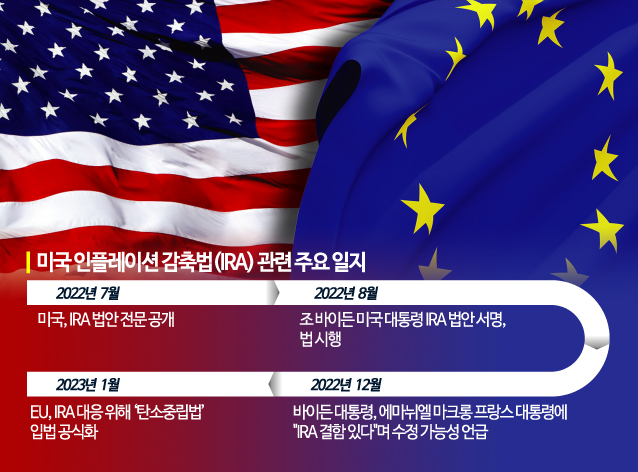
[Asia Economy Reporter Kwon Haeyoung] "A simple and swift measure equivalent to the subsidy payments under the U.S. Inflation Reduction Act (IRA) must be established."
The European Union (EU) has launched a counterattack in response to the U.S. IRA. The leaders of France and Spain agreed on the need for Europe to unite and take the lead in responding, and the EU has officially announced legislation for the 'Carbon Neutrality Act.' As Europe begins its countermeasures, concerns over the spread of global protectionism have intensified.
On the 18th (local time), Ursula von der Leyen, President of the European Commission, addressed the European Parliament plenary session, stating, "We must rapidly expand the scale of clean industries and establish a regulatory environment conducive to industry," and added, "I will propose a new Carbon Neutral Industry Act to realize this."
Von der Leyen explained that the Carbon Neutral Industry Act will be designed similarly to the EU Semiconductor Act. It is expected to include provisions to ease regulations on clean industries and provide subsidies to encourage companies to increase investments within the EU. The EU Semiconductor Act aims to invest 43 billion euros (approximately 57 trillion KRW) by 2030 to raise the region's semiconductor market share from the current 9% to 20%.
The purpose of this legislation is similar to the IRA enacted by the U.S. last year. Starting this year, the U.S. provides approximately 370 billion dollars (about 457 trillion KRW) in tax credits and subsidies through the IRA for renewable energy sectors such as solar and wind power, as well as the electric vehicle industry. Notably, it includes discriminatory elements such as offering up to 7,500 dollars (about 9.3 million KRW) in tax credits per vehicle exclusively for North American-made electric cars.
The EU's Carbon Neutral Act concept, like the U.S., reflects the intention to enhance the competitiveness of the investment environment within Europe to prevent European companies from relocating to the U.S. Until now, Europe has sought amendments to the IRA through negotiations with the U.S., but it appears they judged that no satisfactory progress had been made.
Before enacting the legislation, European leaders have agreed on the need for a joint response to the U.S. IRA. On the 19th, French President Emmanuel Macron held a summit with Spanish Prime Minister Pedro S?nchez in Barcelona, Spain, stating, "We must prepare a simple and swift measure equivalent to the U.S. tax credits and secure a budget at the same level to prevent division within the EU." Prime Minister S?nchez also said, "While we welcome the U.S.'s participation in the green energy transition, we must reach an agreement that it should not harm European industries."
President Macron is also expected to discuss joint responses to the IRA with German Chancellor Olaf Scholz during his visit to Paris on the 22nd. Previously, Macron described the U.S. IRA as "very aggressive" and urged the EU to prepare similar measures at the EU level. EU leaders are also expected to discuss the legislation of the Carbon Neutral Act at the regional summit scheduled for the 9th and 10th of next month.
If the EU follows the U.S. in providing subsidies for clean industries, the global trend toward protectionism is expected to strengthen further. Other countries such as South Korea and Japan, which have opposed the U.S. IRA and demanded amendments, are also likely to implement their own clean industry subsidy policies. Some countries, including South Korea, have announced plans to file complaints with the World Trade Organization (WTO). However, considering relations with the U.S., filing complaints is realistically difficult, and with the WTO's dispute resolution function weakened, practical benefits are expected to be minimal.
Meanwhile, the WTO has urged resolving the international disputes arising from the U.S. IRA through dialogue. Ngozi Okonjo-Iweala, Director-General of the WTO, said in an interview with Bloomberg TV on the same day, "It is much better for South Korea and Europe to resolve this issue through dialogue with the U.S. rather than seeking the WTO dispute settlement system," adding, "I believe urging resolution through dialogue is more effective."
© The Asia Business Daily(www.asiae.co.kr). All rights reserved.

















