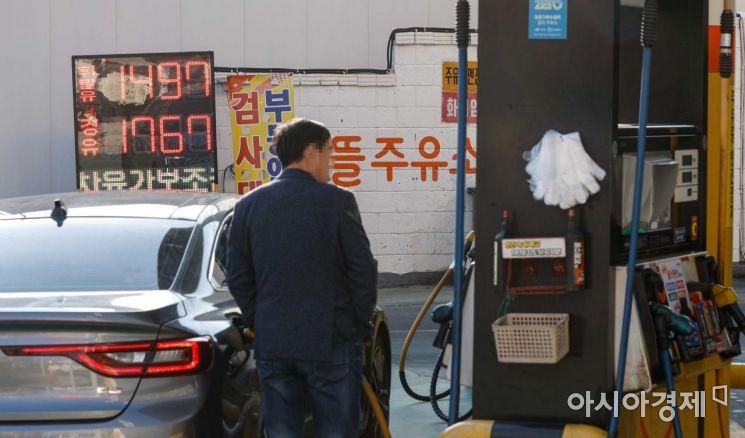
[Asia Economy Reporter Seo So-jung] Producer prices fell for the second consecutive month last month due to the decline in international oil prices and the won-dollar exchange rate.
According to the Bank of Korea on the 20th, the producer price index for December was recorded at 119.96 (2015 level 100), down 0.3% from the previous month. Producer prices turned downward in November after falling 0.4% in August last year, and continued to decline in December.
Compared to a year ago, it rose 6.0%, but the upward trend has been slowing for six consecutive months, with 10.0% in June, 9.2% in July, 8.2% in August, 7.9% in September, 7.3% in October, 6.2% in November, and 6.0% in December.
The decline in the producer price index was largely due to a drop in manufactured goods (such as coal and petroleum products) influenced by falling international oil prices and exchange rates, despite increases in agricultural, forestry, and fishery products.
Agricultural, forestry, and fishery products rose by 4.9%, but manufactured goods fell by 1.0%, resulting in a 0.3% decrease compared to the previous month.
Seo Jeong-seok, head of the Bank of Korea's price statistics team, explained, "Prices of agricultural products rose due to heating costs caused by the cold wave; the cold wave lasted longer than the previous year, and prices of cucumbers and pumpkins grown in facilities increased."
Manufactured goods saw a 0.2% increase in food and beverages, but coal and petroleum products (-8.1%) and chemical products (-0.9%) declined, leading to a 1.0% decrease compared to the previous month.
The electricity, gas, water, and waste sector rose 0.3% compared to the previous month, driven by increases in electricity, gas, and steam (0.3%).
The service sector rose 0.2% from the previous month, with restaurant and accommodation services increasing by 0.6%, despite declines in financial and insurance services (-0.3%).
Last month, the domestic supply price index fell 1.6% compared to the previous month. Raw materials (-6.5%), intermediate goods (-1.3%), and final goods (-0.7%) all declined. This index measures price changes of goods and services supplied domestically to understand the transmission process of price fluctuations.
Annual producer prices last year rose 8.4% compared to 2021, marking the highest increase in 14 years since 2008 (8.6%).
Seo said, "Producer prices tend to be reflected in consumer prices with little lag, but depending on the item, there can be a lag of 1 to 3 months, or up to 6 months. Since many upward factors remain in the future price path and uncertainties remain in domestic economic changes and movements of international oil prices and exchange rates, careful monitoring is necessary."
© The Asia Business Daily(www.asiae.co.kr). All rights reserved.

















