Nearly 3 Million Vehicles Over 15 Years Old Last Year... 200,000 More Than Previous Year
No Cars in First Half of Last Year... Cars Were Expensive in Second Half
"Aging Vehicles Expected to Increase Further This Year"
[Asia Economy Reporter Hyunseok Yoo] The number of cars that have been on the road for more than 15 years is approaching 3 million. This is influenced by consumers giving up on purchasing vehicles due to supply shortages of new cars caused by semiconductor supply disruptions and the burden of automobile installment interest rates.
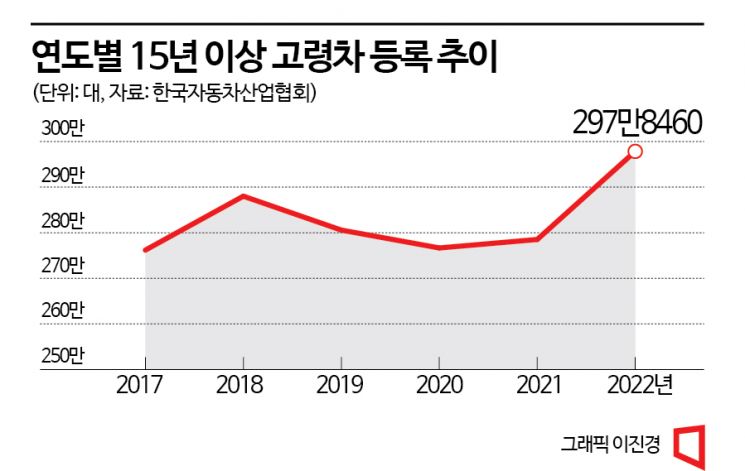
According to the monthly automobile registration statistics report compiled by the Korea Automobile Manufacturers Association (KAMA) on the 20th, the total number of vehicles registered domestically last year was 25,503,078. Among these, vehicles aged 15 years or older totaled 2,978,460, a 6.94% increase compared to 2,785,206 in 2021. Vehicles operated for 10 years or more but less than 15 years also increased significantly, totaling 5,629,697 last year, up 5.92% from 5,314,574 in 2021.
The sharp increase in vehicles aged 15 years or older is unusual. The number of aged vehicles was 2,761,898 in 2017, 2,880,179 in 2018, 2,805,777 in 2019, and 2,766,588 in 2020. It remained between 2.7 million and 2.8 million over the past six years. However, last year it increased by nearly 200,000.
One cause of the increase in aged vehicles is production disruptions due to semiconductor supply shortages. Domestic sales last year were 1,395,297 units, a 3.2% decrease from the previous year. This is the lowest level since 2013 (1,373,902 units). As supply was disrupted, it became difficult to purchase cars. Although delivery times have recently shortened, last year it typically took over a year to receive a new car. For example, if you ordered a Kia Sport Utility Vehicle (SUV) Sorento diesel model in June last year, you had to wait more than 16 months for delivery.
Additionally, the base interest rate hikes starting in the second half of last year also had an impact. As the base interest rate rose last year, automobile installment interest rates also increased. As of the 16th of this month, purchasing a Hyundai Grandeur with 10% cash down and a 36-month installment plan results in an upper limit installment interest rate of 6.6% to 12%. The rise in installment interest rates has led to more consumers giving up on vehicle purchases. Last year, people couldn’t buy cars because they were unavailable, and recently, they can’t buy cars because they are too expensive.
Moreover, improvements in vehicle performance are also cited as a factor increasing the operation of older vehicles. Compared to the past, technological advancements have improved vehicle durability. In fact, the average vehicle scrapping cycle in Korea has increased from 8.3 years in 2000 to 14.87 years in 2015, 15.59 years in 2020, and 16 years in 2021 (Korea Automobile Dismantling & Recycling Association 'Average Vehicle Scrapping Cycle by Year').
The increase in aged vehicles is expected to continue this year as well. The burden on consumers to purchase vehicles has grown due to the combination of high automobile installment interest rates and the impact of an economic recession. Professor Kim Pilsoo of the Department of Automotive Studies at Daelim University said, "During periods of tightening policies, people tend not to buy new cars," adding, "There is a high possibility that aged vehicles will increase further this year."
© The Asia Business Daily(www.asiae.co.kr). All rights reserved.


















