National Assembly Political Reform Special Committee Expert Public Hearing Held
'Skepticism on Large Multi-member District System' in Unison
Alternatives Proposed Including 100% Mixed-Member Proportional Representation
[Asia Economy Reporter Park Jun-yi] As discussions on the revision of the election law have heated up the political sphere since the beginning of the year, political experts unanimously argued that the number of proportional representatives should be increased. They pointed out that the major electoral district system proposed by President Yoon Seok-yeol in his New Year's message has more limitations than advantages.
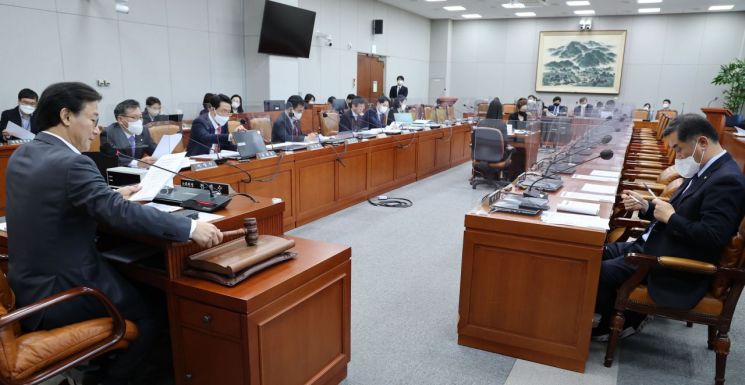
The National Assembly's Special Committee on Political Reform and the Subcommittee on Improvement of Political Relations Law held a public hearing with experts on the 19th to discuss election system reform measures. Professor Jang Seung-jin of the Department of Political Science and Diplomacy at Kookmin University, who gave the first presentation, emphasized, "Whether the number of constituency seats is reduced or the total number of seats is increased while maintaining constituency seats, ultimately the proportion of proportional representatives must increase."
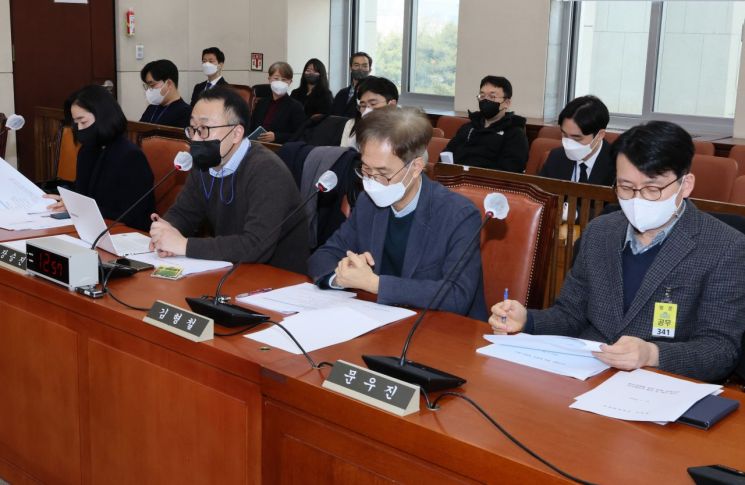
He also pointed out the limitations of the major electoral district system. Referring to the implementation of the major electoral district system in local councilor seats in local elections, he said, "Looking at the recent local elections, out of 1,061 electoral districts, nearly half elected three or more representatives, and the rest were two-member districts, with three to five-member districts making up nearly half. Former local councilors and members of the two major parties accounted for 94%. If our goal is to transform the Korean political structure dominated by two parties into a multiparty system, I am skeptical whether the major electoral district system is our alternative at this point."
Professor Jang expressed skepticism about the 'regional proportional representation system,' which is proposed as an alternative to strengthen proportionality. He said, "If proportional representatives are divided by region, there would be at most about 10 members, so it is questionable how effective the regional proportional representation system would be in expanding proportionality. Also, given the presence of constituency members like in Korea, I am skeptical about the significance of the regional proportional representation system."
He diagnosed that realistically, the total number of members must be increased to expand the number of proportional representatives. Professor Jang argued, "I think persuading the necessity of increasing the total number of members and expanding proportional representation might be a more realistic approach."
Professor Kim Hyung-cheol of the Democracy Research Institute at Sungkonghoe University also pointed out the limitations of the major electoral district system and the regional proportional representation system, advocating for an increase in the total number of members and the introduction of a 100% mixed-member proportional representation system. He said, "Proportional representation is meant to guarantee functional and social representation, but the regional proportional representation system has the limitation of strengthening regional representation. Since reducing constituency seats would face opposition from incumbent members, proportionality can be secured by increasing the total number of members."
He added, "To strengthen democracy, revising the current semi-mixed proportional representation system to a 100% mixed-member proportional representation system is the best option we can choose."
Professor Moon Woo-jin of the Department of Political Science and Diplomacy at Ajou University said, "The key is to reform the election system to align with the purpose of representative democracy," and analyzed, "Breaking the two-party monopoly system and regionalism revealed in the two-party system is the most important."
He also believed that a deeper approach is needed regarding the 'multiparty system,' which has emerged as a political reform topic. Professor Moon said, "Can the multiparty system solve many problems in Korea? Even with a multiparty system, parties that can represent diverse civil societies must be created, and meaningful policy competition must occur. If existing party members split their parties to create multiple minor parties and engage in election wars centered on political elites and conflicts, it is hard to see it as a better system than the two-party system," warning against such scenarios.
He also said, "The important factor is the size of the electoral district," and expressed concern, "If the number of members per region increases and the electoral district becomes large, proportionality increases, but when using an open list, candidates can be elected with low vote shares, allowing members supported by radical groups to be elected." He also pointed out that larger electoral districts weaken the bond between members and voters.
He too viewed the major electoral district system critically. Professor Moon said, "The major electoral district system has more disadvantages than advantages in academia," explaining, "Because candidates from the same party compete against each other. The election results depend on how evenly votes are distributed to prevent other candidates from the same party from losing." He criticized it as "a system that allows satellite parties to appear and distorts the will of the people."
© The Asia Business Daily(www.asiae.co.kr). All rights reserved.
![Clutching a Stolen Dior Bag, Saying "I Hate Being Poor but Real"... The Grotesque Con of a "Human Knockoff" [Slate]](https://cwcontent.asiae.co.kr/asiaresize/183/2026021902243444107_1771435474.jpg)












