Growing Seollal Money Gift Burden Amid Rising Prices
10,000 Won, 30,000 Won, 50,000 Won, 100,000 Won...
[Asia Economy Reporter Park Hyun-joo] Ahead of the Lunar New Year holiday, a debate is arising over the appropriate amount of Sebaetdon (New Year's money).
On the 19th, Hanwha Life Insurance conducted an internal survey on the 'appropriate amount of Sebaetdon for this year (2023),' and the most common answers were 30,000 KRW for elementary school students and younger, 50,000 KRW for middle school students, and 100,000 KRW for high school and university students.
Compared to the survey results from 10 years ago, the level of Sebaetdon has increased significantly. According to a survey conducted by Hanwha Life Insurance in 2013, the most common answers were 10,000 KRW for elementary school students and younger, 30,000 KRW for middle school students, and 50,000 KRW for high school and university students.
The background of this debate lies in the steep rise in prices. In an era of high inflation where many citizens are tightening their belts to the extent that the 'No Spending Challenge' has become popular, Sebaetdon accounts for a significant portion of holiday expenses. Last year, the consumer price inflation rate recorded 5.1%, the highest in 24 years since the foreign exchange crisis.
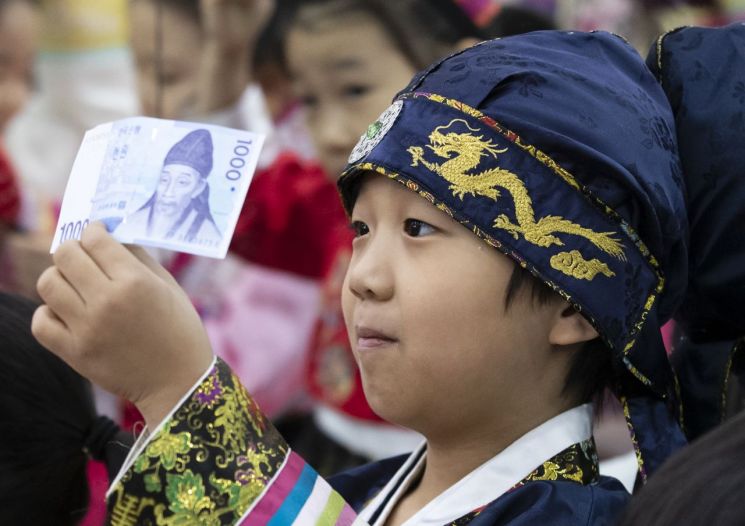 On the morning of January 20, 2020, children from local daycare centers are checking their New Year's money after performing a joint New Year's bow at the Songpa Senior Culture Center in Seoul. [Image source=Yonhap News]
On the 16th, job portal sites JobKorea and Albamon surveyed 1,035 office workers about 'Lunar New Year expenses,' and the average expected expenditure during the holiday was 540,000 KRW. Among this, the budget for Sebaetdon reached 164,000 KRW. In particular, married office workers (283,000 KRW) were found to spend twice as much on Sebaetdon as unmarried office workers (123,000 KRW).
Given this situation, a joke has recently emerged suggesting that it would be nice if a 30,000 KRW bill were issued for holiday allowances. This came after singer Lee Juck posted on his social media earlier this month, gaining much sympathy. Lee Juck stated, "The jump from the 10,000 KRW bill to the 50,000 KRW bill is too big," and added, "Considering the uniquely Korean sense of denominations increasing as 1, 3, 5, 10, a 30,000 KRW bill would surely be useful."
Lee Juck continued, "Many people who, when meeting their nephews or nieces after a long time, felt awkward giving just a 10,000 KRW bill, and felt it a bit stingy to count out several bills, boldly handed over a 50,000 KRW bill and then regretted it afterward, would warmly welcome the introduction of a 30,000 KRW bill." The opinion is that 10,000 KRW is an awkward amount to cover a meal in this high inflation era and feels embarrassing to give, while 50,000 KRW is a burden on the wallet, making a 30,000 KRW bill the appropriate amount.
© The Asia Business Daily(www.asiae.co.kr). All rights reserved.

















