Interview with Sim Gyu-yeol, Director of the Korea Turfgrass Research Institute
The Science Behind the Green... "Self-Repair of Turfgrass Damage is Necessary"
"Great Golf Comes from Skill Development and Good Manners"
"Avoid All Four Players Entering the Teeing Area"
"On Par with Advanced Countries like the US and Japan"
"Just as obesity is the root of all diseases for humans, golf course courses must focus on prevention while minimizing the use of supplements or pesticides for quality management."
Shim Gyu-yeol, director of the Korea Turfgrass Research Institute, is a 'turf doctor' who manages turfgrass at golf courses nationwide, diagnoses problems, and proposes solutions. Leading experts in various fields of natural elements that make up golf courses such as turfgrass, soil, trees, and flowers, he supports necessary growth activities like pest control, environmental management, and nutrient supply. In an interview with Asia Economy on the 19th, he said, "If golfers understand the characteristics of greens, teeing areas, and fairways, and learn the manners they must observe for other users, they will be able to enjoy golf under better conditions," and made several requests.

First is the green. It is the most sensitive and difficult area to manage among golf course turfgrass. Director Shim said, "Drainage is key for greens." It is designed so that water can easily drain to withstand up to 400 mm of rainfall per hour. A sand layer made of uniform grains less than 1 mm in diameter is piled 30 cm deep under the turf, and below that, coarser coarse sand is laid about 10 cm thick. The bottom is filled with gravel to connect to the drainage channels.
Director Shim used a sponge as an example, saying, "When you pour water from a kettle, the sponge holds a certain amount until it becomes saturated, then quickly expels water through the sides and bottom." He explained, "Similarly, on the green, some moisture is absorbed by the sand and gravel, and when it becomes saturated due to heavy rain, the water is rapidly drained to the underground drainage layer by gravity." Normally, the turf stores an appropriate amount of water to prevent drying, and adjusts the water volume during the rainy season or heavy rain.
The green is mowed to a turf length of 3 to 4 mm so that the ball rolls fast and consistently. Because the turf is soft, shots often cause pitch marks. Director Shim emphasized, "Golfers should create a culture of repairing pitch marks themselves to improve putting accuracy and show consideration for the next player." He added, "Carrying a putter keeper and gently lifting the damaged turf, then gathering and covering it with surrounding turf can regenerate the damaged area."
The turf used on fairways grows differently depending on the variety. The representative imported species, Bentgrass, has roots that do not penetrate deeply into the soil and growth points located on the stem, growing prostrate above the ground. Director Shim said, "Bentgrass has shallow roots and soft leaves, so divots (pieces of turf dug out by the club head) can be as large as a palm, but if the fallen area is covered again, the turf can revive by attaching to the growth points on the surface."
On the other hand, Kentucky Bluegrass or Korean-type turf grows with deep roots and stems that penetrate underground. New shoots also sprout from deep within. It is relatively resistant to divots, so the turf is less damaged when shots are made. However, even if the damaged area is covered, the growth points do not touch, so the turf does not regenerate. Nevertheless, Director Shim expressed, "For the sake of the next golfer, it is necessary to fill the damaged area and show consideration when moving."
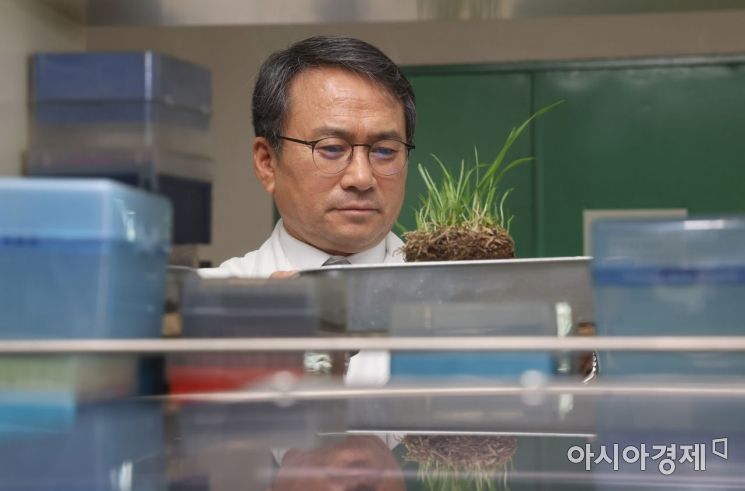 Director Shim Gyu-yeol of the Korea Turfgrass Research Institute is examining golf course turf samples in his laboratory in Bundang-gu, Seongnam-si, Gyeonggi-do. Photo by Huh Younghan younghan@
Director Shim also urged restraint in having all companions stand on the teeing area to watch tee shots, as it accelerates turf wear and hinders good shots. He also emphasized the habit of raking sand after bunker shots. He smiled and said, "If you improve your skills and adopt these few manners, you can truly enjoy wonderful golf."
Director Shim is a founding member of the Turfgrass Research Institute, established in 1989 as an affiliated research institute of the Korea Golf Course Management Association. He holds a doctorate in agricultural science and studied crop pests and diseases at the Rural Development Administration's Agricultural Science and Technology Institute (now the National Institute of Agricultural Sciences) before moving to his current position. The Turfgrass Research Institute originated at the Anyang Country Club (CC), built by Samsung Group. Lee Byung-chul, the founding chairman of Samsung who was deeply attached to golf courses, invited golf course management experts from Japan every month, during which the institute's staff also sought advice and established techniques. Currently, the institute assists in solving problems occurring on golf courses upon requests from 203 member companies of the Golf Course Management Association. They make about 250 to 300 field visits annually.
Director Shim evaluates that their know-how is on par with advanced countries in course management such as the United States and Japan. He said, "Last year, the number of golf course visitors based on 18 holes was 37,000 in the U.S., 31,000 in Japan, but 91,000 in Korea, about three times more. Since course quality is maintained similarly to those countries, our management capability is far superior," expressing pride.
The Greenkeeper School, operated since 1990 to train excellent golf course management personnel, is also a major task of the institute. It is a one-year program providing theoretical and practical education, and graduates can work at various golf courses. It is a military academy that has produced about 500 graduates over 32 years. Director Shim lamented that although demand is high and employment rates are good, young generations show little interest due to perceptions that fieldwork is tough and work frequency increases on weekends or holidays. He emphasized, "Course management is a professional job, and once knowledge and skills are acquired, you can work for a long time regardless of age. It is an attractive job where you can work in a pleasant natural environment and enjoy golf."
© The Asia Business Daily(www.asiae.co.kr). All rights reserved.


















