"Market Recovery Expectations Influence... Cautious Sentiment Continues"
Jeonse Prices Respond to Additional Interest Rate Hikes and Preference for Monthly Rent
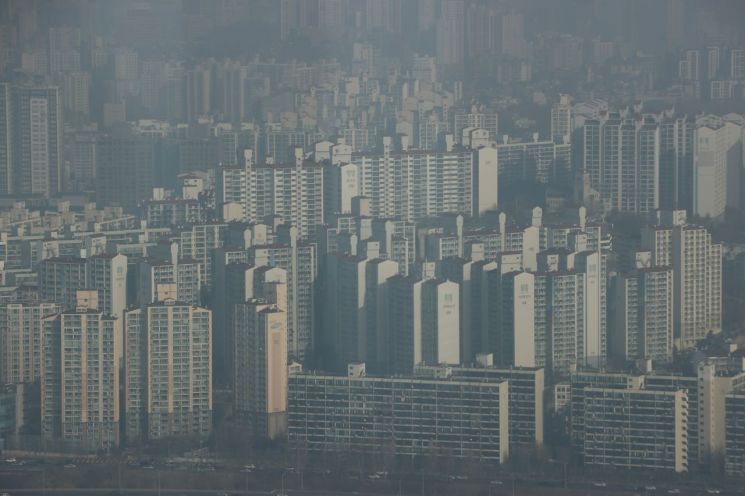
[Asia Economy Reporter Noh Kyung-jo] Seoul apartment prices have continued to decline for 34 consecutive weeks, but the rate of decline has gradually narrowed since the beginning of the new year. Although there is still a gap between the listing prices and the desired purchase prices, expectations for market recovery have emerged due to the government's easing of real estate regulations.
According to the weekly apartment price trends announced by the Korea Real Estate Board on the 19th, Seoul apartment prices in the third week of January (as of the 16th) fell by 0.35%, reducing the decline by 0.10 percentage points compared to the previous week (-0.45%). However, the rate of decline has narrowed for three consecutive weeks.
The Real Estate Board stated, "Although the downward trend continues due to buyers' cautious stance and intermittent quick-sale transactions, the rate of decline is slowing down due to growing expectations for market price recovery."
Among the 25 autonomous districts in Seoul, seven districts including Yangcheon-gu (-0.16%→-0.23%), Gangseo-gu (-0.60%→-0.65%), Guro-gu (-0.44%→-0.50%), Geumcheon-gu (-0.53%→-0.54%), Gwanak-gu (-0.36%→-0.37%), Gangnam-gu (-0.20%→-0.25%), and Gangdong-gu (-0.33%→-0.44%) saw an increase in the rate of decline compared to the previous week. Among these, Gangseo-gu experienced declines mainly in older complexes in Deungchon, Gayang, and Yeomchang-dong, while Geumcheon-gu saw decreases mainly in major complexes in Siheung and Doksan-dong. Gangdong-gu's large complexes in Amsa and Godeok-dong also saw price drops. Additionally, Seodaemun-gu (-0.47%) continued to decline mainly in major complexes in Hong-eun, Namgajwa, and Bukahyeon-dong, and Jung-gu (-0.44%) maintained its downward trend mainly in large complexes in Sindang-dong and small complexes in the old downtown area.
Gyeonggi Province (-0.71%) and Incheon (-0.66%) also saw a slowdown in the rate of decline. However, Hwaseong-si in Gyeonggi (-1.30%) experienced a drop in actual transaction prices mainly in major complexes in Neung-dong, and Osan-si (-1.07%) continued its downward trend centered around Busandong, adjacent to Dongtan New Town. In Incheon, Yeonsu-gu (-0.89%) saw price decreases mainly in older complexes in Yeonsu, Dongchun, and Ongnyeon-dong, affected by the decline in Songdo New Town. Bupyeong-gu (-0.82%) experienced a drop in apartment prices mainly in large older complexes in Samsan, Galsan, and Sangok-dong.
Among the five major metropolitan cities in the provinces, the rate of decline slightly decreased to -0.49% compared to the previous week (-0.50%), but Busan (-0.50%→-0.58%) was the only city where the rate of decline expanded. Nationwide, Sejong recorded the largest decline for seven consecutive weeks, dropping 1.12% due to a backlog of listings.
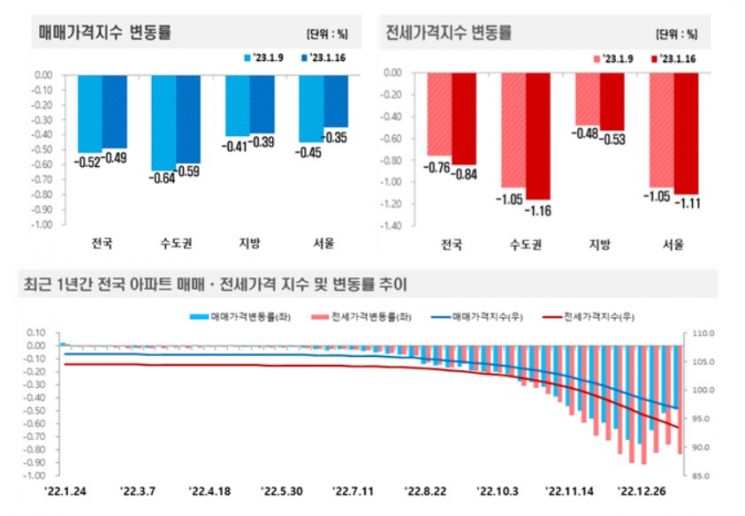
The jeonse (long-term lease) market saw an increase in the rate of price decline again due to prolonged listing backlogs and a preference for monthly rent caused by additional interest rate hikes. Nationwide apartment jeonse prices fell by 0.84%, with Seoul (-1.11%), Gyeonggi (-1.19%), and Incheon (-1.14%) all showing declines in the 1% range. The Real Estate Board explained, "In Seoul, inquiries related to school district demand slightly increased, but the jeonse listing prices continued to decline due to an increase in scheduled move-in volumes."
In the provinces, the five major metropolitan cities showed a decline rate of 0.67%, down 0.03 percentage points from the previous week (-0.64%). The region with the largest change in the rate of decline was Chungnam (-0.28%→-0.39%).
© The Asia Business Daily(www.asiae.co.kr). All rights reserved.













