Development of KIST Robotic Library System Collabot
Connecting Household Items like Mobile Phones and Furniture
Integrated Provision of Desired Services Possible
Winner of Top Award at International Robotics Competition
[Asia Economy Reporter Kim Bong-su] One day in 2030. Kim Young-hee (a fictional character, 60), whose memory has worsened with age, was distressed because she could not find a precious item carefully stored in her home, so she took out her smartphone. In the past, she would have opened all the drawers in the house, but now there is no need. The social bot installed in Kim’s home recently connects household items, furniture, electronic devices, and smartphones, and when she searches for an item she wants to find, it tells her the location. It even opens doors or protrudes items to make them easier to find.
Although still virtual, this is a future that is already becoming a reality. This new concept social robot developed by Korean researchers received the highest evaluation at an international competition. The Korea Institute of Science and Technology (KIST) announced on the 19th that Dr. Kwak Sona’s research team won the top award in the 'Hardware, Design, Interface' category at the Robot Design Competition held as part of the International Conference on Social Robotics (ICSR 2022) from December 13 to 16 last year at the Florence Chamber of Commerce in Italy, with their self-developed CollaBot.
.
Existing social robots have mainly been humanoid robots providing individual services. In other words, the goal was to create robots resembling humans that use various tools to provide complex services suitable for situations. Consumers have high expectations for humanoid robots that resemble humans, expecting human or even superior abilities. However, actual functions have been limited to simple movements or single functions, causing disappointment and difficulties in market formation. Current humanoid-based robotic products are inevitably developed specialized for one function, so they clearly have limitations in providing various complex services tailored to consumer situations.
The research team developed a robotic library system called CollaBot that integrates information recognized by multiple robotic products to understand situational context and provide services appropriate to the recognized situation. This system, composed of bookshelves, desks, chairs, and lighting, offers human-robot interaction based on collaboration among multiple robotic products.
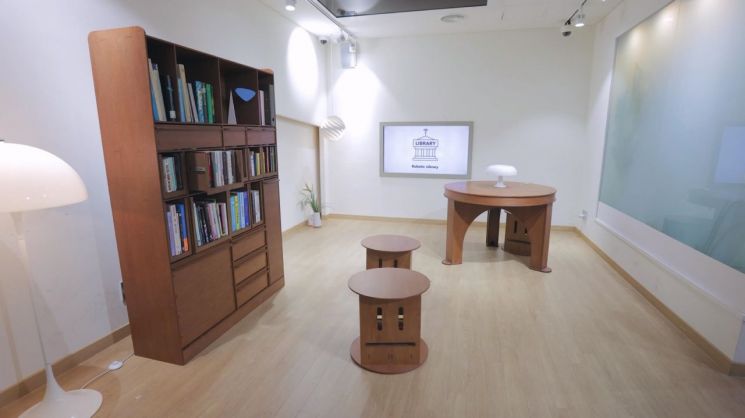 Robotic library system developed by KIST. The system consists of robotic bookshelves, desks, chairs, doors, and lighting, and each robotic product recognizes environmental and user information to understand the situational context and provide appropriate services through collaboration among the robotic products.
 [Photo by KIST]
The detailed system environment is as follows. The user’s smartphone, entrance door, robotic bookshelf, and robotic chair are interconnected, so when the user searches via smartphone, the bookshelf containing the requested book protrudes. The chair acts as a ladder according to the bookshelf’s height and serves as a cart when many books need to be moved. In other words, each component supports user-customized services by transforming its function according to situational context as well as its original function.
Dr. Kang Da-hyun of KIST explained, “A robotic system based on collaboration among multiple robotic products can apply robot technology to the existing Internet of Things to provide physical services.” He added, “It will be possible to realize a hyper-connected society based on the Internet of Robotic Things that enables situational context recognition and services through various channels.” He further stated, “Such systems that provide practical help in our daily lives are expected to pioneer a new robot market with a concept different from anything before.”
© The Asia Business Daily(www.asiae.co.kr). All rights reserved.

















