Economic Budget Increase in the 1% Range... "Ongoing Impact of Corona"
Adoption of Pyongyang Munhwaeo Law, Strengthening Resident Surveillance and Control
[Asia Economy Reporter Jang Hee-jun] North Korea held the Supreme People's Assembly, equivalent to South Korea's National Assembly, and has stepped up ideological control. Analysts suggest that Kim Jong-un's absence from this meeting reflects North Korea's economic situation, which lacks achievements to showcase.
According to the Korean Central News Agency on the 19th, North Korea held the 8th session of the 14th Supreme People's Assembly over two days from the 17th to the 18th at the Mansudae Assembly Hall in Pyongyang. The meeting discussed ▲tasks for 2022?2023 ▲budget for 2022?2023 ▲adoption of the Pyongyang Cultural Language Protection Law ▲status of the Central Prosecutor's Office's work ▲organizational (personnel) issues. Overall, it was evaluated as a step to strengthen ideological control, with no separate messages directed at South Korea or the United States.
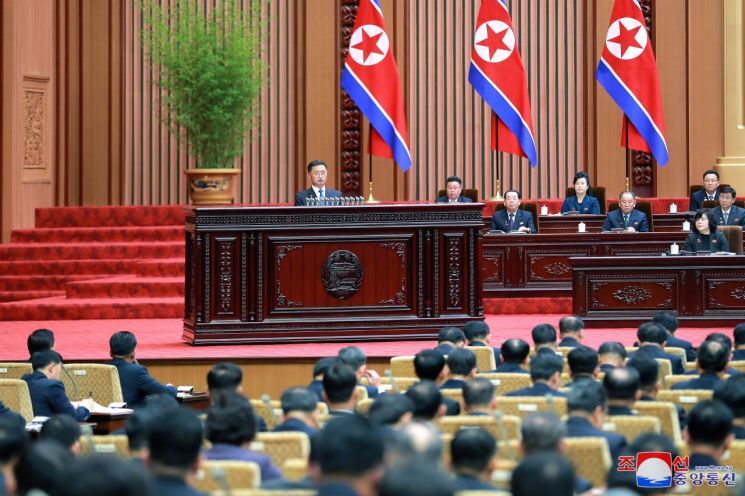
Chairman Kim did not appear at this meeting. There was no mention of a message from the supreme leader. Although Kim is not a delegate to the Supreme People's Assembly and thus not required to attend, he has typically delivered external messages in the form of policy speeches at key times. A representative example was his proclamation of nuclear force legislation in September last year.
Regarding his absence, analysts suggest it is because North Korea has no economic achievements to present. In fact, North Korea increased expenditures by only 1.7% compared to the previous year when preparing this year's budget, and the economic sector budget was raised by a mere 1.2%. This is interpreted as indicating that North Korea's finances remain tight, as it had entered austerity due to the impact of COVID-19.
Professor Park Won-gon of Ewha Womans University’s Department of North Korean Studies said, "Kim Jong-un's direct appearance means there is a need to show achievements or deliver important messages, but this time there was nothing to boast about. He has sufficiently showcased nuclear force, and now there should be something to present on economic issues, but judging by the budget preparation, North Korea's current situation appears to remain poor." Professor Park particularly noted that the increase in expenditures and economic sector budgets remaining in the 1% range "shows that North Korea itself acknowledges it is insufficient to return to the economic level before the COVID-19 outbreak."
"Do Not Use South Korean Speech"…North Korea’s Evidence of Ideological Relaxation
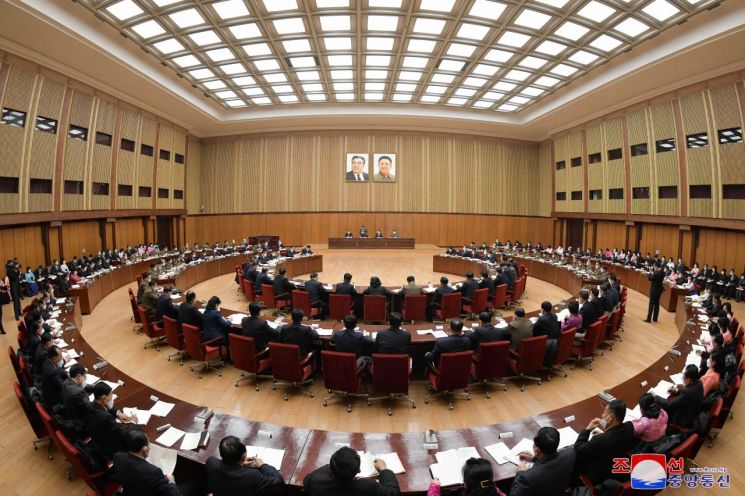
No new policies were presented at this meeting, which Kim Jong-un did not attend. Instead, the Pyongyang Cultural Language Protection Law, which had been announced since last year, was adopted, and the status of the Central Prosecutor's Office's work, equivalent to South Korea's prosecution, was discussed, indicating a move to strengthen surveillance and control over residents.
North Korea has gone through procedures such as research on the draft law and council discussions, and the law was adopted unanimously at this meeting. Kang Yoon-seok, Vice Chairman of the Standing Committee of the Supreme People's Assembly, stated, "The Pyongyang Cultural Language Protection Law regulates issues to thoroughly realize the Korean Workers' Party's plans and intentions to reject non-normative language elements in our language life."
Simply put, the Pyongyang Cultural Language Protection Law legally prohibits the use of 'South Korean-style speech.' This reflects concerns that the spread of Seoul dialect and English-style expressions could weaken regime cohesion. It also shows that South Korean cultural content such as dramas and movies is circulating among residents, causing unrest.
According to the National Intelligence Service, last year North Korea launched a large-scale crackdown targeting youth expressions such as 'namchin' (boyfriend), 'jjokpallinda' (embarrassed), and calling husbands 'oppa' (older brother). In particular, in December 2020, North Korea enacted the Anti-Reactionary Thought and Culture Rejection Law, imposing the death penalty on those distributing South Korean videos as an extreme measure.
© The Asia Business Daily(www.asiae.co.kr). All rights reserved.
![User Who Sold Erroneously Deposited Bitcoins to Repay Debt and Fund Entertainment... What Did the Supreme Court Decide in 2021? [Legal Issue Check]](https://cwcontent.asiae.co.kr/asiaresize/183/2026020910431234020_1770601391.png)

















