Graduation Season... Flowers Not Selling
Prices Rise Due to Soaring Production Costs and Supply Instability
Early Graduation Ceremonies and More Alternatives Increase
"The saying that graduation season is a big business is a thing of the past..."
At around 3 p.m. on the 18th, in an underground shopping area of the flower wholesale market in Yangjae-dong, Seocho-gu, Seoul. Normally, this would be a busy time with the peak graduation season in full swing, but the shopping district lined with flower wholesalers was filled only with silence. Each store was full of colorful flowers, but there was no sign of anyone busy wrapping them. In contrast to the blooming flowers, the expressions of the merchants were gloomy. It was common to see them struggling to attract the few customers who came by. The reason is that flower prices have risen so much that there are fewer customers looking for flowers than before.
Kim Hyun-hee (48, pseudonym), who has been doing business here for nearly 20 years, said, "Even if we sell a lot of flowers these days, there is nothing left to gain," adding, "We mainly do business with regular customers, but since prices change daily, we are afraid to buy flowers in advance."
The high inflation is also blowing a cold wind through the flower market. Although the peak season has arrived with the resumption of in-person graduation ceremonies after three years, domestic flower prices have skyrocketed, leaving merchants full of worries. The main reasons cited are the increased costs of heating, fertilizers, and nutrients for flower production.
According to the Korea Agro-Fisheries & Food Trade Corporation's flower distribution information, from the 1st to the 13th of this month, a bunch of roses was sold at an average price of around 16,000 won at the Yangjae-dong flower wholesale market in Seoul. Compared to the end of last year, this is a price increase of more than 60%, and merchants say that for some varieties, prices soared to nearly 50,000 won per bunch in early this month. At the flower wholesale market, auction prices are determined in real-time through an electronic flower auction system.
The earlier-than-usual start of graduation ceremonies also fueled the price increase. With schools having greater discretion over academic operations, graduation ceremonies in the metropolitan areas such as Seoul, Incheon, and Gyeonggi began as early as December last year. Many farms switched crops due to COVID-19 social distancing measures, causing supply to be unstable, and a cold wave worsened the supply situation, leading to a sharp rise in flower prices due to supply and demand issues, according to merchants.
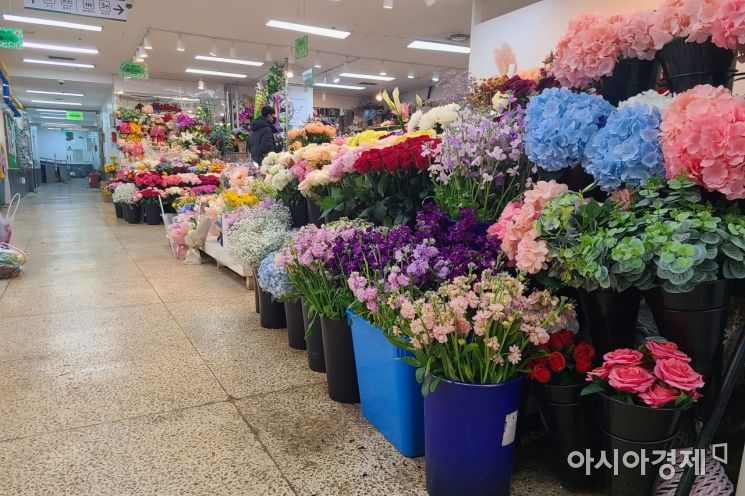 On the afternoon of the 18th, a flower wholesaler at the Yangjae-dong Flower Wholesale Market in Seocho-gu, Seoul, appeared deserted. Photo by Song Seung-yoon
The increased flower prices have led to a decrease in consumer purchases. This is because a bouquet that used to be purchased for 30,000 won now costs at least 50,000 won. Also, with more options such as other gifts or gift certificates instead of the bouquets that were once considered essential at graduation ceremonies, the atmosphere of graduation has changed from before. The popularity of DIY bouquets made from soap, cash or gift certificates, or favorite characters, which are arranged personally, has also contributed to the shift in demand to online platforms.
Oh Hyun-hee (39, pseudonym), who runs a flower shop at the flower wholesale market, said, "Although flower prices will drop sharply once the graduation season ends, they could rise significantly again in May, the peak season, depending on supply and demand," adding, "If flower prices continue to rise, overall flower consumption will shrink further, and that is my biggest concern."
© The Asia Business Daily(www.asiae.co.kr). All rights reserved.













