1 in 5 Seoul Apartment Sales in December Are Direct Transactions
Gifted Sales Priced Billions Below Market Value
Widening Buyer-Seller Price Gaps Deepen Transaction Freeze Amid Market Slump
Office worker Kim (38) recently saw the actual transaction price of Godeok Gracium in Gangdong-gu, Seoul on Naver Real Estate and hurriedly called a nearby real estate agency. He was curious if there were similar listings because an apartment sold 4 months ago for 1.185 billion won was now traded at 900 million won. However, the answer he received was only that it was "cheap because it was a direct transaction." Kim said, "I expected the price to have dropped a lot, but there were no listings at that price," adding, "Even though it's a direct transaction, it's true that I'm hesitant to buy at a higher price."
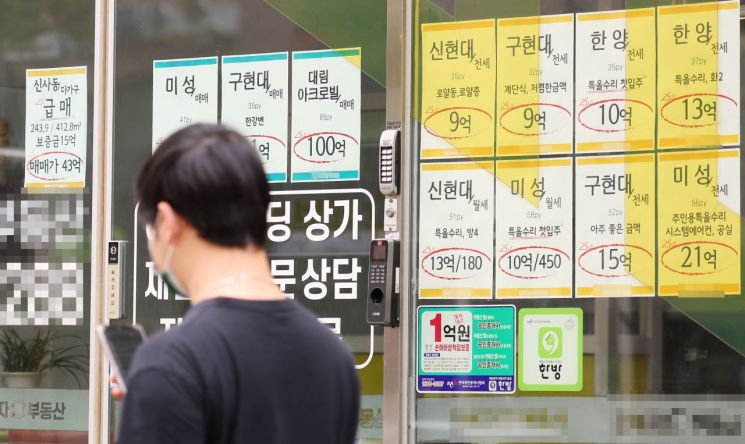
The proportion of direct transactions without real estate agents has surged in the real estate market. This winter, one out of every five apartments bought and sold in Seoul was a direct transaction. Since many of these transactions appear to be priced several hundred million won below market value, it is highly likely that they are gift-like sales among family members. Experts point out that such abnormal low-price transactions widen the gap between sellers' and buyers' asking prices, deepening the real estate transaction freeze.
On the 19th, Asia Economy analyzed the Ministry of Land, Infrastructure and Transport's actual transaction price disclosure system and found that among 796 apartment sales in Seoul last December, 178 cases (22.4%) were direct transactions. The share of direct transactions increased from 5.2% in September 2021 to ▲12.2% in December ▲13.3% in March 2022, then dipped to ▲10.3% in June, before sharply rising to ▲17.4% in September, now exceeding 20%. This trend continues into January this year, with 38 out of 176 cases (21.6%) identified as direct transactions so far.
Direct transactions are sales where the seller and buyer trade the property directly without a real estate agent. Since this method is usually used to save brokerage fees or taxes, transactions often occur at prices lower than market value.
For example, a 131㎡ apartment in Hyundai, Myeongil-dong, Gangdong-gu, Seoul, traded on the 3rd, changed hands for 1.15 billion won, which is 450 million won cheaper than the lowest asking price of 1.6 billion won. Similarly, an 84.9㎡ apartment in DMC Parkview Xi, Seodaemun-gu, Seoul, sold on December 14 last year, was traded for 850 million won, 250 million won less than the lowest asking price of 1.1 billion won.
Experts estimate that many of these direct transactions priced several hundred million won below market value are gift-like sales between special relations such as spouses or children. Instead of paying large gift taxes, sellers can save taxes by selling at a lower price. Under current law, if the difference between the market price and the transaction price is less than 30% of the market price or 300 million won, the transaction is recognized as normal, and gift tax is not imposed.
The problem is that during a severe real estate slump, direct transactions with significantly lowered prices disrupt the market and deepen the transaction freeze. When house prices are falling, buyers are reluctant to purchase at higher prices regardless of previous transaction types. Sellers, on the other hand, do not want to lower their asking prices because of direct transactions. As a result, the gap between buyers' and sellers' asking prices widens, preventing deals from closing. Homeowners who must sell end up reluctantly listing their homes at low prices, which further lowers market prices. Ham Young-jin, head of the Zigbang Big Data Lab, said, "Direct transactions nowadays serve as a means for family members to save gift tax during adjustment periods. While direct transactions themselves are not bad, abnormal low-price transactions can increase the decline in house prices and cause transaction stagnation."
The Ministry of Land, Infrastructure and Transport has recently launched a high-intensity planned investigation into abnormal high- and low-price direct transactions among special relations as the share of direct transactions nationwide has significantly increased. A ministry official said, "Not all low-price direct transactions can be deemed illegal, but transactions at prices significantly below market value can distort prices amid transaction stagnation and cause market instability," adding, "If illegal activities are detected, strict measures will be taken to establish transparent transaction order."
© The Asia Business Daily(www.asiae.co.kr). All rights reserved.
![Clutching a Stolen Dior Bag, Saying "I Hate Being Poor but Real"... The Grotesque Con of a "Human Knockoff" [Slate]](https://cwcontent.asiae.co.kr/asiaresize/183/2026021902243444107_1771435474.jpg)
















