Real Estate Soft Landing: Bank of Korea's Policy Contribution
Increasing Challenges in Monetary Policy
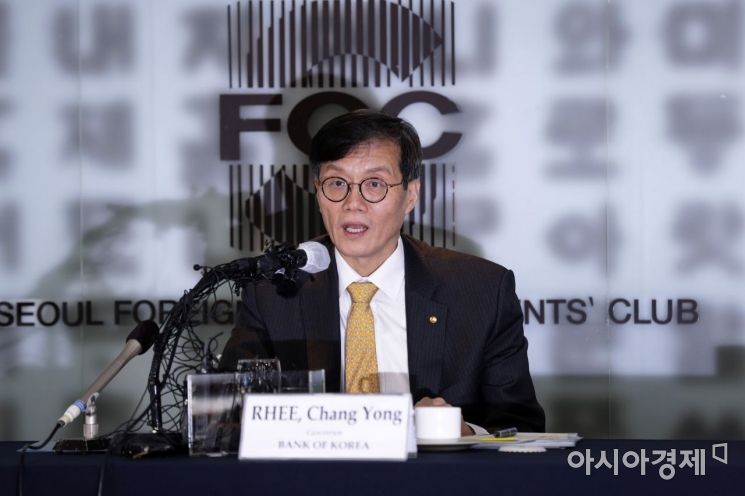 Lee Chang-yong, Governor of the Bank of Korea, is delivering opening remarks at a press briefing held by the Foreign Correspondents' Club on the afternoon of the 18th at the Press Center in Taepyeong-ro, Jung-gu, Seoul. Photo by Joint Press Corps
[Asia Economy Reporter Seo So-jeong] Lee Chang-yong, Governor of the Bank of Korea, forecasted that "this year will be a year in which we must carefully consider the trade-off between inflation and economic and financial stability while focusing on inflation."
At a press conference held by the Seoul Foreign Correspondents' Club at the Press Center in Jung-gu, Seoul, on the afternoon of the 18th, Governor Lee stated, "Last year, we focused on inflation as high inflation above 5% persisted, but this year, we will operate monetary policy delicately by comprehensively considering various policy conditions." He added, "This year, as monetary policies differentiate by country, I believe it will be a year in which the difficulties of monetary policy communication will increase."
Regarding this year's inflation trend, Governor Lee said, "Core inflation, excluding food and energy, is expected to continue slowing down due to increasing downward pressure on the economy, similar to major countries." However, he noted, "The slowdown in Korea's headline inflation may differ from major countries because last year's sharp rise in international oil prices was reflected in the Consumer Price Index (CPI) with a delay."
He explained that while the energy price increase rate, such as electricity and gas charges, exceeded 40% in the Euro area last year, it was only 13% in Korea. Therefore, even if oil prices fall this year compared to last year, Korea's accumulated cost-push pressures may be reflected belatedly in electricity and gas charges this year, causing the headline inflation slowdown to be relatively slower than in major countries.
Governor Lee also anticipated increased communication difficulties related to financial stability. He stated, "There seems to be no short-term risk of problems occurring in the Korean financial system due to debt issues, but it is difficult to rule out the possibility of difficulties arising in the real estate-related sector."
He mentioned, "The financial market related to the real estate market decline and the real estate market itself are likely to face greater difficulties." He added, "Currently, the delinquency rate of real estate loan project financing (PF) we are observing is about 0.6%, whereas during the crisis in 2011, the delinquency rate was close to 15%." He continued, "The household loan delinquency rate was about 2.5% in the past but is now similarly around 0.6%. Although household delinquency rates will naturally rise as real estate prices fall, this is a phenomenon common worldwide." Governor Lee emphasized, "We need to monitor this, and while it may be a difficult time in terms of financial institution soundness, it is not something to exaggerate as a crisis. However, due to the high household debt ratio and structural weaknesses with high dependence on real estate, we will make efforts to achieve a soft landing in the real estate market and contribute to policy together with the government."
Furthermore, Governor Lee identified three hopeful factors for this year: oil price stability, alleviation of hard landing concerns in major countries such as the U.S. and Europe, and the possibility of China's economic normalization. He said, "Oil prices have stabilized compared to last year, broadening the scope for policy maneuvering, and Europe's warm weather has lowered the possibility of a hard landing." He assessed, "The COVID-19 situation in China has eased temporarily, and although it was expected that the Chinese economy would worsen sharply due to a rapid increase, the current progress suggests that the Chinese economy may normalize and economic growth rates may rise in a month or two."
However, he expressed concerns, saying, "If China's economic recovery accelerates, there is a risk of oil prices rising, and local political conflicts could worsen, impacting exports." If oil prices rise due to regional risks, the U.S. CPI will not fall quickly, which would require the U.S. to raise interest rates for a longer period or maintain high rates. He also said, "Although we will manage it, there are concerns about whether the real estate market's soft landing will be properly achieved."
Regarding the Bank of Japan's (BOJ) decision today to hold off on raising interest rates at its policy meeting, Governor Lee said, "The BOJ's decision today may have different views in the market, but it was predictable." He explained, "Haruhiko Kuroda, Governor of the Bank of Japan, has repeatedly stated at various overseas and domestic events in recent weeks that the recent rise in Japanese inflation is not structural, so they will maintain monetary easing policies." Governor Lee added, "I don't know how the market received this, but the Bank of Korea likely anticipated Governor Kuroda's remarks." He continued, "If interest rates rise in April, in principle, as Japan raises rates, Japanese funds that had gone overseas will return domestically, and many countries are paying attention to what impact this will have." He cautiously assessed, "Even if Japan raises rates, the interest rate gap is so large that the impact on capital outflow will likely be limited for the time being. However, this has not happened yet, so we need to observe it afterward."
© The Asia Business Daily(www.asiae.co.kr). All rights reserved.

















