KAIST Research Team
[Asia Economy Reporter Kim Bong-su] Domestic researchers have developed the world's first flash memory that consumes only one ten-thousandth of the power compared to existing models.
The Korea Advanced Institute of Science and Technology (KAIST) announced on the 18th that Professor Jeon Sang-hoon’s research team from the Department of Electrical Engineering has developed the world's first Negative Capacitance Flash Memory (NC-Flash Memory) that surpasses the physical performance limits of existing flash memory by utilizing the Negative Capacitance Effect (NC Effect).
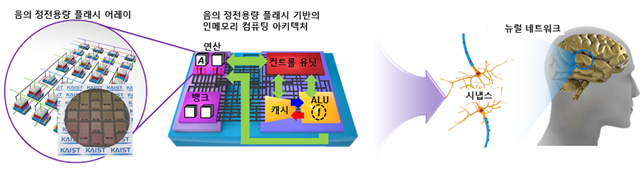 Schematic diagram of a neuromorphic system implementation using high-performance, low-power negative capacitance flash-based in-memory computing. Image courtesy of KAIST.
The Negative Capacitance Effect means that as the applied voltage increases, the amount of charge decreases. When a dielectric with negative capacitance characteristics is used, the voltage applied to the transistor is internally amplified, allowing the use of relatively low operating voltages and thereby reducing power consumption.
In modern electronic devices, capacitors are one of the most important components. As electronic devices become smaller and stacked vertically, the amount of charge (Charge, Q) stored in capacitors decreases, which creates a demand for dielectric materials with high capacitance (Capacitance, C). It has been hypothesized that if capacitors with negative capacitance values (Negative Capacitance) are used, unlike conventional capacitors, the total capacitance of multilayer capacitors can actually be increased, potentially solving the challenge of developing high-capacitance devices suitable for next-generation electronics.
Recently, memory suppliers have been fiercely competing technologically due to the explosive increase in data and demands for higher capacity solid-state drives (SSD) and faster access times. The core technology of storage, 3D NAND flash, continuously requires technology that can stack more layers, and it is expected that by 2028, memory stacking of over 1000 layers will be necessary.
Meanwhile, the Negative Capacitance Effect (NC Effect) observed in ferroelectric materials has the characteristic of internally amplifying the external voltage applied to electronic devices, reducing power consumption, and thus has been suggested as a possibility to overcome the physical performance limits of electronic devices. Although the NC effect has been experimentally observed in perovskite ferroelectrics recently, skepticism has arisen regarding the implementation of electronic devices utilizing the NC effect due to the miniaturization limits of perovskite ferroelectrics and incompatibility with CMOS processes.
The research team stabilized the NC effect of hafnium oxide (HfO2) ferroelectric thin films used in semiconductor processes to develop the world's first ferroelectric NC-flash memory capable of low-voltage operation, overcoming the physical performance limits of existing flash memory and lowering operating voltage. The developed NC-flash memory achieved low power consumption and high performance characteristics with power consumption more than 10,000 times lower than existing flash memory.
Moreover, by implementing in-memory computing based on NC-flash memory, which replaces the conventional von Neumann architecture, the team also achieved world-class energy efficiency.
The research team explained, "It will play a key role in developing next-generation NAND flash memory that meets the demands of modern computing and networking requiring fast storage."
The research was published in the international journal Advanced Functional Materials in December last year.
© The Asia Business Daily(www.asiae.co.kr). All rights reserved.
![From Bar Hostess to Organ Seller to High Society... The Grotesque Con of a "Human Counterfeit" [Slate]](https://cwcontent.asiae.co.kr/asiaresize/183/2026021902243444107_1771435474.jpg)
















