IMF Deputy Managing Director "Economic Improvement in Second Half"
Foreign Media Signal Upward Economic Outlook
German Chancellor "Confident No Recession"
Increased 'Revenge Spending' Expected with China's Reopening
[Asia Economy Reporter Haeyoung Kwon] At the World Economic Forum Annual Meeting (WEF, Davos Forum), which gathers world leaders, businesspeople, and experts, optimism about this year's economy is emerging. Foreign media predicted that the International Monetary Fund (IMF), which had forecast a downward revision of this year's growth rate earlier last month, might revise its economic outlook upward.
On the 17th (local time), major foreign media reported that optimistic views about China's reopening and Europe avoiding a deep recession are spreading at the Davos Forum.
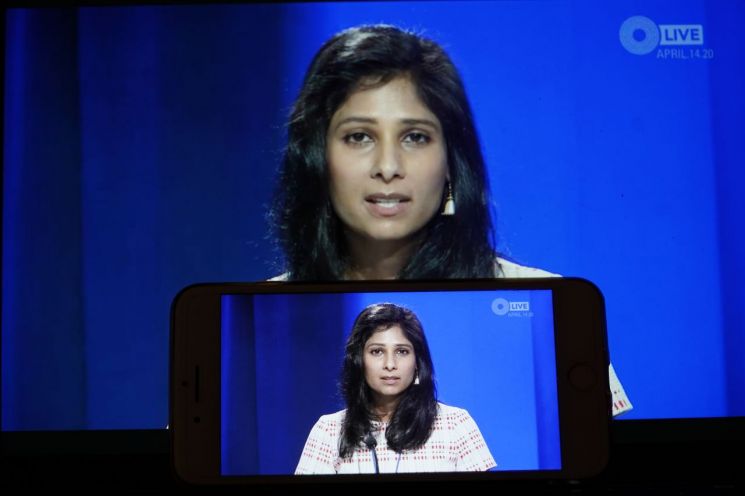
Gita Gopinath, IMF Deputy Managing Director, warned that this year would be a difficult one but predicted that the global economy would "improve" in the second half of this year and next year. Foreign media paid particular attention to her choice of words, describing this year as a 'tough' year rather than a 'tougher' one. One outlet analyzed, "As optimism spreads in Davos, the IMF has sent signals of an upward revision in its (growth rate) forecast," adding, "Positive data from Europe and the U.S. over the past few weeks have raised hopes that the global economy will avoid a recession this year."
Since the beginning of the year, subtle changes have been detected in the IMF's statements. Kristalina Georgieva, IMF Managing Director, said at a New Year's press conference on the 12th, "The global economic slowdown phase will reverse in the second half of this year, probably from the end of this year," and "Next year will show higher growth than this year." Compared to her statement in early December last year that "due to the Ukraine war and simultaneous economic slowdowns in Europe, China, and the U.S., the global growth rate is increasingly likely to fall below 2%," the IMF's outlook shows a positive shift.
German Chancellor Olaf Scholz also emphasized in an interview with Bloomberg held in Davos on the same day, "I am fully confident that Germany will not fall into a recession." On the same day, the European Economic Research Center (ZEW) reported that Germany's January economic sentiment index turned positive at 16.9, marking the first time in 11 months since Russia's invasion of Ukraine that investor sentiment has turned optimistic.
Opinions on China's economy, where COVID-19 is rapidly spreading, are divided. Although China's GDP growth rate fell to the 3% range last year, significantly below the government target of 5.5%, expectations remain high for economic normalization following the transition to 'With COVID-19.' Global companies are already preparing to respond to China's 'revenge consumption.' Alan Jope, CEO of Unilever, said, "Once regulations are eased, consumer purchases in China will surge," adding, "We are preparing for revenge consumption." Bloomberg also published an article highlighting the potential increase in China's revenge consumption. The outlet reported, "Americans have spent 45% of the excess savings accumulated during the pandemic, but the Chinese are just beginning their revenge consumption," and "Many economists expect China to be in the early stages of the economic cycle this year."
The biggest topic at this year's Davos Forum is recession. According to a survey released by consulting firm PricewaterhouseCoopers (PwC) at the opening of the Davos Forum, 73% of global CEOs expect a slowdown in global growth within a year, and 18% of them answered that the possibility of a recession is very high. Despite these gloomy forecasts, cautious optimism is also being raised at Davos that this year's economy may not be as bad as initially feared.
Daniel Pinto, Co-CEO of JP Morgan, positively evaluated the resilience of the global economy, saying, "The world has gone through war, a pandemic, and the largest monetary policy normalization in history. Considering what has happened so far, the situation is much better than expected."
© The Asia Business Daily(www.asiae.co.kr). All rights reserved.

















