US-China Trade Volume Expected to Reach Record High
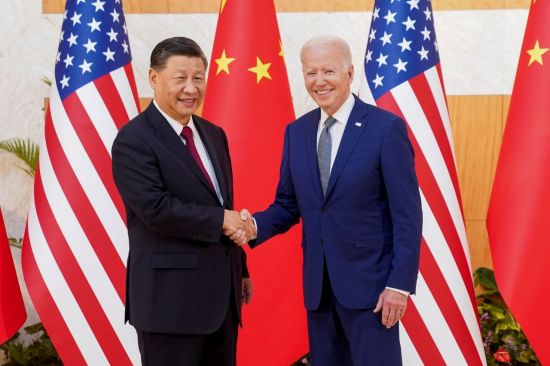 U.S. President Joe Biden (right) and Chinese President Xi Jinping (left). [Image source=Yonhap News]
[Asia Economy Reporter Lee Ji-eun] Last year, the United States attempted to decouple from China amid a power struggle, but forecasts suggest that the actual trade volume between the two countries will reach an all-time high. Despite escalating political and diplomatic disputes, the analysis indicates that the economies of the two countries are so closely connected that achieving decoupling is difficult.
On the 17th (local time), Bloomberg predicted that the US-China trade volume for last year, to be announced in February, will reach or come close to a record high. This prediction is based on data compiled by the US Census Bureau from January to November, combined with the average December trade volume over the past five years. By sector, the US exports to China up to November show that electronic products lead with $10.02 billion (approximately 12.39 trillion KRW). The biotechnology sector and aerospace field follow with $5.08 billion and $4.08 billion, respectively. Bloomberg noted, "It is quite remarkable that these figures have emerged despite the bipartisan consensus in the US on an anti-China diplomatic stance," adding, "This indicates that even as the US counters China's expanding influence, the two countries' economies remain deeply intertwined."
The increase in trade volume is attributed to enhanced economic efficiency between the two countries. David Dollar, a senior fellow in foreign policy at the Brookings Institution, stated, "The reason for these results is that US-China trade is based on economic efficiency and what companies want," adding, "Strict decoupling advocated by Washington politicians would have a significant negative impact on the living standards of the American people."
China also cannot afford to give up trade with the US if it wants to stabilize its citizens' living standards and economic growth. Bloomberg explained that the continuation of US-China trade despite US tariffs on China and semiconductor equipment export restrictions proves this point. On the 17th, Chinese Vice Premier Liu He attended the World Economic Forum Annual Meeting (WEF, Davos Forum) and expressed opposition to "unilateralism and protectionism." This statement criticizes US protectionist and isolationist policies while also addressing perceptions that China is distancing itself from globalization and closing its markets.
Major foreign media outlets expect the expansion of trade volume between the US and China to continue. Bloomberg reported, "Large corporations investing heavily in China indicate they will remain in China for a long time," adding, "Many global companies are still willing to invest funds." Ali Wyne, senior analyst at Eurasia Group, also analyzed, "Rhetoric about decoupling is outpacing reality," and said, "It will be difficult for the US and China to completely sever economic ties."
© The Asia Business Daily(www.asiae.co.kr). All rights reserved.

















