Attention to Alternative Fuels for Natural Gas After the Russia-Ukraine War
"Coal Demand May Increase Further in the Future"
[Asia Economy Reporter Oh Hyung-gil] Although the government and companies are calling for "phasing out coal" to achieve carbon neutrality, the amount South Korea spent on coal imports last year reached an all-time high. This is because, as natural gas prices rose, demand surged for coal, a cheaper and more easily replaceable fuel. Coal prices also soared amid high inflation.
The government has set a goal to reduce the proportion of coal-fired power generation, but there are forecasts that global coal demand may increase in the future.
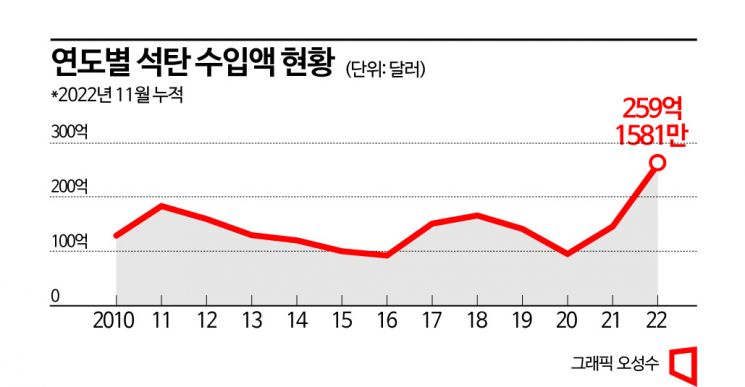
According to the Korea International Trade Association's export-import status, from January to November last year, South Korea's coal import value was $25.915 billion, approaching approximately 32 trillion won. Although December's import value has not yet been tallied, it has already increased by a whopping 78% compared to the previous year's $14.534 billion. With coal import value surpassing $20 billion for the first time, it has far exceeded the previous record high of $18.2 billion set in 2011.
The total coal import volume was 114.34 million tons, similar to the 115.13 million tons in the same period the previous year. Due to raw material-driven inflation, the import value rose relatively sharply.
After the Russia-Ukraine war, sanctions against Russia caused a shortage in natural gas supply, leading to a surge in coal demand as an alternative fuel. Many countries, including South Korea, use coal mostly for electricity consumption (thermal power generation), and recently, the global share of coal-fired power generation has been increasing.
According to a recent report by the Korea National Oil Corporation, global coal power generation increased by 8.5% in 2021 compared to the previous year. This is partly because electricity consumption itself increased as the world emerged from the COVID-19 pandemic. However, the growth rate of coal power generation is 2.9 percentage points higher than the overall electricity generation growth rate (5.6%), indicating that the share of coal power has grown.
The International Energy Agency (IEA) also predicted that global coal consumption would exceed 8 billion tons last year, breaking an all-time record. The IEA stated, "Without stronger efforts to accelerate the transition to clean energy, global coal consumption will maintain a similar growth trend over the next few years," and added, "Coal will remain the largest single source of carbon dioxide emissions in the global energy system."

Bloomberg cited the rapid increase in global coal use as being caused by the surge in electricity demand following the COVID-19 economic recovery, a sharp decline in hydropower due to droughts in Europe, and soaring natural gas prices. It pointed out that these causes are unlikely to be resolved temporarily and will continue to have an effect going forward.
It further noted that considering the intermittent nature of renewable energy generation and the likelihood of prolonged natural gas price increases, coal demand may continue to rise in the future.
The fact that coal is an easily utilizable energy source also supports this outlook. While natural gas requires the development of new gas fields and nuclear power needs new facility investments to increase output, coal can simply be burned more in currently operating thermal power plants.
© The Asia Business Daily(www.asiae.co.kr). All rights reserved.


















