Currently, 'Gonghyeol Animals' Provide Blood Supply
Struggling to Meet Soaring Demand
Movement to Encourage Animal 'Blood Donation Culture'
"Do dogs and cats also receive blood transfusions?"
A man in his 30s who owns a pet was recently surprised when he heard from a friend that they were looking for 'cat blood for transfusion.' Dogs and cats also need external blood supply when they become weak or require surgery, but in Korea, the amount of stored animal blood is low, making it difficult to find.
The man said, "Someday, my cat might fall ill or get into a traffic accident. Then I would have to look for cat blood too." He expressed concern, saying, "Animals have many more blood types than humans, so I worry whether blood can be supplied in time during emergencies."
Although 30% of the entire population raises pets, interest in 'animal blood transfusions' is relatively low. Currently, animal blood in Korea is obtained from 'donor animals' raised for blood collection purposes, but there are concerns that without a proper transfusion network, meeting demand is insufficient.
Animals also need 'emergency transfusions' at times
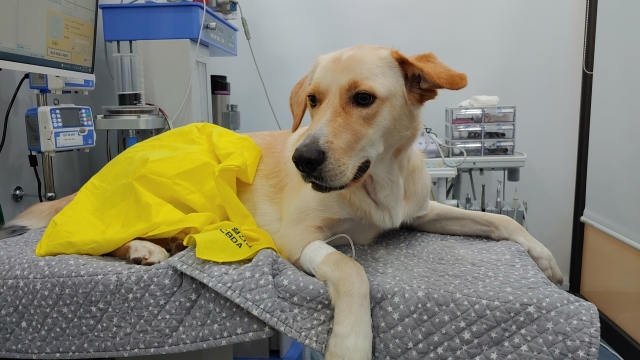 Blood donation dog Raf, number 427 of the Korea Blood Donation Dog Association, is donating blood. / Photo by Korea Blood Donation Dog Association
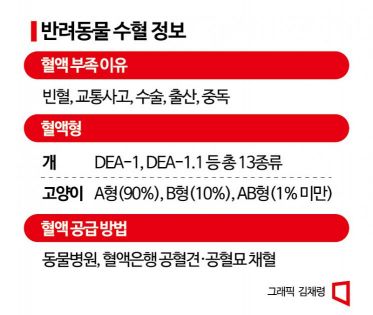
Animals can show symptoms of anemia, lose blood due to accidents, or lose a large amount of blood during childbirth. In fact, dogs can suffer from red blood cell destruction symptoms if they eat certain foods like onions. In such cases, animals need transfusions just like human patients. However, unlike humans, obtaining 'animal blood' is currently very difficult.
First, blood types are an obstacle. Dogs have as many as 13 different blood types, each with varying distribution rates. Cats have three blood types: A, B, and AB, but with an extreme ratio of 90% type A, 10% type B, and less than 1% type AB, making it difficult to store blood of all types.
The methods of obtaining animal blood are also limited. The current Animal Protection Act prohibits drawing blood from ordinary animals, allowing exceptions only for treatment or surgery purposes. Donor animals raised under this legal basis are called 'donor animals.' Currently, donor animals are either raised by animal hospitals themselves or by private organizations such as the 'Korea Animal Blood Bank.'
Donor animals for blood collection: welfare and blood management both insufficient
However, as the number of pets increases, the amount of animal blood needed for surgeries has also rapidly increased. This means that blood banks and some animal hospital donor animals alone cannot meet all the demand. The treatment of donor animals is also problematic.
Currently, there are no legally binding standards for the breeding and blood collection of donor animals. Even if donor dogs and cats are overworked by frequent blood draws, there is a lack of legal grounds to prevent this, and managing the quality of collected blood is also difficult.
In 2019, the National Assembly proposed the 'Humane Animal Blood Collection Act,' which would have the government supervise the welfare and blood collection process of donor animals, but it has not passed the legislative hurdle.
Solving blood supply through 'animal blood donation'
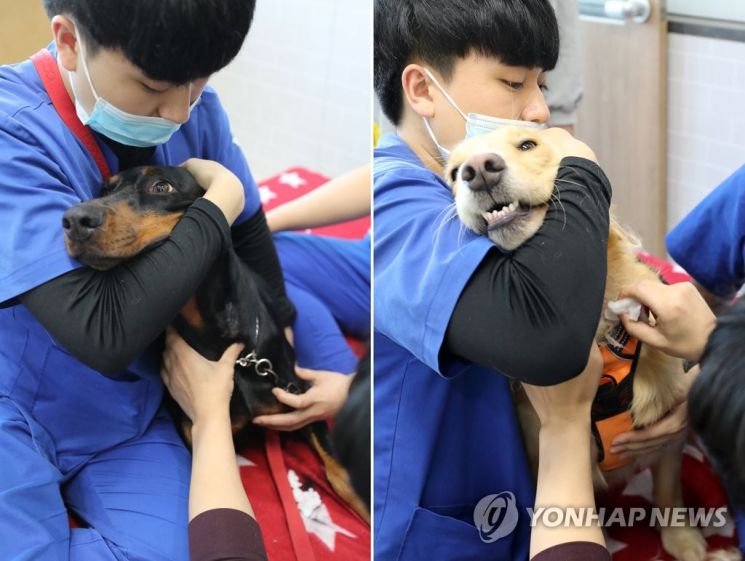 In 2019, blood was drawn from a pet dog participating in a blood donation campaign at the Gwangju Animal Medical Center in Gwangsan-gu, Gwangju. At the time, the campaign was the first pet dog blood donation event held in Honam. / Photo by Yonhap News
So, how can the burden of blood collection on donor animals be reduced while increasing the blood supply? Animal experts suggest 'voluntary blood donation' by pets as a solution. Just as humans regularly donate blood through blood donation organizations, animals can share a little of their blood to build a much smoother transfusion network. Advanced countries with developed pet cultures such as the United States, the United Kingdom, and Australia have already normalized animal blood donation.
Some private organizations and animal protection groups have already established pet blood donation centers. A representative example is the 'KU I'm a Donor Blood Donation Center,' the first domestic pet blood donation center established last year at Konkuk University Animal Hospital.
There are also moves in the political sphere to encourage pet blood donation culture. On the 16th, Min Hong-cheol, a member of the Democratic Party of Korea, introduced the 'Partial Amendment to the Animal Protection Act' as a representative bill. The bill regulates that donor animals cannot have more blood drawn than the standards set by the Ministry of Agriculture, Food and Rural Affairs, and supports the state or local governments in promoting a pet blood donation culture.
Min said, "Unless the prerequisite task of smooth blood supply is resolved, donor animals will be pushed further into legal blind spots," and explained the purpose of the bill, saying, "I hope the amendment will widely raise awareness of the importance and meaning of pet blood donation."
© The Asia Business Daily(www.asiae.co.kr). All rights reserved.
![User Who Sold Erroneously Deposited Bitcoins to Repay Debt and Fund Entertainment... What Did the Supreme Court Decide in 2021? [Legal Issue Check]](https://cwcontent.asiae.co.kr/asiaresize/183/2026020910431234020_1770601391.png)


















