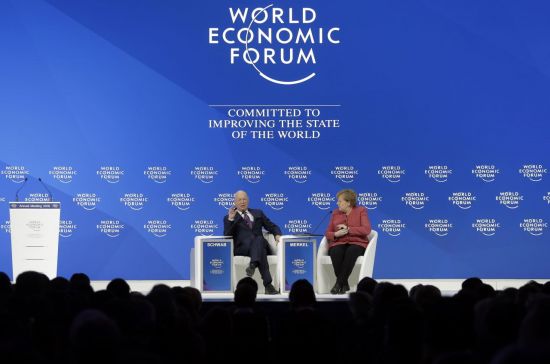
 Klaus Schwab, Founder of the World Economic Forum (WEF), and Angela Merkel, Chancellor of Germany [Image source=AP Yonhap News]
[Asia Economy Reporter Lee Ji-eun] The World Economic Forum (WEF, also known as the Davos Forum), where political and economic leaders from around the globe gather to discuss international issues, opened on the 16th (local time). The event organizers released survey results containing a pessimistic outlook on the global economy.
On the same day, the Davos Forum published a report based on a survey of 50 economists from both the private and public sectors. According to the report, two-thirds of the economists expect a global recession this year. Among them, 18% responded that the likelihood of entering a recession phase is extremely high. The report explained that the recession here refers to a stagflation phenomenon, where the economy contracts due to an economic downturn while prices continue to rise.
The economists also presented pessimistic economic forecasts by region. In Europe, all 50 scholars predicted low economic growth this year, while 91% of respondents in the United States forecast low growth. This is a higher percentage compared to the same interview conducted at the Davos Forum in September last year. At that time, 86% of experts expected a recession in Europe, and 64% did so for the United States.
Furthermore, experts predicted that inflation would persist globally this year as well. In particular, more than half of the respondents (57%) forecast that high prices would continue throughout the year in Europe. The United States and South Asia recorded lower response rates of 24% and 33%, respectively, for continued high prices compared to Europe. China (5%) and East Asia-Pacific countries (16%) also had fewer respondents predicting soaring prices than other regions.
Following this, economists anticipated that countries worldwide would maintain monetary tightening policies this year as inflation continues. The response rates forecasting tightening in Europe and the United States were 59% and 55%, respectively.
In line with these forecasts, the market is expressing concerns about the business environment for companies this year. A global consulting firm, PricewaterhouseCoopers (PwC), conducted a survey at the end of last year targeting 4,410 CEOs worldwide. Seventy-three percent of CEOs expected global economic growth to slow over the next 12 months. Additionally, 40% of respondents said that if they maintain their current management approach, their companies might go bankrupt within 10 years. This is the most pessimistic response rate since PwC began the survey in 2011.
CEO confidence in corporate growth potential also recorded its lowest level since the 2008 global financial crisis. Business leaders identified three major economic crisis factors this year: rising prices, macroeconomic volatility, and geopolitical conflicts. Bob Moritz, Chairman of PwC, explained, "The Russia-Ukraine war, conflicts in the Middle East and Iran, and the U.S. Inflation Reduction Act are among the geopolitical crisis factors," adding, "Geopolitical threats are not limited to threats from Russia and China."
Meanwhile, key leaders such as U.S. President Joe Biden and Chinese President Xi Jinping, the heads of the G2, as well as leaders of the G7, have consecutively declined to attend this year's Davos Forum annual meeting. With the absence of leaders who should discuss geopolitical crises like the Russia-Ukraine war and economic recessions, there are forecasts that the event will be a half-hearted affair.
© The Asia Business Daily(www.asiae.co.kr). All rights reserved.

















