MOU for Battery Business Cooperation in North America
Joint Investment in ESS Battery Factory
United for Green Power Industry in the US
[Asia Economy Reporter Donghoon Jeong] LG and Hanwha have pledged collaboration in the battery sector. Industry attention is focused on the synergy between the two companies, which respectively produce batteries as storage devices and solar modules that generate electricity during this era of energy transition.
On the 17th, three Hanwha companies (Hanwha Solutions Q CELLS Division (Hanwha Q CELLS), Hanwha Corporation Momentum Division (Hanwha Momentum), and Hanwha Aerospace) and LG Energy Solution signed a memorandum of understanding (MOU) the previous day for business cooperation related to battery businesses such as energy storage system (ESS) projects. The two companies agreed to pursue comprehensive cooperation to target the future battery market. They will jointly invest in establishing battery production lines in the U.S., where the eco-friendly energy market is rapidly growing due to the Inflation Reduction Act (IRA). They also plan to secure a leading position in the energy storage system market and expand applications to future new growth businesses such as UAM (Urban Air Mobility).
The two companies plan to jointly participate in North American eco-friendly power generation projects by leveraging ESS batteries and solar modules. Eco-friendly energy sources like solar power face intermittency issues due to inconsistent power generation, making ESS batteries essential. Power generated during daylight hours must be stored and transmitted stably.
North America is expected to see explosive growth in eco-friendly power generation projects. The IRA includes an investment tax credit (ITC) that deducts 30% of the investment amount for renewable energy facilities and technology investments. For example, investing 10 billion KRW would return 3 billion KRW in tax credits alone. These benefits will continue until 2030. Such unprecedented tax credit incentives create an environment where massive investment funds will flow into the eco-friendly energy industry. Additionally, subsidies are provided for each battery module produced ($45 per 1 kWh) and solar module produced ($70 per 1 kW), so the subsidy benefits that the two companies, which are actively expanding new factories in North America, will receive are expected to reach trillions of KRW.
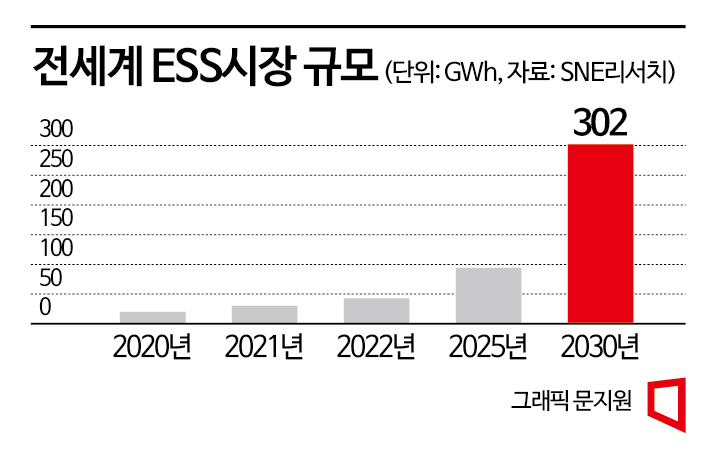
According to market research firm SNE Research, the global ESS market size recorded 20 GWh in 2020, 30 GWh in 2021, and 43 GWh last year. It is expected to grow at an average annual rate of 35% to reach 302 GWh by 2030. Looking only at the U.S. market, it is expected to grow more than ninefold from 9 GWh last year to 95 GWh in 2031 (equivalent to the amount of electricity used daily by about 40 million people in Korea).
The collaboration with Hanwha also marks LG Energy Solution’s ‘starting signal’ to fully enter the LFP (Lithium Iron Phosphate) battery sector. LFP batteries are chemically more stable than ternary batteries, making them less prone to fire, longer-lasting, and cheaper. However, due to their lower energy density, they have not been adopted for electric vehicle batteries as they make it difficult to extend driving range.
However, the consensus is that LFP batteries are more suitable for ESS, which requires storing large amounts of energy, increasing fire risk, and needing long battery life without replacement. LG Energy Solution plans to produce LFP batteries for the first time in China next year targeting the ESS market and to produce LFP batteries in Michigan, USA, in 2024. They also intend to jointly invest with Hanwha to establish a new ESS battery factory, likely adopting LFP batteries. An LG Energy Solution official said, "The battery business is broadly divided into automotive batteries, small batteries, and ESS, but so far, collaboration has mainly focused on electric vehicles. We see ESS as a large market, and this collaboration means securing a significant demand base."
© The Asia Business Daily(www.asiae.co.kr). All rights reserved.
!["The Woman Who Threw Herself into the Water Clutching a Stolen Dior Bag"...A Grotesque Success Story That Shakes the Korean Psyche [Slate]](https://cwcontent.asiae.co.kr/asiaresize/183/2026021902243444107_1771435474.jpg)
















