Democratic Party "Bill Passed According to National Assembly Act,
Chairman Unilaterally Referred It"
People Power Party "Opposition's Unreasonable Claims, Provoking Disruption"
[Asia Economy Reporter Oh Ju-yeon] On the 16th, the ruling and opposition parties clashed over the referral of the "Grain Management Act Amendment" to the Legislative and Judiciary Committee's Subcommittee No. 2, ultimately resulting in a breakdown. Although there was a verbal confrontation in the morning over the Democratic Party's re-discussion of the Grain Management Act, which had been directly referred to the plenary session, at the Legislative and Judiciary Committee, later, Chairman Kim Do-eup of the committee unilaterally tabled the bill to the committee and referred it to Subcommittee No. 2. This led to strong opposition from Democratic Party members, who gathered and then left the meeting.
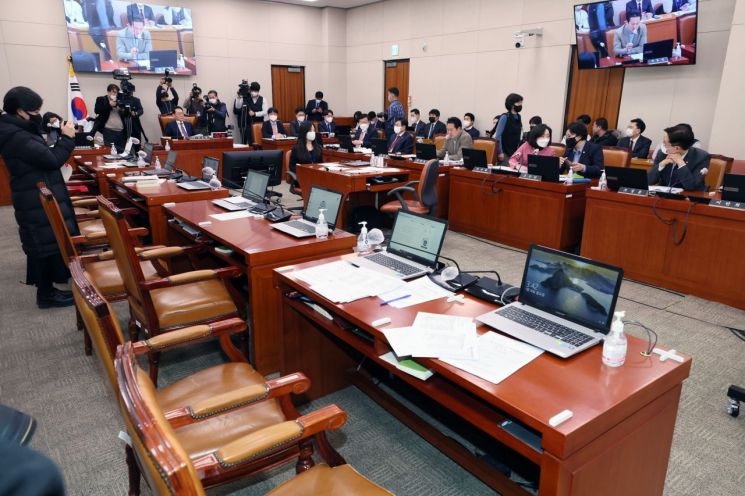
On that day, Chairman Kim, at the full meeting of the Legislative and Judiciary Committee held at the National Assembly, unilaterally tabled the Grain Management Act and referred it to the Bill Review Subcommittee No. 2. At the resumed afternoon meeting, the Democratic Party demanded an apology, stating, "Chairman Kim unilaterally referred the Grain Management Act to the subcommittee."
Gi Dong-min, the opposition party's secretary of the Legislative and Judiciary Committee and a Democratic Party member, pointed out, "If it is referred to Subcommittee No. 2, based on past precedent, it will completely fall into a swamp, making proper deliberation difficult." He added, "At least if it remains pending in the full committee, there is a basis for continuous discussion," emphasizing, "Not only the Grain Management Act but also various issues including the Broadcasting Act and the Nursing Act should be prevented from being passed to Subcommittee No. 2 in advance."
He continued, "If there is a disagreement, naturally, the chairman should ask the members how to handle it and make a judgment," criticizing, "Despite raising issues, deciding unilaterally to refer and then adjourning makes those who raised the issues look ridiculous."
Kim Eui-gyeom, a member of the same party, criticized, "There are differences of opinion between the ruling and opposition parties and clear differences in views on handling this issue, but if the chairman unilaterally decides and leaves pretending not to hear our protests, how can our committee trust and follow the chairman in the future?"
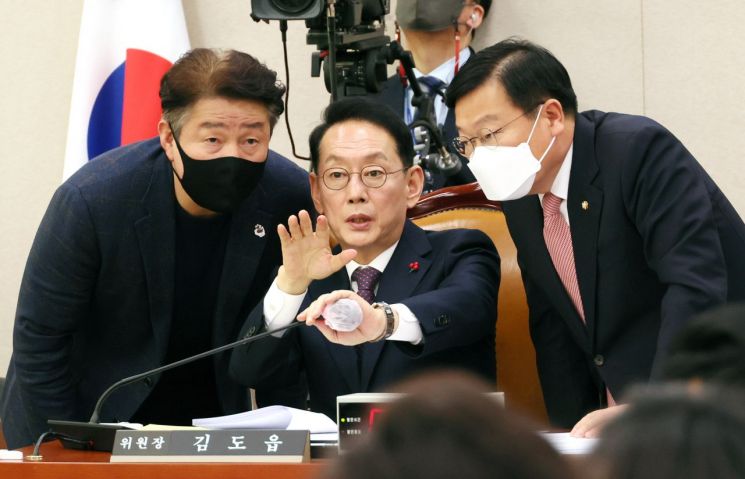
On the other hand, the People Power Party argued that the chairman's referral of the bill to the subcommittee does not require a vote.
Jeong Jeom-sik, the ruling party's secretary, explained, "There is no separate regulation requiring committee approval when referring an agenda to a subcommittee." He added, "The past practice of the Legislative and Judiciary Committee has been to refer all bills to the subcommittee if even one member suggests it," and rebutted, "Regarding the Grain Management Act, our party members proposed referral to the subcommittee, so it was referred accordingly. Therefore, there is no difference from the past operation practices of the Legislative and Judiciary Committee."
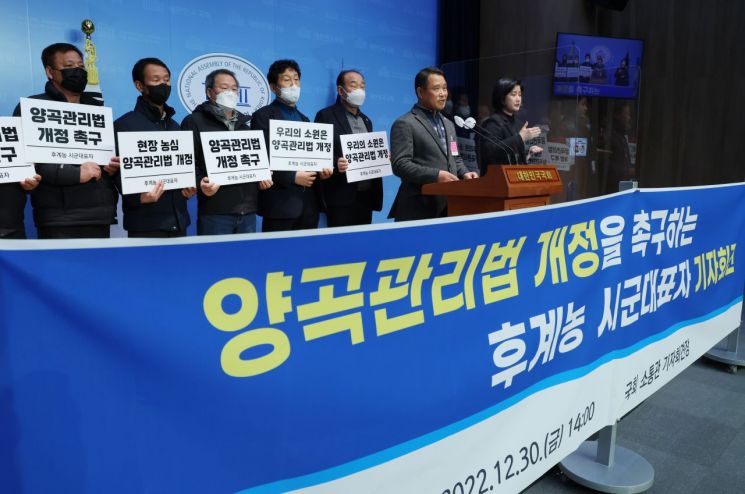
Afterward, Democratic Party members held a press conference at the National Assembly Communication Office after leaving the committee chairman, claiming that the "referral of the Grain Management Act Amendment to the Legislative and Judiciary Committee's Subcommittee No. 2" is "null and void."
Representative Gi criticized, "Today, Chairman Kim Do-eup unilaterally tabled the partial amendment to the Grain Management Act and, contrary to the initial promise to ask members' opinions, referred it to Subcommittee No. 2 despite the majority opposing."
He pointed out, "On December 28 last year, the National Assembly's Agriculture, Food, Rural Affairs, Oceans and Fisheries Committee resolved to request the plenary session to consider the alternative to the Grain Management Act Amendment. Since it was referred to the Legislative and Judiciary Committee but not even tabled for over 60 days due to the ruling party's opposition, the plenary session request was lawfully made under Article 86, Paragraph 3 of the National Assembly Act," and criticized, "According to the National Assembly Act, when there is a request for plenary session consideration of an amendment, the Speaker must agree with the leaders of each negotiation group within 30 days to submit it to the plenary. The People Power Party's claim that it is pending in the Legislative and Judiciary Committee is merely a formal argument."
He continued, "Before today's meeting, the People Power Party restricted the tabling of six amendments, including the Grain Management Act Amendment, the Nursing Act, and the Medical Act, which the National Assembly Welfare Committee urged for expedited processing, as well as three amendments related to the Broadcasting Act for improving the governance of public broadcasters like KBS and MBC under the Science, ICT, Broadcasting and Communications Committee. Ultimately, this is to prevent second and third versions of the Grain Management Act," emphasizing, "Opposition to mandatory market isolation for rice price stabilization is just a pretense."
Earlier that morning, the Democratic Party expressed regret that the Grain Management Act, which had already passed the relevant standing committee, was re-submitted to the Legislative and Judiciary Committee, while the People Power Party strongly countered by pointing out procedural and substantive contradictions in the Grain Management Act.
Representative Gi said, "I cannot understand that the chairman unilaterally tabled the Grain Management Act despite no agreement between the ruling and opposition secretaries," and criticized, "It has been 60 days since the standing committee approved it, yet the Legislative and Judiciary Committee tabled it without special reasons. There is no clear legal basis, so I cannot accept or understand why they are now discussing the Grain Management Act at the full committee."
According to the National Assembly Act, if a specific bill is pending in the Legislative and Judiciary Committee for 60 days without discussion, even without bipartisan agreement, if more than three-fifths of the standing committee members approve, it can be submitted to the plenary session. At the end of last year, the Democratic Party unilaterally passed a motion at the Agriculture, Food, Rural Affairs, Oceans and Fisheries Committee to bypass the Legislative and Judiciary Committee and directly refer the Grain Management Act Amendment to the plenary session. Of the 19 total members, 12 voted in favor and 7 abstained; at that time, independent lawmaker Yoon Mi-hyang, formerly of the Democratic Party, joined to meet the quorum. The People Power Party criticized this mobilization of Yoon as a "trick" with all members abstaining.
Democratic Party lawmakers showed discomfort from the morning over the re-discussion of the Grain Management Act, which had passed the Agriculture, Food, Rural Affairs, Oceans and Fisheries Committee, at the Legislative and Judiciary Committee, emphasizing the National Assembly Act. Representative Kim Seung-won said, "The Grain Management Act is a bill that the relevant standing committee resolved to submit to the plenary session," and criticized, "Suddenly, the chairman unilaterally tabled it, which does not violate the National Assembly Act but goes against the purpose of the amendment."
However, the People Power Party rebutted by pointing out procedural problems and substantive defects in the Grain Management Act's passage through the standing committee.
Jeong Jeom-sik said, "The bill itself is still pending in the Legislative and Judiciary Committee," and added, "Until the Speaker decides whether to directly submit it to the plenary session, there is still a legal basis for the Legislative and Judiciary Committee to review it."
His party colleague Cho Su-jin said, "There were serious procedural defects when it passed the standing committee," recalling that independent lawmaker Yoon Mi-hyang supported the motion at the Agriculture, Food, Rural Affairs, Oceans and Fisheries Committee. Cho criticized, "To meet the three-fifths quorum for direct referral to the plenary session, they used a 'nominal independent' member as a trick."
The Grain Management Act Amendment mandates that the government compulsorily purchase rice if the rice price falls by more than 5% or if the excess production exceeds 3% of rice demand. The Democratic Party has pushed this as party policy to stabilize rice prices and unilaterally passed it at the Agriculture, Food, Rural Affairs, Oceans and Fisheries Committee at the end of last year. However, the government and ruling party oppose it, arguing that compulsory rice purchases would require billions of won in annual taxes and could encourage overproduction of rice.
© The Asia Business Daily(www.asiae.co.kr). All rights reserved.
![Clutching a Stolen Dior Bag, Saying "I Hate Being Poor but Real"... The Grotesque Con of a "Human Knockoff" [Slate]](https://cwcontent.asiae.co.kr/asiaresize/183/2026021902243444107_1771435474.jpg)


















