Hanbok 'Voluminous Two-Piece'... Hanfu 'Slim One-Piece'
Differences in Silhouette, Production Techniques, and Fabrics
[Asia Economy Reporter Yoon Seul-gi] It has become controversial after it was revealed that a famous domestic online shopping mall introduced Korea's traditional clothing, Hanbok, as the Chinese traditional garment Hanfu (漢服) and sold it as such. Since Hanbok and Hanfu have distinctly different historical roots and clothing characteristics, there are calls for careful labeling.
According to Professor Seo Kyung-deok of Sungshin Women's University on the 16th, an investigation of over 30 major domestic online shopping malls found numerous cases where Hanbok was introduced and sold as "Chinese Hanbok Hanfu" on open markets such as Coupang, Tmon, Interpark, Gmarket, Auction, 11st, Naver Shopping, and Daum Shoppinghow. Some even sold Hanfu as "Tang Dynasty style Hanbok."
Professor Seo urged correction, warning that such situations could provide a pretext for China's "cultural engineering." He pointed out, "China is making unfounded claims that our Hanbok originated from Hanfu," adding, "Since Hanbok and Hanfu are different garments, they must be clearly distinguished when sold."

Since 2020, China has repeatedly claimed that Hanbok was influenced by Hanfu, the clothing of the Han ethnic group. There have even been cases where Hanbok was mistakenly identified as Hanfu. In February last year, the famous American fashion magazine Vogue stirred controversy by introducing Hanbok as Hanfu on its official Instagram account, stating, "Hanfu is one of the historical clothing styles from the era when the Han ethnic group ruled."
However, Hanbok and Hanfu are distinctly different garments. According to the paper "A Study on the Differences between Hanbok and Hanfu" (2022 / Kim Ji-su & Na Young-joo), Hanbok is a two-piece consisting of a skirt and a jeogori (jacket), characterized by layering pants and underskirts to create an overall voluminous bell-shaped silhouette.
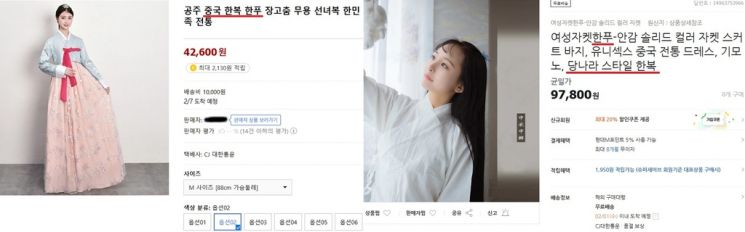 Error in the introduction of Hanbok on a major domestic shopping mall. Photo by Yonhap News, Facebook of Professor Seokyung Deok, Sungshin Women's University
On the other hand, Hanfu is a wrap-around one-piece style that forms a slim silhouette. It is often worn by wrapping one or two garments around the body, resulting in a straight shape that reveals the body's curves.
Because the clothing styles differ, the pattern drafting methods and sewing techniques are also different. Hanbok requires advanced sewing skills due to the many goreum (ribbons), whereas Hanfu is worn by wrapping the garment itself without goreum.
The fabrics used also differ. Hanbok often uses relatively stiff or high-density Shandong silk, ramie, and thick fabrics to achieve fullness. Hanfu mainly uses relatively thin, low-density China silk plain weave fabrics with good drape that flow naturally. Additionally, when wearing Hanbok, various colored waistbands symbolizing social status are worn, and unmarried men and women must wear daenggi (ribbons) in their hair, but this is not the case with Hanfu.
© The Asia Business Daily(www.asiae.co.kr). All rights reserved.


















