Traffic Violation Fine Notices and More
Public Institution Impersonation Text Scams Surge
"Do Not Click on URLs from Unknown Sources"
[Asia Economy Reporter Seongpil Jo] The National Police Agency, Ministry of Science and ICT, and Financial Services Commission urged on the 16th to be cautious of text message scams (smishing) disguised as parcel delivery and traffic violation fine notices, as well as messenger phishing disguised as holiday greetings from acquaintances ahead of the Lunar New Year holiday. They especially emphasized not to click on unclear internet addresses (URLs) or phone numbers included in texts impersonating parcel tracking, holiday greetings, mobile gift certificates, transportation tickets, performance tickets giveaways, or messages pretending to be from acquaintances.
Smishing refers to a method where text messages containing malicious app addresses are sent to induce users to install malicious apps or make phone calls. During the holiday period when parcel deliveries surge due to gift shipments, text scams disguised as parcel delivery messages also increase significantly.
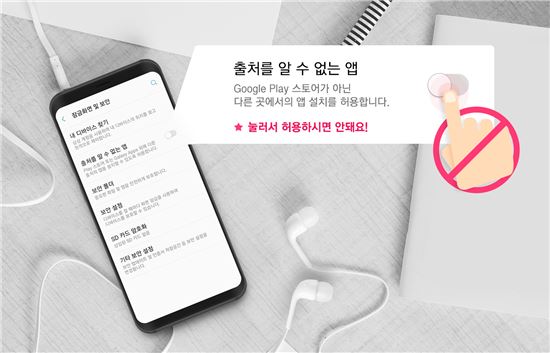 For smartphones using the Android operating system, to prevent smishing, the security settings should be configured to set 'Unknown sources' to 'Do not allow'.
According to the police, last year, text scams impersonating parcel delivery and public institutions such as traffic violation fine notices accounted for 51.8% and 47.8%, respectively. Unlike the previous year when parcel impersonation accounted for 86.9% of all cases, there has been an increase in text scams impersonating public institutions such as traffic violation notices. The police expect such traffic violation impersonation text scams to become rampant during the Lunar New Year holiday when long-distance travel is common.
The police explained that recently, a type of text scam has been continuously discovered where after sending parcel delivery-related texts, scammers induce messenger conversations via apps like KakaoTalk, impersonating parcel delivery workers. Messenger phishing damage is also on the rise, where scammers claim to be family or acquaintances through messenger apps and demand money or gift certificates by citing urgent situations such as phone malfunctions or credit card theft/loss.
A government official said, "If you click on an unclear link and install a malicious app or remote control app, control of your phone can be taken over, and information stored on electronic devices can be stolen." They added, "You can suffer significant financial damage such as unauthorized bank transfers and small payments, so do not comply with the other party's demands until you verify them accurately through phone calls or video calls." The official also emphasized the importance of strengthening smartphone security settings to prevent installation of unknown apps and installing apps through authorized open markets rather than links in messages when downloads are necessary.
The government plans to establish a 24-hour safety response system in cooperation with related ministries during the Lunar New Year holiday and focus on monitoring text scams and cracking down on cybercrime. The National Police Agency provides cybercrime prevention guidelines and damage alerts through its website and the mobile app 'CyberCop.' They also plan to strengthen crackdowns on malicious cybercrimes occurring before and after the holiday period.
A police official urged, "If you suffer cybercrime damage, please report it using the Cybercrime Reporting System (ECRM)." If you receive suspicious scam texts or suspect malicious app infections during the holiday, you can report to the 118 Counseling Center without an area code and receive free 24-hour consultation.
© The Asia Business Daily(www.asiae.co.kr). All rights reserved.
![Clutching a Stolen Dior Bag, Saying "I Hate Being Poor but Real"... The Grotesque Con of a "Human Knockoff" [Slate]](https://cwcontent.asiae.co.kr/asiaresize/183/2026021902243444107_1771435474.jpg)










