WSJ "A Challenging Year Ahead Due to Increased Regulation"
[Asia Economy Reporter Yujin Cho] Google and Meta, which had established monopolistic systems in the U.S. search engine and social media markets respectively, saw their market shares fall below 50% for the first time in eight years. The big tech industry, whose monopolistic systems have collapsed, shifted to austerity management for the first time in decades due to the economic recession that began last year. Amid sluggish core business performance and worsening external conditions, global antitrust regulatory movements targeting these companies are spreading worldwide, leading to forecasts that this year will be the most challenging year for the big tech industry.
On the 15th (local time), the Wall Street Journal (WSJ), citing research firm Insider Intelligence, reported that Google and Meta's market shares in the U.S. digital advertising market fell below 50% for the first time since 2014. This is attributed to the rapid growth of emerging companies like China's ByteDance's TikTok, which have taken market share in the digital market.
Big tech companies experienced rapid expansion and soaring performance for two years starting in 2020, riding the COVID-19 pandemic. As non-face-to-face consumption expanded, advertising demand concentrated online, causing core business revenues of big tech firms to surge and their scale to grow rapidly. However, the economic recession that began last year dealt a direct blow to product sales and online advertising revenue.
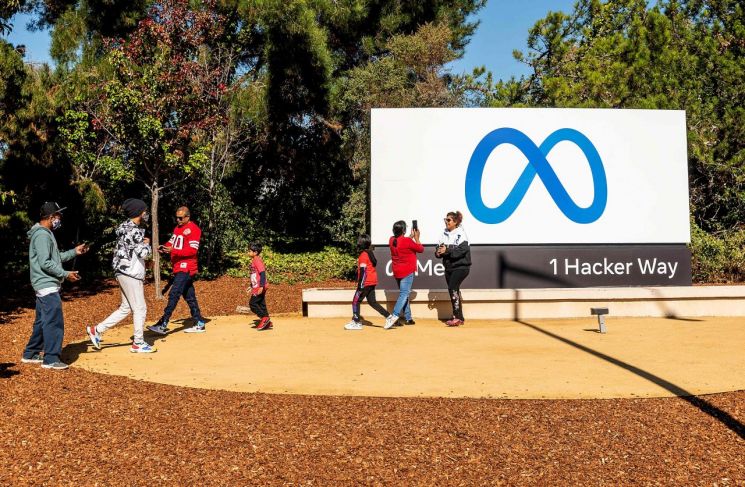
Facing growth stagnation, big tech companies are tightening the reins on workforce reductions and cost-cutting. Amazon announced plans to cut 18,000 jobs earlier this year, and Alphabet, Google's parent company, decided to lay off 15% of employees at its healthcare subsidiary Verily. Meta reduced about 13% of its total workforce through intensive restructuring last year. According to Layoffs.fyi, a site that tracks layoffs in tech companies, the scale of layoffs in tech firms last year reached 170,000.
Wedbush Securities analyst Dan Ives said, "The era when big tech could easily make money is over," describing it as a difficult period akin to a 'top 5-grade storm.' He added, "Tech companies that used to spend money like rock stars in the 1980s are now spending like elderly people within fixed budgets."
There are also forecasts that the layoffs continuing since last year will be the prelude to even more severe restructuring. The prolonged Russia-Ukraine war, ongoing global inflation, and interest rate hikes are hampering the world economy.
In particular, the global 'regulatory crossfire' aimed at curbing big tech's monopolistic power is expected to be the biggest challenge this year. In the U.S., President Joe Biden has taken the lead in urging bipartisan cooperation to prepare reform and regulatory bills for big tech. With the House of Representatives, which holds legislative and budgetary authority, shifting to Republican control this year, concerns have arisen that major big tech regulatory bills previously pursued may be stalled, prompting an acceleration of regulatory pressure.
In Congress and political circles, antitrust package bills that prohibit preferential treatment of their own services on platforms operated by big tech companies such as Google, Apple, Amazon, Meta, and Microsoft (MS), as well as the '21st Century Antitrust Act' aimed at blocking mergers and acquisitions (M&A) attempts to exert dominant power or eliminate competitors in specific markets, are being pushed simultaneously. However, debates over the scope and level of regulation continue, and these bills remain stalled without passing the congressional hurdle.
WSJ is focusing on regulatory strengthening originating from Europe this year. EU regulators plan to intensify their offensive against big tech's anti-competitive behavior and content management through the Digital Markets Act (DMA) and Digital Services Act (DSA), which were passed last year. Leading big tech companies Apple and Meta have faced hefty fines in Europe since the beginning of the year. Apple was fined 8 million euros (about 10.8 billion KRW) by France's data protection authority, the Commission Nationale de l'Informatique et des Libert?s (CNIL), on the 4th for using some iPhone operating systems to utilize personal data for advertising without user consent. Meta was also fined 390 million euros (about 530 billion KRW) by the European Union (EU) for its use of user data in targeted advertising.
Particularly threatening is Germany, which is regarded as having a more robust legal framework for antitrust regulation than the U.S. and the U.K., and is gearing up big tech regulation with new legislation. Foreign media have warned that Germany's Competition Act Section 19a, effective since January 2021, could be stronger than the EU's DMA and DSA. WSJ predicts that the EU's recent measures could spread to other countries considering similar legislation, such as India, leading to a broader trend of regulatory strengthening against big tech.
© The Asia Business Daily(www.asiae.co.kr). All rights reserved.
![Clutching a Stolen Dior Bag, Saying "I Hate Being Poor but Real"... The Grotesque Con of a "Human Knockoff" [Slate]](https://cwcontent.asiae.co.kr/asiaresize/183/2026021902243444107_1771435474.jpg)











