[Asia Economy Reporter Yuri Choi] Kakao Mobility announced on the 16th that it has opened a research center called ‘Nemo Garage (Next Mobility Garage)’ in Dangsan-dong, Yeongdeungpo-gu, Seoul, for future mobility research and digital twin construction.
Kakao Mobility has gathered the hardware research facilities and personnel necessary for autonomous mobility research and digital twin construction into Nemo Garage to establish an ‘in-house factory.’ Moving beyond focusing solely on platform technology development, the company is expanding its research scope to hardware development for future mobility and infrastructure.
Nemo Garage spans six floors with a total area of 2,734㎡. It includes a maker space equipped with 3D printing farms, printed circuit board (PCB) printers, and reverse engineering scanners for hardware prototyping and component manufacturing; its own data storage infrastructure to enhance data security and reduce service implementation time; and a digital twin factory capable of comprehensive digital twin solution development from data acquisition to updates. It also features a testbed for performance testing of autonomous vehicles and mapping robots for map construction, verification of indoor-outdoor hybrid positioning technology, and sensor calibration. This setup allows all processes from design to prototyping and verification to be conducted in one place.
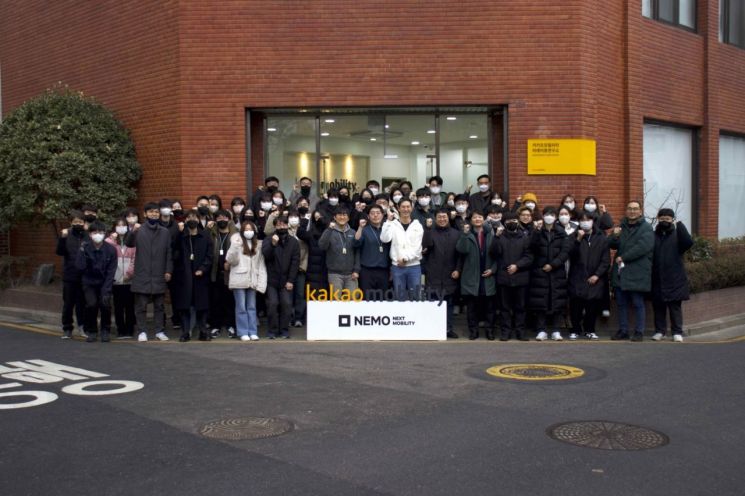 Kakao Mobility employees participating in the opening ceremony of Nemo Garage
 Photo by Kakao Mobility
Teams under Kakao Mobility’s Future Mobility Research Center are stationed at Nemo Garage to study various mobility devices that can be integrated into the Kakao T platform. They also conduct technology development and business collaborations for digital twin production. Notably, they have established a foundation to independently manufacture the mobile mapping system (MMS) equipment ‘ARGOS’ optimized for different required environments to build high-precision maps.
Kakao Mobility plans to research smart mobility infrastructure technologies such as edge infrastructure, vehicle-to-everything (V2X) communication, autonomous parking, infrastructure-based autonomous driving, and robotics through Nemo Garage. In the long term, the research scope will expand to developing smart mobility vehicles such as purpose-built mobility vehicles (PBV) and software-defined vehicles (SDV).
Jang Sung-wook, head of Kakao Mobility’s Future Mobility Research Center, said, “We have secured the first dedicated research center specializing in autonomous driving and digital twin technology among platform companies. We will strive to expand global opportunities through bold and active investment in future mobility technologies and digital twins.”
© The Asia Business Daily(www.asiae.co.kr). All rights reserved.
![Clutching a Stolen Dior Bag, Saying "I Hate Being Poor but Real"... The Grotesque Con of a "Human Knockoff" [Slate]](https://cwcontent.asiae.co.kr/asiaresize/183/2026021902243444107_1771435474.jpg)











