Bank of Korea's First Ever 7 Consecutive Rate Hikes
Between Inflation War and Recession Defense
3 Monetary Policy Committee Members Favor Final Rate at 3.5%
Other 3 Members Open to 3.75% Possibility
Timing of Rate Cut Also in Focus
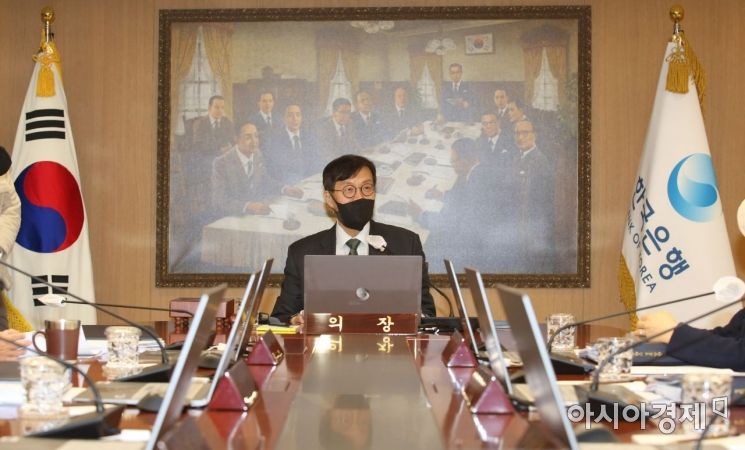 Lee Chang-yong, Governor of the Bank of Korea, is presiding over the first Monetary Policy Committee meeting of 2023 held at the Bank of Korea in Jung-gu, Seoul on the 13th. Photo by Joint Press Corps
[Asia Economy reporters Seo So-jeong and Moon Je-won] On the 13th, as the Bank of Korea raised the base interest rate by 0.25 percentage points at the Monetary Policy Committee meeting, market attention is rapidly shifting to the final interest rate and the timing of rate cuts. With the rate hike trend entering its final stage, the key question is whether the Bank of Korea will stop raising rates at 3.5% this month or make one more additional hike to conclude the rate hike cycle at 3.75%.
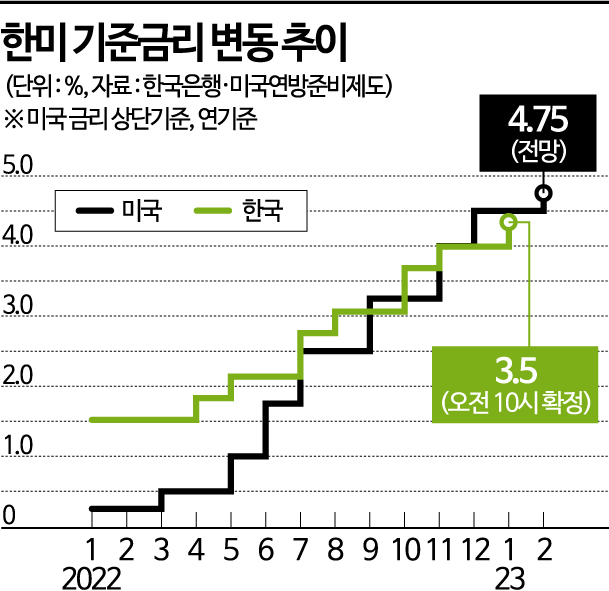
At the monetary policy direction decision meeting held that day, the Bank of Korea's Monetary Policy Committee raised the base rate from 3.25% to 3.50% per annum. Last year, the base rate was raised by 0.25 percentage points each in January, April, and May; by 0.50 percentage points in July; 0.25 percentage points in August; 0.50 percentage points in October; 0.25 percentage points in November; and with this month's additional hike, it has returned to 3.5% for the first time in 14 years and 1 month since December 2008.
The Bank of Korea's first monetary policy meeting this year marked the first-ever seventh consecutive rate hike due to persistent inflation expectations (price rise) pressure. Governor Lee Chang-yong emphasized, "Consumer price inflation is expected to be around 5% in January and February," adding, "Although domestic economic growth is expected to be lower than the November forecast (1.7%), inflation is expected to continue rising above the target level (2%), so it is necessary to focus on price stability and maintain a tightening stance." However, Governor Lee also stated, "We will carefully examine downside risks to growth, financial stability risks, the effects of past rate hikes, the pace of inflation slowdown, and changes in major countries' monetary policies to determine the necessity of further hikes."
◆ Inflation → Shift of Weight to Economic Slowdown and Real Estate Market = Market attention is now on the final interest rate and the timing of rate cuts. Although the high inflation rate above 5% remains a burden, the recent stabilization of the won-dollar exchange rate and international oil prices, along with a slight decline in expected inflation rates for the next year, have raised the possibility of shifting the focus of monetary policy toward economic slowdown and the real estate market.
Experts' views on the final interest rate are evenly split between 3.5% and 3.75%. Due to the continuation of high inflation until early this year, the Bank of Korea raised rates this month, but from next month, it is necessary to review the effects of past hikes while simultaneously monitoring price stability and the intensity of domestic economic slowdown. Yoon Yeo-sam, a researcher at Meritz Securities, predicted, "After the January hike, additional hikes will not be made unless there is an unexpected upward shock to inflation." Shinhan Investment Corp. economist Ahn Jae-kyun said, "Considering the ongoing trend of additional public utility fee hikes, the contribution of administered prices to this year's consumer price index (CPI) inflation is expected to remain high," adding, "This means that future inflation will be largely cost-driven, and cost-push inflation reduces consumers' spending power, which is a factor that weakens growth, making 3.5% likely to be the final rate."
On the other hand, there are considerable opinions that an additional hike should be made next month considering the interest rate gap between Korea and the U.S. The base rate gap between Korea and the U.S., which widened to 1.25 percentage points after the Fed's big step (0.50 percentage point hike) in December last year, narrowed somewhat to 1 percentage point with this month's hike, but as the Fed's tightening is expected to continue, pressure on the Bank of Korea to raise rates remains. Woo Hye-young, a researcher at eBest Investment & Securities, said, "The Fed's strong determination to raise rates to achieve price stability is likely to continue throughout the first quarter," and judged, "If the Fed realizes the final rate level of 5.25% indicated in the December dot plot, the Bank of Korea will need to raise rates to 3.75%."
Regarding this, Governor Lee said at a press conference held immediately after the Monetary Policy Committee meeting, "Three committee members viewed the final rate level as 3.5% and expressed the opinion that it is desirable to observe the effects at that level for a while," adding, "The other three members suggested keeping open the possibility that the final rate could be 3.75% depending on the situation." Governor Lee did not disclose his personal opinion.
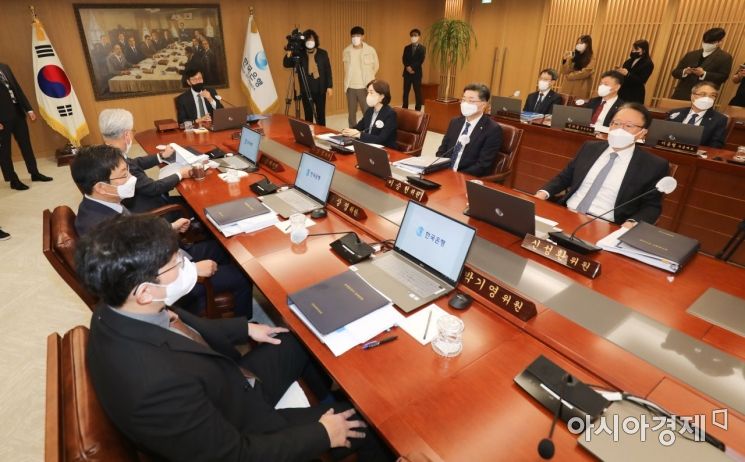 Lee Chang-yong, Governor of the Bank of Korea, is presiding over the first Monetary Policy Committee meeting of 2023 held at the Bank of Korea in Jung-gu, Seoul on the 13th. Photo by Joint Press Corps
◆ Rate Cut: Q4 This Year vs. Next Year... Election Variables = Opinions on the timing of rate cuts were divided between the possibility of as early as the fourth quarter of this year and the view that it will be next year. Professor Heo Jin-wook of Incheon National University’s Department of Economics said, "Since the inflation rate is slowly slowing down and the economy, especially manufacturing, is weak, discussions on rate cuts could begin as early as the second half of the year," adding, "The inflation rate and monetary policy transition timing in the U.S. are important variables."
Professor Heo Jun-young of Sogang University’s Department of Economics predicted, "Although the Fed has said it will not start cutting rates this year, Korea’s economy is clearly weakening differently from the U.S., and household loans and funding market issues persist, so the possibility of starting rate cuts earlier than the U.S. by the end of this year cannot be ruled out." Joo Won, head of economic research at Hyundai Research Institute, said, "As the real economy recession intensifies in the second half of this year in both the U.S. and Korea, discussions on the timing of rate cuts will begin," adding, "With the U.S. presidential election and Korea’s general election next year, pressure for rate cuts may intensify."
On the other hand, Heo Jeong-in, a researcher at Daol Investment & Securities, said, "Due to continued tightening in countries including the U.S., Europe, and Japan, the Bank of Korea is unlikely to make a premature pivot (direction change)," adding, "If a pivot causes inflation instability to resurge or domestic financial imbalances to worsen, the environment may arise where the base rate needs to be raised, making rate cuts this year difficult." Jo Young-moo, a research fellow at LG Economic Research Institute, also added, "It would be burdensome for Korea to cut rates before the U.S.," and "If high inflation levels continue, the Bank of Korea may not start rate cuts this year."
Regarding the possibility and timing of rate cuts, Governor Lee dismissed the idea, saying, "Basically, it is premature to talk about it before we are confident that inflation will definitely converge to the level we expect and converge to the policy target in the medium to long term."
© The Asia Business Daily(www.asiae.co.kr). All rights reserved.
![Clutching a Stolen Dior Bag, Saying "I Hate Being Poor but Real"... The Grotesque Con of a "Human Knockoff" [Slate]](https://cwcontent.asiae.co.kr/asiaresize/183/2026021902243444107_1771435474.jpg)


















