Celltrion Advances New Drug Development Beyond Biosimilars to ADCs
Healthcare Establishes Direct Sales System in the US Following Europe
Pharmaceuticals Actively Expanding Pipeline
[Asia Economy Reporter Chunhee Lee] The Celltrion Group has unveiled the new growth visions and key business objectives of its affiliates for the new year. Celltrion is striving to secure new growth engines by focusing on new drug development such as antibodies and antibody-drug conjugates (ADC), beyond its existing biosimilars (biopharmaceutical generics), while Celltrion Healthcare is challenging profitability by establishing a full-fledged overseas direct sales system.
Celltrion Advances Beyond Biosimilars to Develop New Drugs Including ADCs
Celltrion plans to secure new growth engines this year by developing various antibody new drugs beyond biosimilars. In particular, it is developing a diverse antibody new drug pipeline based on a strategy of ‘Fast Following,’ which selects promising candidates among early-stage development substances.
It is also accelerating the development of ADC anticancer drugs, which have recently become a hot topic in the industry. ADCs are drugs that conjugate antibodies and drugs. By linking antibodies that bind to cancer antigens with cytotoxic drugs (payloads) that kill cancer cells via a linker, ADCs can effectively deliver toxins specifically to cancer cells like guided missiles, making them a next-generation anticancer technology. As a result, major technology licensing deals have been made consecutively, and contract development and manufacturing organizations (CDMOs) have announced plans to build production facilities, rapidly emerging as a key modality in the bio industry.
In October last year, Celltrion signed a contract with Pinobio to introduce an option for ADC linker-payload platform technology. It secured the rights to use Pinobio’s ADC platform for up to 15 targets. If all options are exercised, the total contract value could soar to as much as $1.2428 billion (approximately KRW 1.537 trillion), making it a large-scale deal. In addition, it established a long-term partnership through equity investment and joint research agreements. Celltrion also plans to expand its anticancer portfolio through domestic and international collaborations and investments, including investing in the UK-based ADC specialist developer Iksuda Therapeutics.
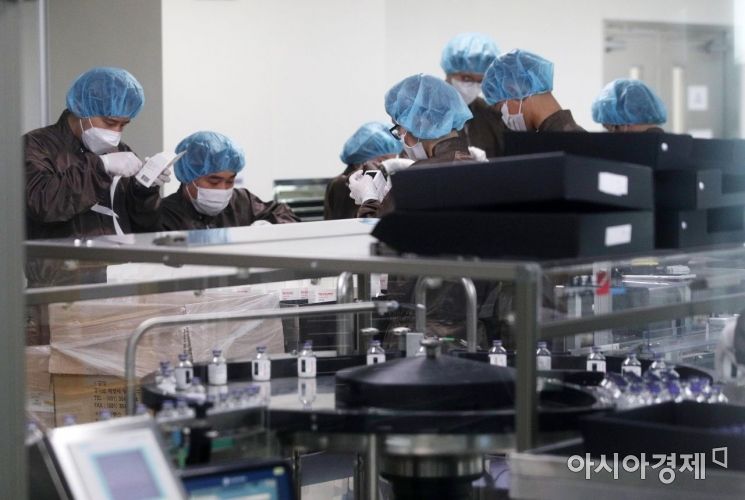 Celtreon anticancer drug 'Herzuma' finished product process scene. / Incheon - Photo by Hyunmin Kim kimhyun81@
On the 9th, Celltrion also signed a contract with the US biotech company Rani Therapeutics to develop an oral antibody therapeutic. Using a capsule platform technology that converts existing intravenous (IV) or subcutaneous (SC) injectable drugs into oral forms, they plan to jointly develop an oral form of ‘ustekinumab.’ Ustekinumab’s original drug is ‘Stelara,’ developed by Janssen (a Johnson & Johnson subsidiary). It is a treatment for autoimmune diseases such as psoriasis, arthritis, Crohn’s disease, and ulcerative colitis. According to Johnson & Johnson, Stelara recorded blockbuster sales of $9.134 billion (approximately KRW 11.298 trillion) in 2021. The substance patent expires in the US in September and in Europe in July 2024, triggering fierce competition in biosimilar development as the biosimilar market opens.
To accelerate such research and development (R&D), Celltrion plans to complete its Global Biotechnology Research Center this year. The center will be a large-scale, one-stop research facility combining R&D, process development, and clinical trials, spanning 10,033 square meters of land with one basement floor and six above-ground floors. Occupancy will begin in April, with over 300 specialized research and development staff in bio and chemical fields expected to work there. The company plans to develop this center as a core base to enhance R&D capabilities not only for new drug development but also for the entire pipeline.
Celltrion Healthcare Challenges Direct Sales in the US Following Europe
Celltrion Healthcare, responsible for overseas sales of Celltrion products, expanded direct sales to all products in the European market last year and announced plans to enter direct sales in the US starting this year by acquiring Celltrion USA, Celltrion’s US subsidiary. Based on this, it aims to grow prescriptions of existing products and expand the market for new products in both Europe and the US.
Sales in Europe continue to perform well. ‘Remsima’ maintained its top prescription position with a 54% market share in the second quarter of last year, while ‘Truxima’ and ‘Herzuma’ consistently held leading biosimilar prescription shares at 24% and 13%, respectively, during the same period. The world’s first infliximab subcutaneous (SC) formulation, ‘Remsima SC,’ which is sold through direct sales, had only a 1% market share in its first year of launch in Europe in 2020 but grew to 12% by the second quarter of last year, continuing growth through direct sales.
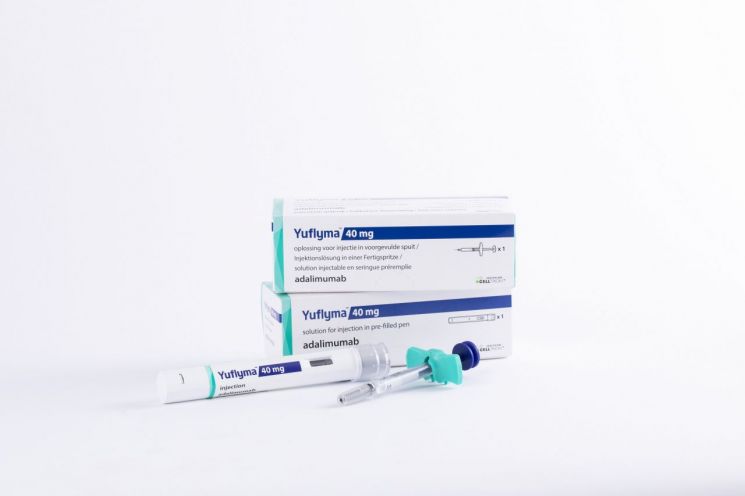 Celltrion biosimilar (biopharmaceutical generic) 'Yuflyma' 40 mg 0.4 ml [Photo by Celltrion Healthcare]
In the US, the world’s largest pharmaceutical market, Celltrion Healthcare will continue to launch new products alongside establishing a direct sales system. ‘Vegzelma (bevacizumab)’ will be launched in the first half of this year, and ‘Uplima (adalimumab)’ in the second half. The US market for bevacizumab is estimated at KRW 3 trillion, and for adalimumab at KRW 22 trillion. Notably, Uplima was developed with the same high-concentration formulation (HCF) as the original ‘Humira’ and removed citrate, which causes pain, to improve patient convenience. A global Phase 3 clinical trial to demonstrate interchangeability between Humira and Uplima is also underway to enhance competitiveness.
This foundation is supported by the direct sales launch in the US starting this year. Celltrion Healthcare acquired Celltrion USA, which holds a US pharmaceutical distribution license, last year and has completed hiring sales professionals, including a Chief Commercial Officer (CCO) to oversee US operations, preparing for successful direct sales.
Celltrion Pharm Actively Expands Pipeline
Celltrion Pharm is also expanding its chemical pipeline through next-generation improved drug development and new drug discovery. It aims to launch 12 items by 2028, including a new drug for hypertrophic cardiomyopathy, new drugs, improved drugs, and high-value generics.
Celltrion Pharm has completed the acquisition process of rights assets for Takeda Pharmaceutical’s Asia-Pacific product portfolio and plans to accelerate improved drug development and production internalization to enhance profitability. The diabetes drug ‘Nesina’ and hypertension drug ‘Edarbi’ acquired from Takeda have substance patents valid until 2026 and 2027, respectively, and active development of improved drugs based on these patents is underway to create synergy with existing product lines. Notably, production internalization through Celltrion Pharm’s own manufacturing facilities is also in progress for Nesina and Edarbi. Celltrion Pharm plans to sequentially internalize production to expand profitability and strengthen product supply stability. Development is ongoing with the goal of submitting production approval for some items within the year.
Additionally, the holding company Celltrion Holdings focuses on securing synergies among group affiliates and enhancing cost efficiency to build a stable financial structure. It is also strategically scouting investment targets and actively considering mergers and acquisitions (M&A) to secure global competitiveness. Celltrion Skincure is significantly increasing its online business share and aggressively targeting overseas markets to strengthen profitability. Celltrion Entertainment is planning to produce a total of four new dramas this year, including two that have already been scheduled for broadcast on terrestrial channels.
© The Asia Business Daily(www.asiae.co.kr). All rights reserved.
![From Bar Hostess to Organ Seller to High Society... The Grotesque Con of a "Human Counterfeit" [Slate]](https://cwcontent.asiae.co.kr/asiaresize/183/2026021902243444107_1771435474.jpg)


















