Opportunities Must Be Provided to Private Companies to Promote Small Modular Reactor Overseas Expansion
Increase in Financial Limits for Plant-Related Projects Also Needed
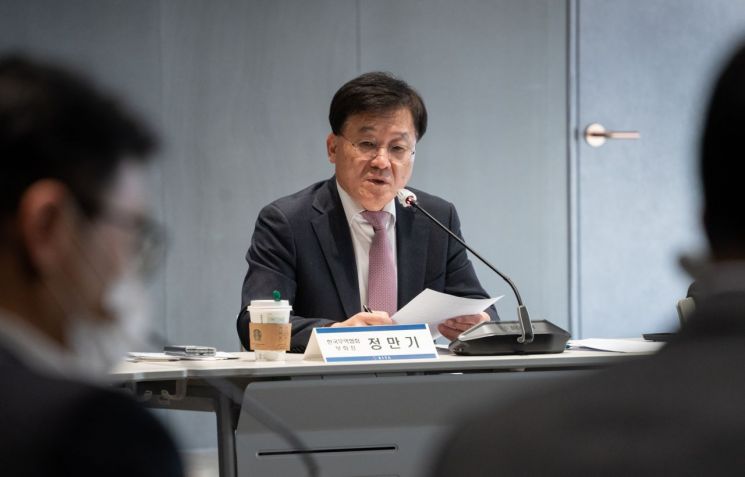 At the "3rd Urgent Industry-Specific Countermeasure Meeting to Overcome Export Difficulties and Expand Exports" held by the Korea International Trade Association on Thursday the 12th at the Trade Tower in Samseong-dong, Vice Chairman Jeong Manki is speaking.
[Asia Economy Reporter Park Sun-mi] The Korea International Trade Association held the "3rd Emergency Industry-Specific (Nuclear Power Plant, Plant, Engineering Industry) Countermeasure Meeting to Overcome and Expand Exports" chaired by Vice Chairman Jeong Manki at the Trade Center in Samseong-dong. Industry-specific organizations such as the Korea Nuclear Power Export Industry Association, Korea Plant Industry Association, Korea Engineering Association, and Korea Industrial Federation Forum, along with nuclear power, plant, and engineering export companies and about 20 officials from the Ministry of Trade, Industry and Energy attended.
At the meeting held the previous day, Vice Chairman Jeong said, "Although our exports are expected to contract, considering that the global plant market is projected to grow from $2.1 trillion last year to $2.2 trillion this year, it is necessary to strengthen plant export efforts to offset export sluggishness." He added, "It is a crucial time to adopt a preemptive strategy for the ASEAN market, which is expected to expand, as well as the Middle Eastern energy and infrastructure markets such as the UAE and Saudi Arabia, and to prepare strategies for demand related to post-war reconstruction in Ukraine." Furthermore, "Considering that orders in the high value-added engineering sector easily lead to construction and building orders, it is necessary to enhance technology and competitiveness," he said, urging, "The government should support the industry by expanding budgets for overseas business feasibility studies, increasing education on design, supervision, and project management consulting (PMC), providing opportunities to accumulate domestic performance, and supplying specialized personnel."
In the subsequent industry-specific presentations, Choi Un-seo, Head of Management Strategy at the Korea Nuclear Power Export Industry Association, stated, "The nuclear power industry is uniting all public and private capabilities with the goal of exporting 10 nuclear reactors by 2030." He requested, "In the case of plant construction, since it requires tens of trillions of won in funding and more than 10 years of construction, securing financial competitiveness and advancing financial structures for stable procurement of large-scale long-term funds are necessary." Industry insiders also emphasized, "To expand the nuclear power export support system, currently focused on large reactors, to small modular reactors (SMR) and micro modular reactors (MMR), a financial support system must be established." They added, "For SMR and MMR projects currently monopolized by public enterprises, allowing private companies to operate would open opportunities for private firms to enter overseas small nuclear power markets like Canada."
Lee Moon-ho, Head of Strategic Planning at the Korea Engineering Association, said, "Infrastructure projects in ASEAN and India, post-war reconstruction demand in Ukraine, expansion of energy and infrastructure orders in the Middle East benefiting from high oil prices, and promotion of nuclear power exports will be opportunity factors for engineering exports this year." He proposed, "It is necessary to provide differentiated feasibility study support funds according to the economic conditions and project scale of target countries and to expand the scope and scale of cost support for projects with high chances of winning orders." He continued, "The domestic bidding system, which induces low-price bids, should be improved to establish a structure where companies with technological competitiveness are selected rather than by price. If order performance accumulation expands, it will greatly help the engineering industry's overseas expansion base."
Seo Bo-seong, Team Leader at the Korea Plant Industry Association, pointed out that with the current K-ECA budget provided by the Export Credit Agencies (ECA), it is difficult to derive competitive financial plans for projects targeting ultra-high risk, low credit, and reconstruction countries, raising concerns about losing orders. He said, "When supporting ECA, it is necessary to improve by judging projects based on business feasibility and providing interest rate benefits for competitive projects, expanding the application of special accounts and support scope for countries," and mentioned, "It is also necessary to increase the EDCF budget and expand the support limits per project."
The Korea International Trade Association plans to prepare specific policy alternatives for the difficulties raised at the meeting and propose them to related ministries such as the Ministry of Trade, Industry and Energy and the Ministry of Land, Infrastructure and Transport. Meanwhile, the next meeting, the fourth of five industry-specific countermeasure meetings, will be held on the 18th at the Trade Center in Samseong-dong, focusing on the semiconductor, display, home appliance, and information and communication industries.
© The Asia Business Daily(www.asiae.co.kr). All rights reserved.
![User Who Sold Erroneously Deposited Bitcoins to Repay Debt and Fund Entertainment... What Did the Supreme Court Decide in 2021? [Legal Issue Check]](https://cwcontent.asiae.co.kr/asiaresize/183/2026020910431234020_1770601391.png)















