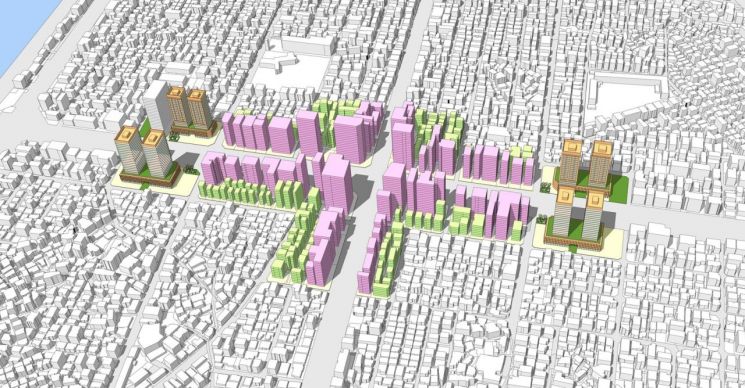
Valuable Achievements Made Through Tireless Efforts for 'Urban Development,' a Long-Standing Wish of Residents Since the Inauguration of Kim Kyung-ho, Mayor of Gwangjin District
On the 12th, Seoul City Officially Announces the Final Decision on the 'Gunja Station District Unit Plan (Amendment)'
Commercial Area Around Gunja Station Increased by 24,720㎡, Securing Conditions for Residential-Complex Development
[Asia Economy Reporter Park Jong-il] Gwangjin District (Mayor Kim Kyung-ho) has received a boost in urban development as the 'District Unit Plan Area Decision (Amendment)' to expand the commercial area around Gunja Station was officially announced on the 12th.
Last October, the 'Gunja Station District Unit Plan Amendment' was successfully approved by the Seoul City Urban Architecture Joint Committee. After a public inspection process, the final decision was announced, marking the official start of the Gunja Station area development.
The Gunja Station district is a major hub in the northeastern area according to Seoul's living zone plan, with unlimited growth potential.
The district unit plan target area covers approximately 160,000㎡ around Junggok-dong 157-1, of which the commercial area increased by 24,720㎡ from 47,016㎡ to 71,736㎡. This decision has created conditions for high-density residential-complex development in this double subway station area served by lines 5 and 7.
The final announced plan focuses on ▲expanding the district unit plan area ▲large-scale development through special planning zones ▲upgrading land use to commercial areas ▲allowing residential-complex buildings, thereby strengthening its status as a business hub.
With the possibility of upgrading land use around Gunja Station, the district plans to rapidly promote urban development plans to foster a mixed-use center combining commercial, office, and residential functions. This is expected to significantly contribute to improving residential environments and revitalizing the local economy.
Kim Kyung-ho, Mayor of Gwangjin District, said, “This final decision announcement is a valuable result achieved through active consultation with Seoul City to realize the residents' aspirations. Starting with the Gunja Station district development, we will accelerate high-density mixed-use development around the station area to revitalize the underdeveloped region and achieve balanced development.”
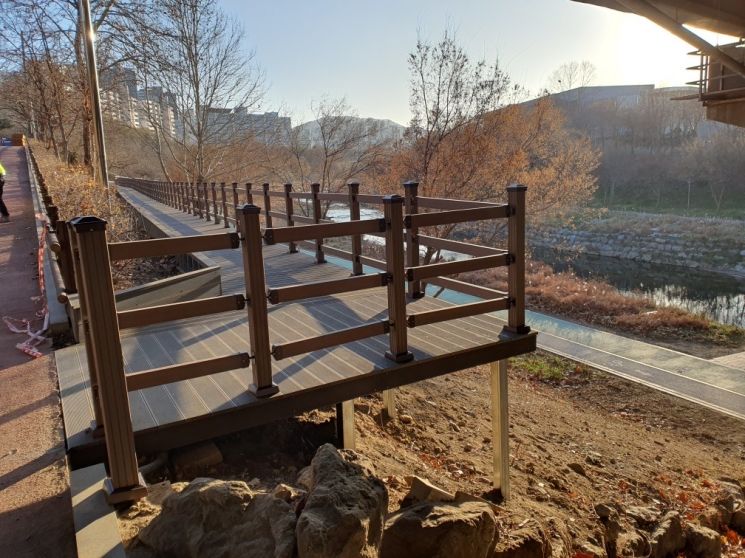
Gangnam District Connects the Disconnected Sodang-gil Along Yangjaecheon from Yeongdong 6 Bridge to Daechi Bridge
Construction of the 580m Disconnected Sodang-gil Section Along Yangjaecheon Completed in December Last Year, Creating a Spacious Walking Path by Dispersing Users
Gangnam District (Mayor Jo Seong-myeong) completed construction connecting the disconnected Sodang-gil along Yangjaecheon from Yeongdong 6 Bridge to Daechi Bridge, establishing a new Sodang-gil walking path between these bridges in December last year.
The walking paths along Yangjaecheon consist of ▲the riverside embankment path (walking and bicycle path) ▲Sodang-gil ▲the upper embankment path. 'Sodang' means a small staircase installed on a slope, and 'Yangjaecheon Sodang-gil' refers to the walking path built on the embankment slope of Yangjaecheon. The section between Yeongdong 6 Bridge and Daechi Bridge, where the construction took place, previously only had the embankment path and upper embankment path. With increasing users of Yangjaecheon and the embankment path being shared by bicycles and pedestrians, the Sodang-gil walking path was created on the embankment slope to disperse users.
The project, with a total budget of approximately 1.15 billion KRW, features a 580m long and 2m wide wooden deck path. Construction began in 2021, completing a 300m section, and the remaining 280m section was built from September to December 2022, completing the entire walking path last December. For user safety, fences and security lights were installed. This construction connects the previously disconnected Sodang-gil from Yeongdong 6 Bridge to Daechi Bridge, allowing visitors to enjoy the Yangjaecheon walking path more comfortably.
Meanwhile, the district continues to promote riverside infrastructure projects along Yangjaecheon, Tancheon, and Segokcheon. In the first half of this year, construction will connect the disconnected walking path on the embankment slope between Gwangpyeong Bridge and Daegok Bridge on Tancheon. During this project, the existing shared bicycle and pedestrian road on the upper embankment will be converted into a bicycle-only road with two-way traffic for enhanced safety. Additionally, a waterside sensory city project is underway, including the installation of stand-type entrances between Segok 3 Bridge and Eungok Bridge on Segokcheon.
Jo Seong-myeong, Mayor of Gangnam District, said, “Gangnam has natural environments that can be enjoyed by walking from Daemosan Mountain to Yangjaecheon, Tancheon, and the Han River. We will continue to expand riverside infrastructure by installing walking paths, bicycle roads, and convenience facilities along Gangnam’s ecological rivers.”
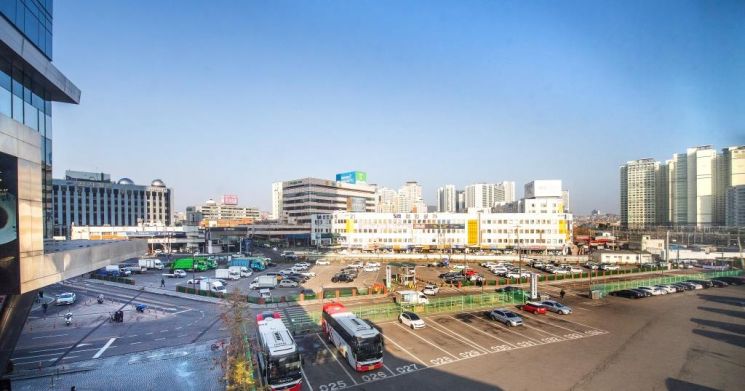
Yongsan District Improves Yongsan Retention Basin Drainage System...Part of Yongsan Urban Regeneration Innovation District Creation
Basic and Detailed Design Service Tender Announcement for Drainage System Improvement...To Be Announced on the Public Procurement Service Next Week
Yongsan District to Lead Construction, Funded by LH...Agreement Signed Last December
Yongsan District (Mayor Park Hee-young) will post a tender announcement next week for the 'Basic and Detailed Design Service for Yongsan Retention Basin Drainage System Improvement' and begin efforts to improve drainage and odor issues around Yongsan Electronics Market. This is part of the Yongsan Urban Regeneration Innovation District project.
The Yongsan Urban Regeneration Innovation District project aims to establish an innovative regional hub integrating key functions such as industry, commerce, housing, welfare, and administration within the declining area around Yongsan Electronics Market (including part of the closed Yongsan retention basin and the automobile bus stop site, totaling 13,963㎡ of national and city-owned land). The project is implemented by the Korea Land and Housing Corporation (LH) and Seoul Housing Corporation (SH).
In 2019, the district conducted a feasibility study on the reorganization of the Yongsan retention basin, confirming that when expanding and upgrading the upstream sewer pipes based on a 50-year rainfall frequency, 9,862㎡ of the 37,985㎡ retention basin area can be closed. Of the closed area, 7,350㎡ will be used for the innovation district site.
Yongsan District and LH signed an agreement last December to implement the drainage system improvement project for the Yongsan Urban Regeneration Innovation District national pilot complex development project. The district will receive design and construction funds from LH to carry out the project.
The design service for 'Basic and Detailed Design of Yongsan Retention Basin Drainage System Improvement' is budgeted at 700 million KRW, with a 12-month execution period from the start date. The scope includes the Yongsan retention basin (Han-gangro 3-ga 23-1 area) and 2,770m of sewer pipes. The work covers ▲drainage and storage capacity measures due to partial closure of the retention basin ▲basic and detailed design of the retention basin and sewer pipes ▲construction cost estimation.
Details such as bidder qualifications and evaluation methods can be found on the Public Procurement Service website tender announcement. Interested companies should submit their bid participation applications and proposals online within the announcement period.
The district will select a service provider by February, conduct external expert consultations and reviews, and complete the service. Construction costs will be estimated based on the service results. The goal is to complete the expansion and upgrading of upstream sewer pipes and retention basin maintenance within 2024.
Deputy Mayor Kim Seon-su said, “This project will help prevent flooding and eliminate odors around Yongsan Electronics Market. Furthermore, it will lay the foundation for the successful promotion of the Yongsan Urban Regeneration Innovation District.”
A retention basin temporarily stores excess rainwater during heavy rainfall to regulate drainage volume. Yongsan District has three retention basins: Yongsan, Wonhyo, and Hannam.
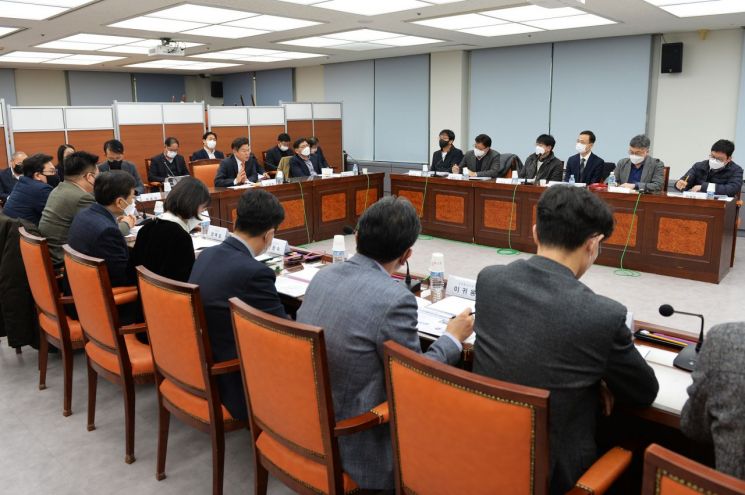 Lee Pil-hyung, Mayor of Dongdaemun-gu, speaking at the kickoff briefing for the Dongdaemun-gu Future Vision Establishment Project (second from the right at the desk in the center)
Dongdaemun Holds '2050 Future Vision Establishment Service Kickoff Meeting'
Maximizing Dongdaemun’s Potential...Taking the First Step to Realize the Vision of the 8th Term Administration
Dongdaemun District (Mayor Lee Pil-hyung) announced that it held the 'Dongdaemun Future Vision 2050 Establishment Service' kickoff meeting at 10:30 a.m. on the 12th in the 5th-floor planning situation room of the district office.
To concretize the new Dongdaemun envisioned by Mayor Lee Pil-hyung of the 8th term administration, the district reflected on the current status analysis of five areas including location conditions and industrial-economic conditions, as well as opinions from the Future Happiness Policy Advisory Group, to establish a draft of the 'Future Vision and Development Strategy' last year. This meeting officially announced the draft.
At the meeting, the mayor, staff, and policy advisory group exchanged opinions on various fields for Dongdaemun’s development.
Under the vision of 'Dongdaemun Opening Happiness,' four core future images were set: ▲an economically vibrant city opening the future of the 4th industrial revolution ▲a culturally sensitive city centered on cultural experiences ▲an educational welfare city fostering coexistence ▲a smart leading city utilizing technology and services. Detailed development strategies to realize these future images were presented.
The policy advisory group stated, “It is clear that Dongdaemun has great potential. For the core strategy of Cheongnyangni as the residential, transportation, and commercial center of northeastern Seoul to succeed, it is important to clearly define and develop unique factors that make people want to stay in Dongdaemun.”
Mayor Lee Pil-hyung said, “Everything started from the fundamental question, ‘What will the city’s future be?’ By studying foreign cities over 100 years old such as Manhattan, Chicago, and King’s Cross, I realized that cities constantly evolve. Just as blood circulation is key to health, I believe that what truly brings a city to life is the free movement of people within the urban core. I hope the policy advisory group and staff will work together with a sense of mission and historical awareness to create a city where people want to walk, stay, enjoy, and that is an attractive future city.”
Dongdaemun District plans to hold a mid-term report in May after meetings with the district advisory group and finalize core projects to move toward '2050 Future City Dongdaemun' by December this year.
© The Asia Business Daily(www.asiae.co.kr). All rights reserved.



















