10th Basic Plan for Electricity Supply and Demand Confirmed
Nuclear Power Share to Expand to 32.4% by 2030
Renewable Energy 8.6%P Lower than Moon Administration's Target
Coal Power Share Reduced to Below 15%
[Asia Economy Sejong = Reporter Dongwoo Lee] The government plans to increase the share of nuclear power generation from 23.4% in 2018 to 34.6% by 2036. It will complete the construction of five nuclear power plants currently under construction by 2025 and resume the construction of two nuclear power plants that were halted by the previous administration. The government is expected to actively abandon the 'denuclearization' policy and utilize nuclear power as a baseload power source, giving more momentum to the power generation mix.
The Ministry of Trade, Industry and Energy announced on the 12th that it finalized the '10th Basic Plan for Electricity Supply and Demand (Electricity Basic Plan)' through the Electricity Policy Deliberation Committee, which includes these details. The 10th Electricity Basic Plan is a mid- to long-term electricity demand plan covering the 15 years from 2022 to 2036, including electricity supply and demand forecasts and facility expansion, and the government establishes the plan every two years.
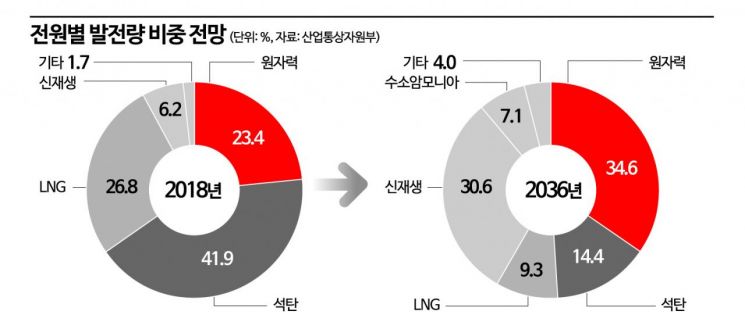
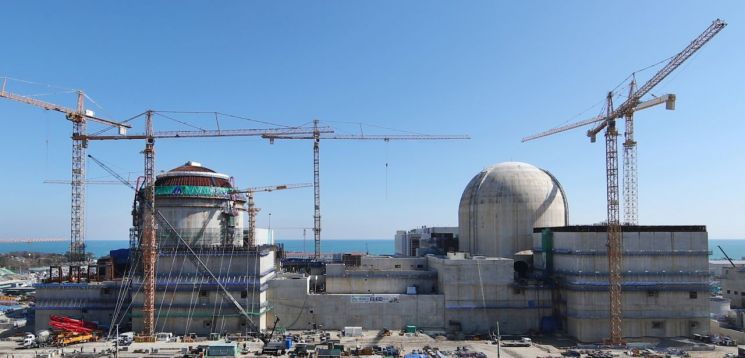
The core of the 10th Electricity Basic Plan is to expand the share of nuclear power, which was only 23.4% in 2018, to 32.4% by 2030 and 34.6% by 2036. This is an increase of 8.5 percentage points compared to the 23.9% nuclear power generation share targeted by the Moon Jae-in administration for 2030. To achieve this, the government plans to complete five nuclear power plants currently under construction, including Shin Hanul Unit 2 and Saeul Units 3 and 4, by 2025, and resume the construction of Shin Hanul Units 3 and 4, which were halted by the previous administration.
The government will also promote the continued operation (life extension) of nuclear power plants. The Nuclear Safety and Security Commission has already started a safety review for extending the operation of Kori Unit 2, whose design life expires in April. Starting with Kori Unit 2, the government plans to apply for continued operation of a total of 10 nuclear power plants, including Kori Units 3 and 4, Hanbit Units 1 and 2, and Wolsong Units 2, 3, and 4.
The share of renewable energy will be expanded from 6.2% in 2018 to 21.6% in 2030 and 30.6% in 2036. However, this is 8.6 percentage points lower than the 30.2% renewable energy generation target set by the previous administration for 2030. The Ministry of Trade, Industry and Energy emphasized that the adjustment to lower the renewable energy share and increase the nuclear power share is not intended to support any specific sector, but reflects considerations such as energy security in utilizing nuclear power.
Considering the level of renewable energy generation, the government views the targets set in the 10th Electricity Basic Plan as quite challenging. During the previous administration’s five years, renewable energy capacity increased by an average of 3.5 GW per year, but to achieve a 21.6% share of renewable energy generation by 2030, an annual increase of 5.3 GW is required.
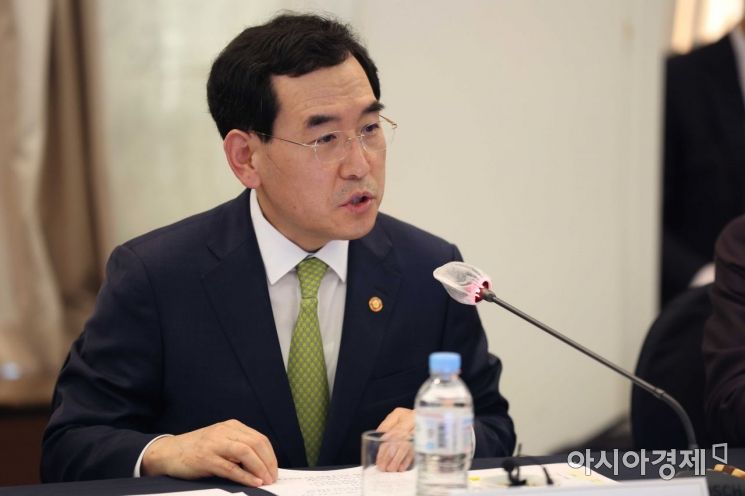 Minister Lee Chang-yang of the Ministry of Trade, Industry and Energy is speaking at the signing ceremony of the win-win agreement for the activation of eco-friendly biofuels and the industry meeting held on the 13th at the Press Center in Jung-gu, Seoul. / Photo by Moon Ho-nam munonam@
The plan to replace aging coal-fired power plants with liquefied natural gas (LNG) power plants will continue. By adding Donghae Units 1 and 2 and Dangjin Units 5 and 6, a total of 28 aging coal-fired power plants will be replaced with LNG power plants by 2036. Through this, the share of coal, which was 41.9% in 2018, is expected to decrease to 19.7% in 2030 and 14.4% in 2036, while the share of LNG will also gradually decrease from 26.8% in 2018 to 22.9% in 2030 and 9.3% in 2036.
The government projects the maximum electricity demand (target demand) in 2036 to be 118.0 GW. To ensure stable electricity supply and demand, a total effective capacity of 143.9 GW will be required by the same period. The scale of new facilities needed during this period is 1.7 GW, and except for some capacity in the Jeju region, the power sources for new facilities will be decided in the next Electricity Basic Plan considering technology development and social acceptance.
Additionally, through the 10th Electricity Basic Plan facility plan, the government expects to achieve the emission target of 149.9 million tons for the power sector set in the '2030 Nationally Determined Contribution (NDC) upward revision.' This requires a 44.4% reduction compared to the 2018 emission levels.
Professor Dongwook Jung of the Department of Energy Systems Engineering at Chung-Ang University said, "The core of the 10th Electricity Basic Plan is a plan to achieve carbon neutrality and energy security by realistically utilizing all available nuclear resources." However, he added, "Further discussion is needed on specific measures to secure new nuclear power plants, which were excluded from the 8th Electricity Basic Plan."
© The Asia Business Daily(www.asiae.co.kr). All rights reserved.



















