[Asia Economy New York=Special Correspondent Joselgina] The World Economic Forum (WEF) identified the 'cost of living crisis' as the biggest immediate risk ahead of its annual meeting (Davos Forum), where prominent figures from global politics, business, and academia gather. High inflation and growing recession concerns are fueling this cost of living risk, which is expected to dominate the global economy over the next two years. Climate change-related issues ranked high among long-term risks over the next decade.
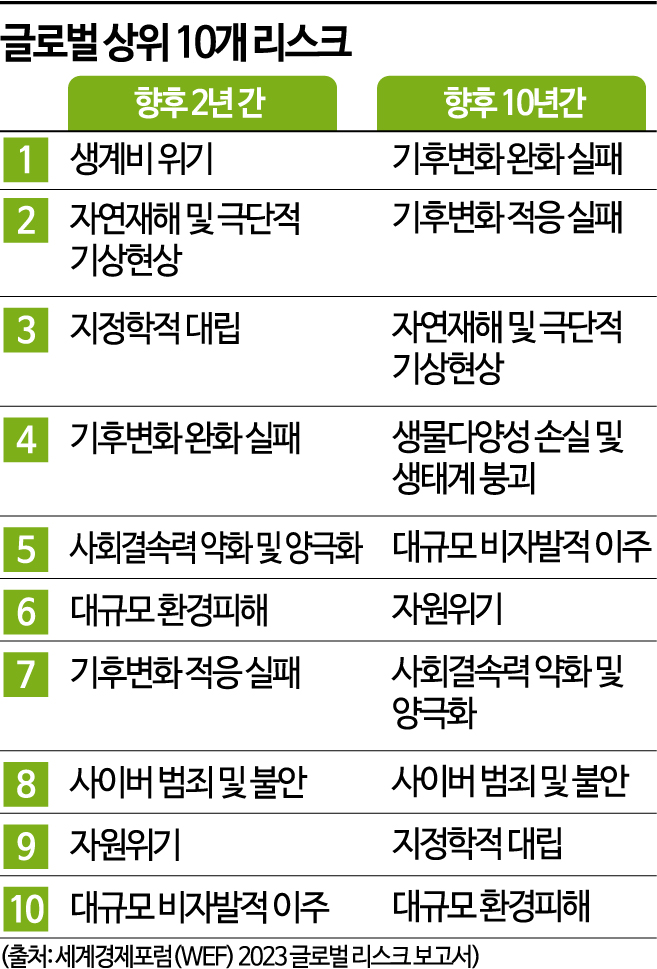
On the 11th (local time), WEF revealed this in its '2023 Global Risks Report.' Published annually in January just before the Davos Forum, this report is based on a survey of 1,200 experts from various fields and highlights risk factors affecting the world economy. This year marks the 18th edition. The report stated, "This year is a year of 'multiple crises' where risks are more interdependent and mutually damaging than ever," adding, "The urgency of the cost of living crisis dominates the 2023 Global Risks Report."
The top risk over the next two years was identified as the cost of living crisis caused by inflation. It explained that Russia's invasion of Ukraine and the pandemic triggered an energy crisis, food shortages, and inflation, posing a significant global threat to livelihoods. Moreover, governments and central banks face an unavoidable dilemma of economic slowdown amid interest rate hikes aimed at curbing soaring inflation. Carolina Klint, head of Marsh, the consulting firm compiling the report, expressed concern, saying, "Risks from the distant past have reappeared," and "The impact of the cost of living crisis on vulnerable groups is almost unbearable."
Other short-term risks following the cost of living crisis include natural disasters and extreme weather events, geopolitical conflicts, weakening social cohesion and polarization, climate change, cybercrime, and resource depletion. In particular, geopolitical risks are expected to exacerbate both short- and long-term risks worldwide by raising economic barriers such as various trade sanctions. The report pointed out recent deglobalization trends among major countries, noting that "economic warfare is becoming normalized."
Long-term risks faced globally are largely related to climate change responses. The top two risks over the next decade are failure to mitigate climate change and failure to adapt to climate change, respectively. Among the top 10 risks, four are climate-related, including natural disasters, extreme weather events, biodiversity loss, and ecosystem collapse. The report emphasized, "To avoid ecosystem collapse and global warming, the world must cooperate more effectively on climate action over the next decade."
Issues related to the COVID-19 pandemic, which had dominated the world, were considered relatively lower threats and did not appear in the top 10 short- or long-term risks in this report. Sadia Zahidi, WEF Managing Director, stressed, "Cooperation is the only way forward."
This year's Davos Forum will open on the 16th in Davos, Switzerland, under the theme "Cooperation in a Fragmented World."
© The Asia Business Daily(www.asiae.co.kr). All rights reserved.
![User Who Sold Erroneously Deposited Bitcoins to Repay Debt and Fund Entertainment... What Did the Supreme Court Decide in 2021? [Legal Issue Check]](https://cwcontent.asiae.co.kr/asiaresize/183/2026020910431234020_1770601391.png)















