[Asia Economy New York=Special Correspondent Joselgina] On the 11th (local time), the United States and Japan condemned North Korea's continuous ballistic missile provocations and reaffirmed their commitment to pursuing complete denuclearization. They also agreed to expand security cooperation across all domains, including land, sea, air, cyberspace, and space, such as strengthening the capabilities of the U.S. Marine Corps stationed in Okinawa to defend Japan in case of emergency.
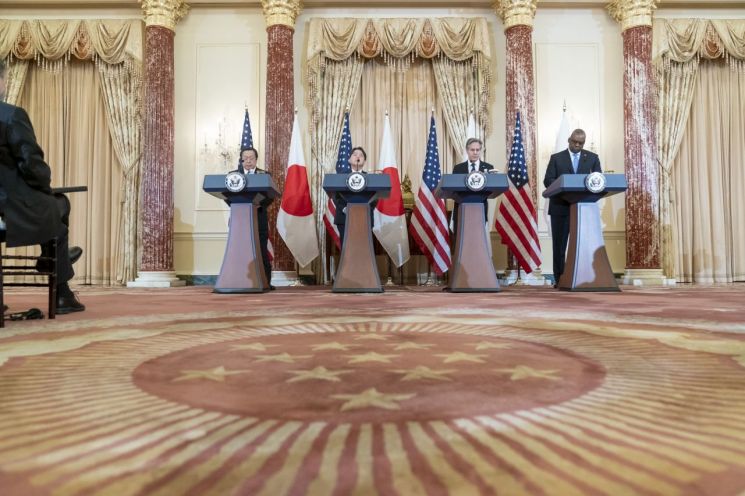
According to the U.S. State Department and others, the two countries held a '2+2 meeting' attended by their foreign and defense ministers in Washington DC on the same day and announced this at a joint press conference.
This meeting took place two days before the summit between U.S. President Joe Biden and Japanese Prime Minister Fumio Kishida at the White House on the 13th. From the U.S. side, Secretary of State Antony Blinken and Secretary of Defense Lloyd Austin attended, while from Japan, Foreign Minister Yoshimasa Hayashi and Defense Minister Yasukazu Hamada participated.
At the press conference, Secretary Blinken said, "We are facing North Korea's illegal and reckless missile launches, including long-range ballistic missiles flying over Japanese airspace last October," adding, "We are deepening trilateral cooperation with South Korea to defend against aggression and to deter if necessary." He continued, "This is a commitment emphasized by the leaders at the trilateral summit of South Korea, the U.S., and Japan last November."
Secretary Blinken confirmed that the meeting included discussions to strengthen alliance-level defense capabilities and credibility in response to North Korea's broad threats. Secretary Austin also explained, "We discussed various issues, including shared concerns about peace and stability in the East China Sea, South China Sea, and around Taiwan," adding, "This includes our commitment to North Korea's denuclearization." Foreign Minister Hayashi stated, "(At the meeting) we strongly condemned North Korea, which has launched ballistic missiles at an unprecedented frequency over the past year, and reaffirmed our firm commitment to North Korea's complete denuclearization in accordance with United Nations Security Council resolutions."
The U.S.-Japan talks also addressed strengthening defense capabilities against threats from North Korea, China, and Russia. Secretary Austin expressed strong support for Japan's policy to possess so-called "counterstrike capabilities," emphasizing, "The U.S.-Japan alliance is the cornerstone of Indo-Pacific power and essential for maintaining a free and open regional order."
They decided to strengthen the U.S. Marine Corps stationed in Okinawa by reorganizing it into a "Marine Littoral Regiment," and also agreed on measures such as sharing enemy location information between the Japan Self-Defense Forces and U.S. military in case of counterattacks. This is interpreted as an alliance-level measure to deter potential provocations by China, which has openly shown ambitions toward Taiwan.
Additionally, the United States and Japan agreed to apply Article 5 of the U.S.-Japan Security Treaty to the space domain. This is an additional measure following the 2019 agreement to apply it to cyberspace. The expansion of defense obligations in space is particularly analyzed as assuming the case of attacks on Japanese satellites. Both sides viewed this as a major achievement in enhancing the deterrence capability of the entire alliance.
Secretary Austin emphasized, "We will strengthen multilateral cooperation with South Korea, Australia, and other like-minded partners to expand cooperation across all domains, including space and cyberspace." Secretary Blinken also stressed, "We will cooperate to deepen collaboration across all domains?land, sea, air, cyberspace, and space," adding, "Space is important for the alliance's security and prosperity."
.
© The Asia Business Daily(www.asiae.co.kr). All rights reserved.

















