Temporary and Rapid Support for Residents in Crisis Situations
[Asia Economy Reporter Kiho Sung] The Seoul Metropolitan Government announced on the 12th that it will invest a total of 12.9 billion KRW in the “Seoul-type Emergency Welfare” program, which provides temporary and rapid support to residents facing livelihood difficulties due to crises such as unemployment, illness, business suspension or closure, and accidents.
In line with the city’s core philosophy of “walking together with the vulnerable,” the city has revised the related ordinance enforcement rules to apply the temporarily relaxed support criteria, which were eased in response to the COVID-19 situation since July 2020, as the regular support standards starting from the 12th of this month. The main changes include ▲ relaxing the income criteria to up to 100% of the median income, ▲ applying an additional deduction limit of 69 million KRW for residential property in the asset criteria, ▲ and increasing the amount of livelihood support.
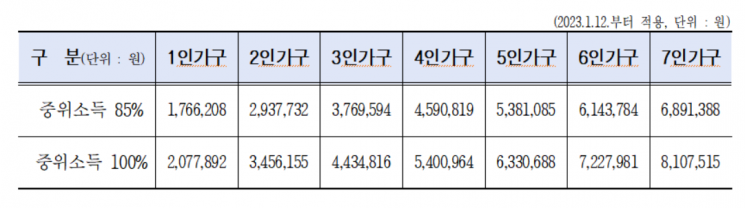
Previously, the income criterion for Seoul-type Emergency Welfare support was set at 85% or less of the median income, but it was temporarily relaxed to 100% or less during the COVID-19 situation. With the revision of the ordinance enforcement rules, households with income up to 100% of the median income can now receive Seoul-type Emergency Welfare support. Accordingly, for a four-person household in 2023, support was previously available only if income was 4,590,819 KRW or less, but now households with income up to 5,409,640 KRW can receive support.
Also, although the asset criterion was supposed to revert to 310 million KRW after the temporary relaxation ended, the revision of the ordinance enforcement rules applies this year an additional deduction limit of 69 million KRW for residential property in the asset criteria, allowing households with assets up to 409 million KRW to receive support.
From 2018 to 2022, the Seoul-type Emergency Welfare livelihood support was set at 300,000 KRW for single-person households and 1 million KRW for households of four or more, supplementing the “National Emergency Welfare” under the Emergency Welfare Act. Starting this year, the payment amount will be increased to the same level as the National Emergency Welfare, expanding support for vulnerable groups.
With the expansion of support under the “Seoul-type Emergency Welfare” system, households meeting the criteria of median income at or below 100% and assets at or below 409 million KRW, and experiencing a crisis, can receive immediate support of up to 3.62 million KRW for a four-person household. Livelihood support amounts are determined by the number of household members, while medical and housing support are provided up to 1 million KRW each regardless of household size. Additional support is also available for the use of social welfare facilities, education, and more.
The city also plans to actively utilize “Seoul-type Emergency Welfare Livelihood Support” to prevent unfortunate accidents occurring in welfare blind spots. To this end, if a household without a welfare benefit history faces a crisis, livelihood support will be proactively provided once even if they do not meet the support criteria. This initial one-time support will be reviewed and decided through the “Dong/Gu Case Conference” (with three or more public officials), a system that allows special support for those exceeding the support criteria, by examining the crisis situation.
“Seoul-type Emergency Welfare” can be applied for at any time by visiting the local community service center (Dong Resident Center) or district office (Gu). Consultations are also available by phone through the 120 Dasan Call Center and district welfare counseling centers. When someone in need or a neighbor in crisis is identified, calling the 120 Dasan Call Center and pressing 3 (Emergency Welfare, COVID-19, and General Administration) will connect to the relevant district’s welfare counseling center for consultation. Direct calls to the district welfare counseling centers are also possible.
District welfare counseling centers operate from 9 a.m. to 6 p.m. on weekdays. For nights or holidays, consultations can be requested through the 120 Dasan Call Center (operating 24 hours), with phone consultations provided the next day (excluding holidays).
Support under Seoul-type Emergency Welfare is determined after application review by the Dong Resident Center and district case conferences. For more details, inquiries can be made through the Seoul Welfare Portal website or the local Dong Resident Center.
Kim Sang-han, Director of Welfare Policy, said, “This year, due to economic uncertainties, there is concern that the economic difficulties of neighbors around us may increase.” He added, “Even after the temporary relaxation of criteria for COVID-19 response ends, Seoul will do its best to ensure that vulnerable groups can live dignified lives by easing the regular support criteria for Seoul-type Emergency Welfare and increasing livelihood support payments, in line with the city’s policy of walking together with the vulnerable.”
© The Asia Business Daily(www.asiae.co.kr). All rights reserved.
![From Bar Hostess to Organ Seller to High Society... The Grotesque Con of a "Human Counterfeit" [Slate]](https://cwcontent.asiae.co.kr/asiaresize/183/2026021902243444107_1771435474.jpg)
















