Discussion on Innovation Measures for SME R&D System
Increasing Challenge Opportunities and Strengthening Autonomy and Responsibility
[Asia Economy Reporter Kim Bo-kyung] In the future, small and medium-sized enterprises (SMEs) with a debt ratio exceeding 1000% will also be able to apply for government research and development (R&D) projects. While increasing autonomy in the use of research funds, strict measures will be taken against fraudulent activities.
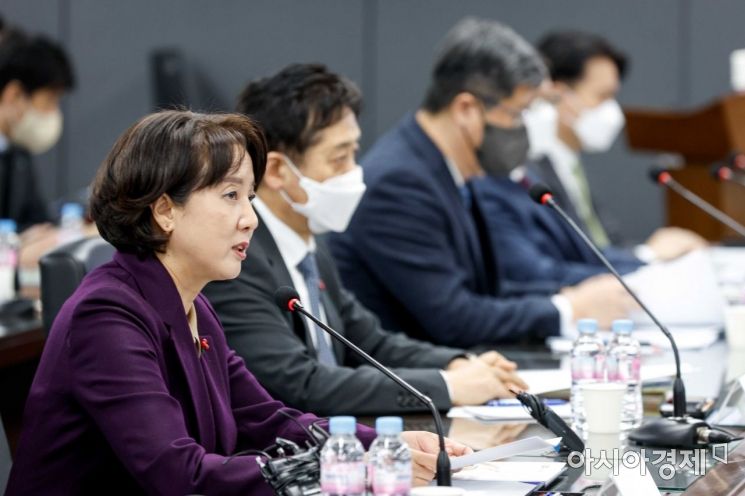
Lee Young, Minister of the Ministry of SMEs and Startups, attended the SME R&D System Innovation Meeting held on the 12th at the Korea Press Center in Seoul. The Ministry of SMEs and Startups announced the background and key contents of the system innovation plan and shared opinions from company representatives and R&D experts.
The main points of the innovation plan are ▲ expanding R&D opportunities for capable companies ▲ fostering autonomous and creative research activities ▲ strengthening accountability in research activities.
First, financial disqualification criteria will be abolished for companies with sufficient potential and capabilities but poor financial conditions, such as those with a debt ratio exceeding 1000%. This takes into account that R&D-focused companies often have high debt ratios and that investments can be recognized as debt in accounting terms.
The abolition of financial disqualification criteria will be initially applied to projects under 500 million KRW and plans to be expanded to projects over 500 million KRW later.
Project proposals will be significantly shortened by requiring entries focused on research and development content and methods, the company's technological development capabilities, and the performance and results of prior R&D.
Changes to project plans will shift from a 'prior approval' system by specialized institutions (Small and Medium Business Technology Information Promotion Agency) to a 'post-notification' system. Procedures will also be established to allow suspension without penalties if technical or economic environments change, making continued execution of a specific project impractical.
Additionally, direct costs such as labor and material expenses will be autonomously used by companies within the permitted scope and reported upon changes. However, companies must sufficiently explain the use, details, and relevance to project execution during the settlement phase.
Finally, fraudulent activities will be strictly addressed to strengthen accountability in R&D. Research misconduct involving embezzlement of research funds through labor cost misuse or false transactions will be heavily reflected in project evaluations.
If fraudulent activities are organized at the company level, strict measures will be taken through tracking and management of representatives and research managers.
Minister Lee stated, "This system innovation plan is a groundbreaking reform, venturing into uncharted territory. There may be some trial and error, so we will closely monitor the system's operation and promptly improve any shortcomings discovered."
© The Asia Business Daily(www.asiae.co.kr). All rights reserved.

















