Establishment of 'Solar Hub' Production Complex in Georgia, USA
Annual 3.3GW Production from Ingots and Wafers to Modules
Completing Solar Battery Value Chain... Total 8.4GW

[Asia Economy Reporter Donghoon Jung] Hanwha Solutions is investing approximately 3.2 trillion KRW to build the largest solar power plant in North America. This investment aligns with the rapid growth of the solar market following the implementation of the Inflation Reduction Act (IRA). The company envisions completing the solar value chain in North America, from raw materials such as ingots and wafers to cell and module production. The production complex has been named the 'Solar Hub.'
On the 11th, Lee Gu-young, CEO of Hanwha Solutions Q CELLS division, stated, "The establishment of the Solar Hub aims to maximize competitiveness by fully leveraging the U.S. government's energy transition policies," adding, "Once the Solar Hub is fully operational, we expect significant improvements in solar business sales and profitability."
Next Year, North America's Largest Integrated Solar Production Complex 'Solar Hub' to Begin Full Operation
Hanwha Solutions' investment in the Solar Hub is the largest in the history of the U.S. solar energy industry. It is also the first time a single company has established production lines for all key solar value chain segments in North America. The solar module production capacity planned for the plant in 2025 is about 8.4 GW, which is enough to supply electricity to approximately 1.3 million U.S. households for one year.
Once the planned mass production system is established, Hanwha Solutions expects to generate sales of approximately $440 million (about 548.6 billion KRW) from module production alone. CEO Lee said, "We anticipate being able to sell modules at around 44 cents per watt," adding, "Additionally, sales from high value-added residential and commercial solar power, as well as power EPC (engineering, procurement, and construction) services, are expected to contribute further."
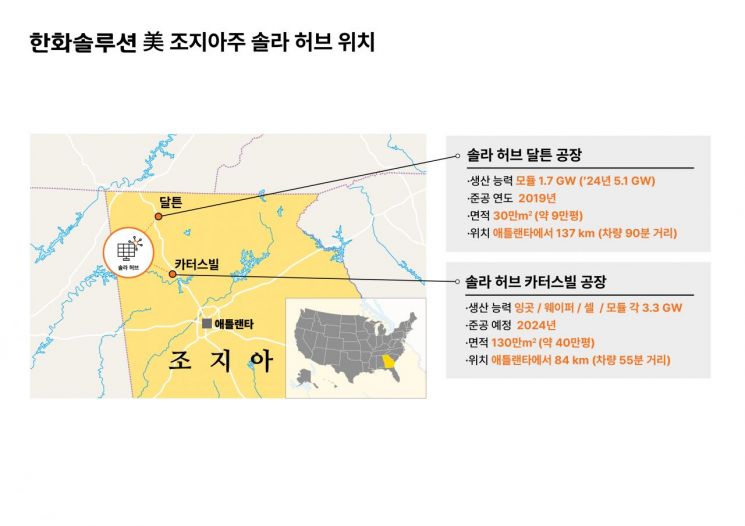
Hanwha Solutions will first invest 3 trillion KRW in Cartersville, Georgia, aiming for commercial production by the end of next year, constructing an integrated production complex for ingots, wafers, cells, and modules, each with a capacity of 3.3 GW. The core solar value chain consists of five stages: 'Polysilicon (raw material for solar cells made primarily of silicon) → Ingot (cylindrical block made by melting polysilicon into crystals) → Wafer (thin slices cut from ingots) → Cell (solar cell) → Module (panel assembled from solar cells) → Power generation (construction and operation).' The Solar Hub will produce the four products excluding the raw material polysilicon in one location.
The new plant will be built in Cartersville, which is about a 55-minute drive from Atlanta, the capital of Georgia. It is located approximately 33 minutes from Dalton, where the existing module plant is situated, also in Georgia. The area offers locational advantages such as good accessibility, making logistics operations and workforce recruitment relatively easier.
In addition, Hanwha Solutions plans to expand the annual production capacity of its Dalton, Georgia module plant, which began mass production in 2019, from the current 1.7 GW to 5.1 GW by the end of this year. The company aims to complete a 1.4 GW production line expansion in the first half of this year and add another 2 GW by the end of the year. Once the new expansions at the Dalton and Cartersville plants are completed by the end of next year, the total local module production capacity will reach 8.4 GW, making it the largest solar production capacity in North America.
Although Hanwha Solutions is investing over 3 trillion KRW, it expects tax credit benefits to exceed 1 trillion KRW in the future. The IRA provides tax credits and subsidies for both investment and production. It offers a 30% tax credit on investments in eco-friendly energy such as solar power and provides subsidies for each segment of the solar value chain: 7 cents per watt for modules, 4 cents for cells, and 4.69 cents for ingots/wafers. The IRA's eco-friendly energy subsidies are provided through a 'direct pay' system, which pays the amount directly rather than reducing taxes upon sale.
If Hanwha Solutions proceeds with the planned solar value chain production in 2025, it will receive tax credit benefits worth $875 million (approximately 1.091 trillion KRW).
Hanwha Solutions Aims to Solidify 'No.1 in U.S. Solar' Position Aligned with IRA
Hanwha Solutions expects that this large-scale investment will enable effective response to the IRA, which supports climate change mitigation and renewable energy industries. Since the IRA came into full effect this year, companies producing solar products locally can receive various government supports, including tax credits. Moreover, by consolidating production lines for each value chain segment in one location, the company anticipates reducing logistics costs and improving operational efficiency, thereby enhancing cost competitiveness.
Hanwha Solutions is considering using polysilicon produced by REC Silicon, in which it acquired shares last year, for the Solar Hub production lines. REC Silicon is an eco-friendly polysilicon producer based on hydropower, located in Moses Lake, Washington. It plans to mass-produce about 16,000 tons of polysilicon annually, sufficient for a cell production capacity of approximately 5.3 GW, starting at the end of this year.
Once the Solar Hub begins full operation next year, Hanwha Solutions will have a complete five-stage value chain production line in North America, from basic materials like polysilicon to finished products such as modules. The company expects to further solidify its position as the number one local market leader by selling 'Made in America' solar products produced entirely in the U.S., from raw materials to finished goods.
Energy market research firm Wood Mackenzie reported that Hanwha Solutions held the number one market share for residential solar modules in the U.S. for 17 consecutive quarters and for commercial solar modules for 12 consecutive quarters through the third quarter of last year.
CEO Lee Gu-young said, "The Solar Hub will become a key production base in the U.S. solar industry, which is expected to grow rapidly at around 20% annually," adding, "We will continue to expand our renewable energy business to strengthen Korea-U.S. energy security and achieve carbon neutrality."
© The Asia Business Daily(www.asiae.co.kr). All rights reserved.
![Clutching a Stolen Dior Bag, Saying "I Hate Being Poor but Real"... The Grotesque Con of a "Human Knockoff" [Slate]](https://cwcontent.asiae.co.kr/asiaresize/183/2026021902243444107_1771435474.jpg)


















