High Potassium Intake Lowers Mortality by 21%
"Increase Consumption of Fruits, Vegetables, and Whole Grains"
[Asia Economy Reporter Lee Gwan-ju] There is a common perception that consuming too much salt is bad for health. However, research has also shown that consuming too little salt can be harmful, leading to ongoing debates in academia about the relationship between salt and health.
Meanwhile, a domestic research team has confirmed the association between sodium intake and mortality tailored to Koreans. In conclusion, sodium intake had no effect on mortality, while higher potassium intake was associated with lower mortality rates.

The research team, led by Professor Lee Ji-won from the Department of Family Medicine at Severance Hospital, Professor Kwon Yoo-jin from the Department of Family Medicine at Yongin Severance Hospital, and Professor Lee Hye-seon from the Department of Medical Statistics at Gangnam Severance Hospital, announced on the 11th that sodium intake has no effect on mortality, but higher potassium intake can reduce mortality by up to 21%.
Sodium and potassium are essential nutrients that maintain body fluid balance and regulate osmotic pressure. High sodium intake has been known to raise blood pressure and affect cardiovascular diseases. The World Health Organization (WHO) recommends a daily sodium intake of 2g and potassium intake of 3.5g.
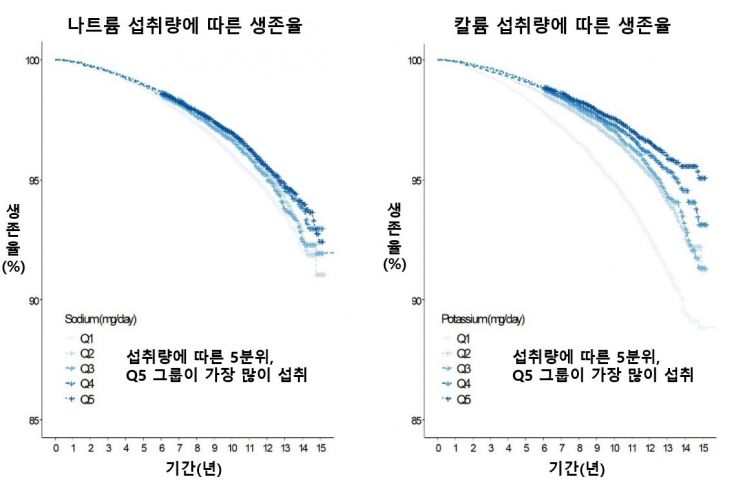 Survival rates showed no significant difference according to sodium intake, whereas survival rates varied clearly across quintiles based on potassium intake. The mortality rate in the group corresponding to the highest potassium intake quintile was 21% lower than that of the lowest quintile. [Data provided by Yonsei Medical Center]
The research team investigated the relationship between sodium and potassium intake and mortality and cardiovascular mortality among 143,050 Korean adults using Korean Genome Epidemiology data. According to a food frequency questionnaire assessing nutrient intake, the average daily sodium intake was 2.5g, and potassium intake was 2.2g. During an average follow-up period of 10.1 years, 5,436 deaths occurred, of which 985 were due to cardiovascular diseases.
Next, the team divided the deceased into quintiles based on sodium and potassium intake to examine the effects of these nutrients on overall and cardiovascular mortality. The results showed that sodium intake was not associated with overall or cardiovascular mortality, while the group in the highest quintile of potassium intake had a 21% lower total mortality rate compared to the lowest quintile group. Cardiovascular mortality was particularly reduced by 32%.
Professor Lee Ji-won stated, "This study found that potassium intake among Koreans was about half of the recommended amount, and sufficient potassium intake was shown to reduce overall and cardiovascular mortality. It is important to increase the consumption of potassium-rich fruits, vegetables, and whole grains."
The study results were published in the international journal Frontiers in Nutrition.
© The Asia Business Daily(www.asiae.co.kr). All rights reserved.


















