[Asia Economy Sejong=Reporter Song Seung-seop] This year, the global economic growth rate is expected to remain in the 1% range. The World Bank advised that international cooperation is necessary to prepare for the onset of prolonged low growth.
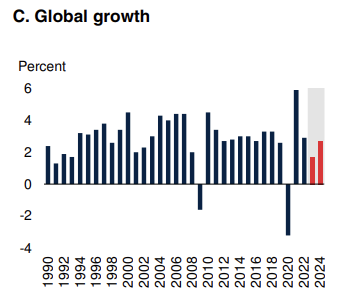
According to the "Global Economic Outlook" released by the World Bank on the 10th (local time), the forecast for this year's global economic growth rate is estimated at 1.7%. The World Bank releases forecasts every January and June, and this is 1.3 percentage points lower than the 2.9% growth rate predicted in June last year for 2023. Except for 2020, when COVID-19 broke out, and 2009, during the global financial crisis, this is the lowest in the past 30 years.
The causes cited include global inflation and rapid monetary policy tightening, which have slowed growth in advanced economies. The World Bank analyzed that these effects have also worsened financing and fiscal conditions in emerging and developing countries. It also mentioned the overlapping of several negative factors such as a global decline in investment sentiment and the Russia-Ukraine war.
Advanced economies have seen a sharp deterioration in economic conditions since mid-last year due to high inflation, fiscal and monetary tightening policies, and energy supply instability, with growth expected to remain at 0.5%. The United States is projected to record a 0.5% growth rate due to rising food and energy prices and persistent labor market tightness. The Eurozone's forecast dropped from 3.3% to 0% as energy issues worsened amid the war between Ukraine and Russia.
Emerging and developing countries faced concerns over growth constraints due to weakened external demand from advanced economies and rising borrowing costs, but with China's recovery expected, a growth rate of 3.4% is projected. This is the same as last year's forecast.
The East Asia and Pacific region is expected to see a significant economic rebound compared to the previous year due to China's easing of border restrictions. The growth forecast, previously 3.2%, was raised to 4.3%. However, excluding China, the growth forecast was adjusted down from 5.6% to 4.7%. This is because the negative impact from reduced exports outweighs the recovery in tourism, and risks such as additional fiscal tightening and global growth slowdown remain.
Europe and Central Asia, strongly affected by the Ukraine war, showed a growth forecast of 0.1%, while Latin America, facing reduced export demand and high capital outflow risks, showed 1.3%. The Middle East and North Africa were at 3.5%, South Asia at 5.5%, and Sub-Saharan Africa at 3.6%.
The World Bank pointed out that, with the risk of re-entering a recession increasing for the first time in three years since the COVID-19 crisis in 2020, international cooperation is needed to manage downside risks. Especially given the high possibility of recession spread and downturn due to additional tightening, financial vulnerabilities in emerging and developing countries, and slowing growth in China, it emphasized the need to focus on avoiding recession risks and preventing debt defaults through monetary policy coordination, support for vulnerable groups, and debt management in developing countries.
© The Asia Business Daily(www.asiae.co.kr). All rights reserved.

















