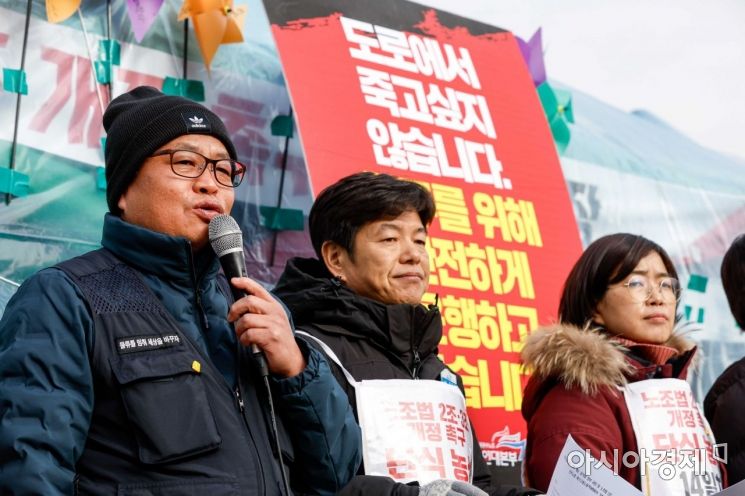
 Jae-seok Park, Secretary General of the Cargo Solidarity Union, is speaking at the press conference urging the amendment of Articles 2 and 3 of the Labor Union Act held in front of the National Assembly in Yeouido, Seoul. Photo by Jinhyung Kang aymsdream@
[Asia Economy Reporter Kim Hyung-min] On the 10th, the Fair Trade Commission (FTC) held a small committee meeting and discussed whether to report the Korean Confederation of Trade Unions Public Transport Workers' Union Cargo Solidarity Headquarters (Cargo Solidarity) to the prosecution for obstructing an investigation, but no conclusion was reached.
The FTC stated that "as a result of the small committee deliberation, it was judged that a plenary session is necessary, and the agenda will be submitted to the plenary session."
FTC meetings are divided into plenary sessions and small committee meetings. Typically, plenary sessions handle cases with many and complex issues. The plenary session consists of all nine commissioners, including the chairman. The small committee includes three members: standing and non-standing commissioners.
Earlier, in December last year, the FTC attempted three times to conduct on-site investigations at the Cargo Solidarity headquarters and the Busan regional headquarters to determine whether Cargo Solidarity coerced participation in the general strike or obstructed transportation during the strike. However, these attempts failed as Cargo Solidarity refused cooperation. Cargo Solidarity argues that investigating a labor union like Cargo Solidarity under the Fair Trade Act, which regulates businesses, is unfair and that the necessity of on-site investigations has not been substantiated.
© The Asia Business Daily(www.asiae.co.kr). All rights reserved.
!["I'd Rather Live as a Glamorous Fake Than as a Poor Real Me"...A Grotesque Success Story Shaking the Korean Psyche [Slate]](https://cwcontent.asiae.co.kr/asiaresize/183/2026021902243444107_1771435474.jpg)
















