Paid 300,000 Won but Only Got 15,000 Won Back: The Story
Instead of Congratulations, It Sparked a Debate on 'What Is an Appropriate Amount?'
"Increasing Single and Unmarried Households... Concerns Over Celebration Expenses"
[Asia Economy Reporter Kang Juhee] A story about receiving three 5,000-won bills (15,000 won) as wedding congratulatory money from a friend of ten years has become a hot topic online. The author of the story confessed that they were very embarrassed upon opening the congratulatory money envelope because they had given 300,000 won at the ten-year friend's wedding. It turned out that the ten-year friend felt hurt because other friends received paper wedding invitations, but they received an 'online invitation.' Where did the conflict over congratulatory money go wrong?
Congratulatory Money as a Measure of Intimacy, Wanting to Give More but Feeling 'Burdened'
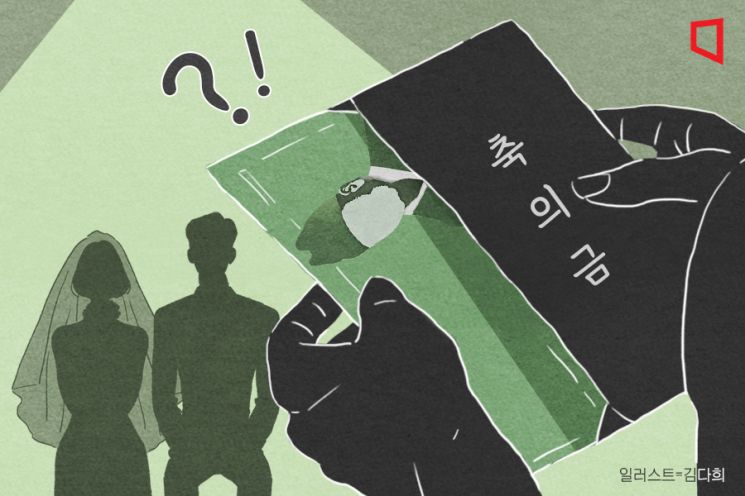
The response to the author's story posted on an anonymous workplace community on the 8th was heated. Comments such as "Even as a joke, three 5,000-won bills are too much," "Cut ties with such a friend," and "They are not a true friend" dominated, criticizing the ten-year friend's behavior. On the other hand, some sympathized with the ten-year friend, saying, "If other friends received paper invitations but only you got a mobile invitation, you might feel hurt."
The appropriate amount for congratulatory money is a hot topic of debate. Recently, on online communities, stories have gone viral such as a junior who gave 50,000 won as congratulatory money at a senior's wedding where the meal cost was around 80,000 won and was scolded, and another who gave 100,000 won and attended the wedding with their partner but was insulted.
On online communities and elsewhere, posts summarizing appropriate congratulatory money amounts based on intimacy levels are spreading. For example, over 200,000 won for very close relationships, 100,000 to 150,000 won for fairly close relationships, 50,000 to 70,000 won for coworkers, and no congratulatory money if not attending the wedding, setting amounts by category.
As the amount of congratulatory money becomes a measure of intimacy and affects relationship maintenance, many citizens feel fatigued. There are complaints that at gatherings meant for celebration, people cannot fully enjoy themselves because they worry and debate whether the congratulatory money amount was appropriate.
With various public utility fees and prices rising, voices expressing the burden of congratulatory money are growing louder. Kim, a person in their 30s living alone and working in Seoul, said, "I have to pay about 1 million won every month for rent, public utility fees, and student loan interest, and if additional expenses like weddings or other family events occur that month, my savings become 'zero.'"
Experts point out that perceptions of congratulatory money and other ceremonial expenses have changed significantly from the past. Professor Seo Ijong of the Sociology Department at Seoul National University said, "In the past, the culture of congratulatory money was established as a form of mutual aid," and added, "However, recently, not only economic reasons like inflation but also the increase in single-person households and people choosing not to marry have led many to view these customs as unreasonable."
He continued, "The COVID-19 pandemic has normalized non-face-to-face interactions, which may have weakened bonds and solidarity compared to the past," and advised, "The situation is very different from before. The culture of congratulatory money should not cling to past customs but needs to change to fit the present."
© The Asia Business Daily(www.asiae.co.kr). All rights reserved.

















