"Constitutional Court Must Rule Unconstitutional on North Korean Leaflet Ban Law"
Yoon's 'Suspension of 9·19 Effect'... Will It Empower Legal Nullification?
Park Sang-hak "Will Fly Drones"... Ministry of Unification "Please Refrain"
[Asia Economy Reporter Jang Hee-jun] North Korea human rights organizations have urged a swift conclusion to the constitutional complaint seeking a ruling on the unconstitutionality of the so-called 'Anti-North Korea Leaflet Act.' Attention is focused on whether efforts to nullify the Anti-North Korea Leaflet Act will gain momentum following President Yoon Suk-yeol's directive to review the suspension of the effectiveness of the September 19 inter-Korean military agreement in response to North Korea's provocations.
The Lawyers for Human Rights and Unification of Korea (Hanbyun) and the nonprofit organization North Korea Human Rights, among others, held a Tuesday rally on the 10th in front of the Constitutional Court in Jongno-gu, Seoul, and submitted a petition urging the court to declare the Anti-North Korea Leaflet Act unconstitutional.
 Police are collecting balloons used for sending leaflets to North Korea that fell into the river.
 [Image source=Yonhap News]
Kim Tae-hoon, honorary chairman of Hanbyun and director of North Korea Human Rights, stated, "If the effectiveness of the September 19 agreement is suspended following President Yoon Suk-yeol's decision, the operation of loudspeakers toward North Korea and the distribution of leaflets will no longer be punishable," adding, "Regardless of this decision, the Anti-North Korea Leaflet Act, which restricts citizens' fundamental rights and blinds and deafens North Korean compatriots in violation of the principle of proportionality, must be invalidated promptly."
The constitutional complaint challenging the unconstitutionality concerns Article 24 of the Act on the Development of Inter-Korean Relations, which prohibits the operation of loudspeakers toward North Korea, among other provisions, and was filed on December 29, 2020. The case was referred for judgment on January 12 of the following year, but no further procedures have been conducted since. North Korea human rights organizations have pointed out that the Constitutional Court has not reached a conclusion even after more than two years since the complaint was filed.
Conservative circles argue that the law banning loudspeaker broadcasts toward North Korea during the Moon Jae-in administration restricts constitutionally guaranteed freedom of expression and the 'freedom to seek, receive and impart information across borders' as guaranteed by the Universal Declaration of Human Rights. According to Article 24 of the Act on the Development of Inter-Korean Relations, those who conduct loudspeaker broadcasts or distribute leaflets toward North Korea near the Military Demarcation Line may face imprisonment of up to three years or a fine of up to 30 million won.
In this regard, President Yoon mentioned during his candidacy that the "Anti-North Korea Leaflet Act is a wrong decision," and Minister of Unification Kwon Young-se recently submitted a petition to the Constitutional Court stating that the law "unconstitutionally excessively restricts freedom of expression."
'Yoon hints at suspension of effectiveness... Will it lead to nullification of the law?'
 President Yoon Seok-yeol Visits Drone Research Site at the Agency for Defense Development
 [Image Source=Yonhap News]
Following North Korea's drone provocations, President Yoon Suk-yeol recently instructed, "If North Korea commits another provocation by invading our territory again, review the suspension of the effectiveness of the September 19 military agreement." This has led to discussions on whether Article 24 of the Act on the Development of Inter-Korean Relations, known as the Anti-North Korea Leaflet Act, will be affected by the suspension of the agreement's effectiveness, and the Ministry of Unification has begun reviewing related laws.
Whether the Act on the Development of Inter-Korean Relations will be affected if the September 19 agreement's effectiveness is suspended essentially depends on the government's judgment. Interpretation of laws falls under the jurisdiction of the relevant ministry, and if the Ministry of Unification concludes that "upon suspension of the military agreement's effectiveness, loudspeaker broadcasts and leaflet distribution toward North Korea may resume," the Anti-North Korea Leaflet Act could be nullified.
Separately from the suspension of the September 19 agreement's effectiveness, voices calling for the revival of loudspeakers and leaflets are emerging, mainly from the ruling party. On the 30th of last month, Tae Young-ho, a member of the People Power Party, said at a floor strategy meeting, "A bill to repeal the Anti-North Korea Leaflet Act is pending in the National Assembly's Foreign Affairs and Unification Committee," adding, "We urge the Democratic Party to join promptly so that the Yoon administration can cooperate to deter additional provocations by the Kim Jong-un regime."
On December 29, 2020, the same day North Korean organizations filed the constitutional complaint, Representative Ji Sung-ho and 12 others proposed a partial amendment to the Act on the Development of Inter-Korean Relations to delete the provisions banning leaflet distribution toward North Korea. However, since the bill was submitted to the subcommittee for bill review on November 16, 2021, no significant progress has been made.
Will North Korea leaflets be revived?"Drones to fly as early as spring"
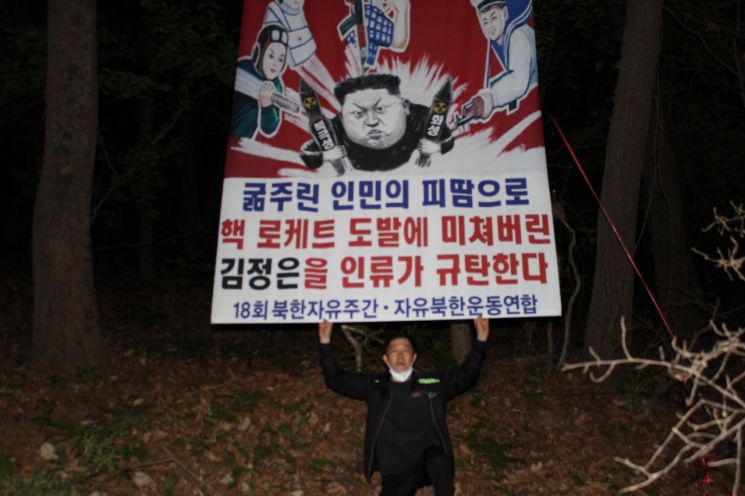 Park Sang-hak, head of the Free North Korea Movement Alliance, distributing leaflets to North Korea [Image source=Yonhap News]
As efforts to nullify the Anti-North Korea Leaflet Act gain momentum, some organizations have announced plans to resume leaflet distribution toward North Korea without waiting for the Constitutional Court's judgment or the government's legal interpretation.
Park Sang-hak, head of the Free North Korea Movement Alliance, said, "We are preparing to send leaflets to North Korea by drone as soon as possible," adding, "We could not launch balloons in winter due to the wind. We plan to send leaflets by drone, which can accurately distribute leaflets to the desired location regardless of the wind."
Park revealed that he forcibly distributed leaflets toward North Korea even during the Moon Jae-in administration and sent one million leaflets containing photos of President Yoon, who was then a private citizen, to North Korea in April last year. Most recently, in October last year, he launched eight balloons carrying COVID-19 prevention supplies, medicines, and leaflets criticizing the North Korean regime in the Paju area of Gyeonggi Province.
However, concerns remain about the resumption of leaflet distribution toward North Korea. At present, such acts still violate the Act on the Development of Inter-Korean Relations, and if South Korea distributes leaflets first, it could provide North Korea with a pretext for provocations. Whether the penal provisions of the Act on the Development of Inter-Korean Relations will be nullified due to the suspension of the September 19 agreement's effectiveness depends on the premise of "North Korea's re-invasion of territory."
The Ministry of Unification reportedly contacted Park on the previous day, requesting restraint in leaflet distribution toward North Korea. A ministry official said, "Considering compliance with current laws, the sensitive inter-Korean situation, and the safety and lives of citizens, the government believes it is necessary to refrain from leaflet distribution activities that could cause unnecessary risks."
© The Asia Business Daily(www.asiae.co.kr). All rights reserved.



















