Trade Balance in Deficit for Two Consecutive Months
Exports Plunge Due to Global Economic Slowdown
Weakness in Semiconductors, Shipbuilding, and Petrochemical Products
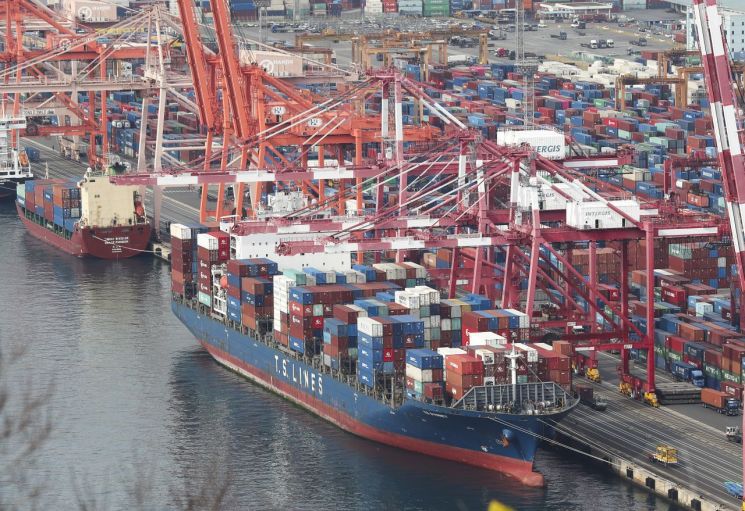
[Asia Economy Reporter Seo So-jeong] Due to the global economic slowdown, exports have significantly decreased, causing the current account balance to return to a deficit in November after three months. The export of key products such as semiconductors declined due to sluggish IT industry conditions, resulting in a $7.64 billion decrease in the goods balance compared to the same month last year. Additionally, the service balance deficit widened, causing significant fluctuations in the current account balance.
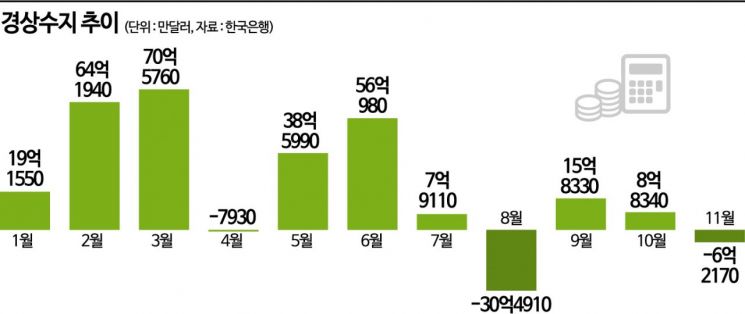
According to the "November Balance of Payments (Provisional)" released by the Bank of Korea on the 10th, the domestic current account recorded a deficit of $620 million (approximately 772 billion KRW). This is a decrease of $7.44 billion compared to a surplus of $6.82 billion a year ago. The goods balance shifted from a $6.07 billion surplus in the same month last year to a $1.57 billion deficit.
The current account maintained a surplus for 23 consecutive months from May 2020 to March 2022, then recorded a deficit of $79.3 million in April, followed by surpluses of $3.8599 billion in May and $5.698 billion in June. However, the surplus sharply decreased to $791.1 million in July and turned into a deficit of $3.0491 billion in August. It barely recorded surpluses of $1.5833 billion in September and $883.4 million in October for two consecutive months, but only narrowly avoided a deficit. In November, it returned to a deficit again.
The cumulative current account surplus from January to November last year was $24.37 billion, a reduction of $57.87 billion compared to the same period the previous year.
By detailed item, the goods balance showed a deficit for two consecutive months. Exports amounted to $52.32 billion, down $7.31 billion (12.3%) from the same month last year. This is the largest decline rate in 30 months since May 2020 (-28.7%). Exports declined for three consecutive months due to the global economic slowdown, mainly in semiconductors, ships, and chemical products. In particular, semiconductors (customs basis -28.6%), chemical industrial products (-16.0%), and steel products (-11.3%) were sluggish.
On the other hand, imports ($53.88 billion) increased by $320 million (0.6%) compared to the same month last year. Imports of raw materials, capital goods, and consumer goods increased by 4.8%, 0.4%, and 0.7%, respectively, compared to the same month last year. Among raw materials, the import growth rates of gas, coal, and crude oil (customs basis) reached 44.8%, 9.1%, and 21.8%, respectively.
The service balance recorded a deficit of $340 million as the surplus in the transportation balance shrank. The service balance deficit widened by $70 million compared to the same month last year. The transportation balance recorded a surplus of $480 million, but the surplus decreased by $1.24 billion compared to a year ago. This was due to the Shanghai Containerized Freight Index (SCFI) dropping by 69.5% year-on-year in November last year. The travel balance deficit also expanded to $780 million due to the easing of COVID-19 restrictions.
The net financial account, which is assets minus liabilities, increased by $1.85 billion. In direct investment, domestic investors' overseas investment increased by $3.24 billion, and foreign investors' domestic investment increased by $550 million.
Domestic investors' overseas securities investment increased by $4.08 billion, turning to an upward trend for the first time in three months since August last year ($610 million). Overseas stock investment increased due to expectations of easing monetary tightening in major countries, while bond investment decreased mainly in funds and other financial institutions.
Foreign investors' domestic securities investment increased by $1.49 billion, continuing an upward trend for five consecutive months since July last year. Foreign investors' domestic stock investment increased due to expectations of the U.S. Federal Reserve (Fed) slowing the pace of interest rate hikes and easing of China's zero-COVID policy, while bond investment decreased mainly in short-term bonds.
The Bank of Korea projected a current account surplus of $25 billion for this year in its revised economic outlook in November last year. Kim Young-hwan, head of the Bank of Korea's Financial Statistics Department, said, "It is difficult to discuss the direction without basic data on the primary income account and service account for December," but added, "Considering that the trade deficit in December narrowed compared to November, it is unlikely to deviate significantly from the existing forecast."
Joo Won, head of the Economic Research Office at Hyundai Research Institute, said, "Due to the global economic slowdown, exports are sluggish, and the goods balance has sharply declined, so difficulties in the current account are expected to continue in the first half of this year." He also predicted, "The travel balance deficit is likely to widen as overseas departures surge due to eased quarantine measures, and until restrictions on Chinese visitors are completely lifted, the deficit is expected to expand."
© The Asia Business Daily(www.asiae.co.kr). All rights reserved.


















