Yellow Dust and Fine Dust Gradually Clearing from Weekend
Annual Average Ultrafine Dust Concentration Ranks Lowest Among OECD
Ministry of Employment and Labor Establishes Outdoor Worker Protection Guidelines
[Asia Economy Reporter Park Hyun-joo] As high concentrations of fine dust engulf the Korean Peninsula, the health of outdoor workers is being threatened.
From the afternoon of January 7, the first weekend of the new year, fine dust and ultrafine dust advisories were issued in most regions nationwide, including Seoul. It is the first time in 1 year and 2 months since November 2021 that two advisories were simultaneously in effect in Seoul.
The current deterioration of air quality is largely influenced by fine dust originating from China. Since the 5th, the concentration of fine dust gradually thickened, and yellow dust originating from northern China and the Gobi Desert was additionally carried by northwesterly winds, causing the levels of ultrafine dust (PM2.5) and fine dust (PM10) to simultaneously soar to a "very bad" level. As the Korean Peninsula came under the influence of a high-pressure system, the airflow stagnated, preventing the inflowing yellow dust and fine dust from dispersing and causing them to remain over the peninsula.
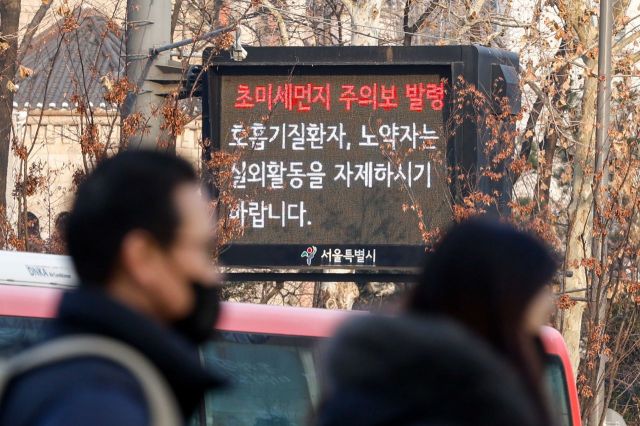 On the 9th, when an ultrafine dust advisory was issued in Seoul, an electronic display near Seoul City Hall in Jung-gu, Seoul showed the fine dust situation.
 [Photo by Kang Jin-hyung]
Outdoor workers who have to work for long hours outside have been directly hit by the "fine dust." Sanitation workers, delivery riders, and street vendors are enduring work environments exposed to the outdoors for extended periods, relying on just a single mask.
Kim, a part-time worker at a take-out specialty cafe where the counter and beverage preparation area are always open for outdoor orders, said, "In the past few days while working, I felt like I had a sore throat as if I caught a cold," adding, "Normally, I use less than one pack of disposable artificial tears a day, but my eyes feel dry, so I think I have used two or three packs."
The Ministry of Employment and Labor has prepared the "Guidelines for Protecting Outdoor Workers According to Fine Dust Advisories and Warnings" to protect the health of outdoor workers vulnerable to fine dust. This includes distributing the "Health Damage Prevention Guide Due to Fine Dust" to vulnerable workplaces such as construction sites and providing dust masks free of charge to small-scale businesses.
Fine dust and ultrafine dust concentrations, mainly in the central region, are expected to maintain a "bad" grade for some time before gradually easing around the weekend of the 14th to 15th. However, South Korea's annual average ultrafine dust concentration (18㎍/㎥ in Seoul) ranks 35th among 38 OECD capital cities, placing it near the bottom. This is why measures to improve overall air quality are necessary even after fine dust advisories are lifted.
The Ministry of Environment plans to reduce the nationwide annual average ultrafine dust concentration to 13㎍/㎥, the OECD median level, by 2027 and achieve 12㎍/㎥ by 2032 through the "3rd Comprehensive Plan for Air Quality Improvement (2023?2032)."
© The Asia Business Daily(www.asiae.co.kr). All rights reserved.
![Clutching a Stolen Dior Bag, Saying "I Hate Being Poor but Real"... The Grotesque Con of a "Human Knockoff" [Slate]](https://cwcontent.asiae.co.kr/asiaresize/183/2026021902243444107_1771435474.jpg)
















